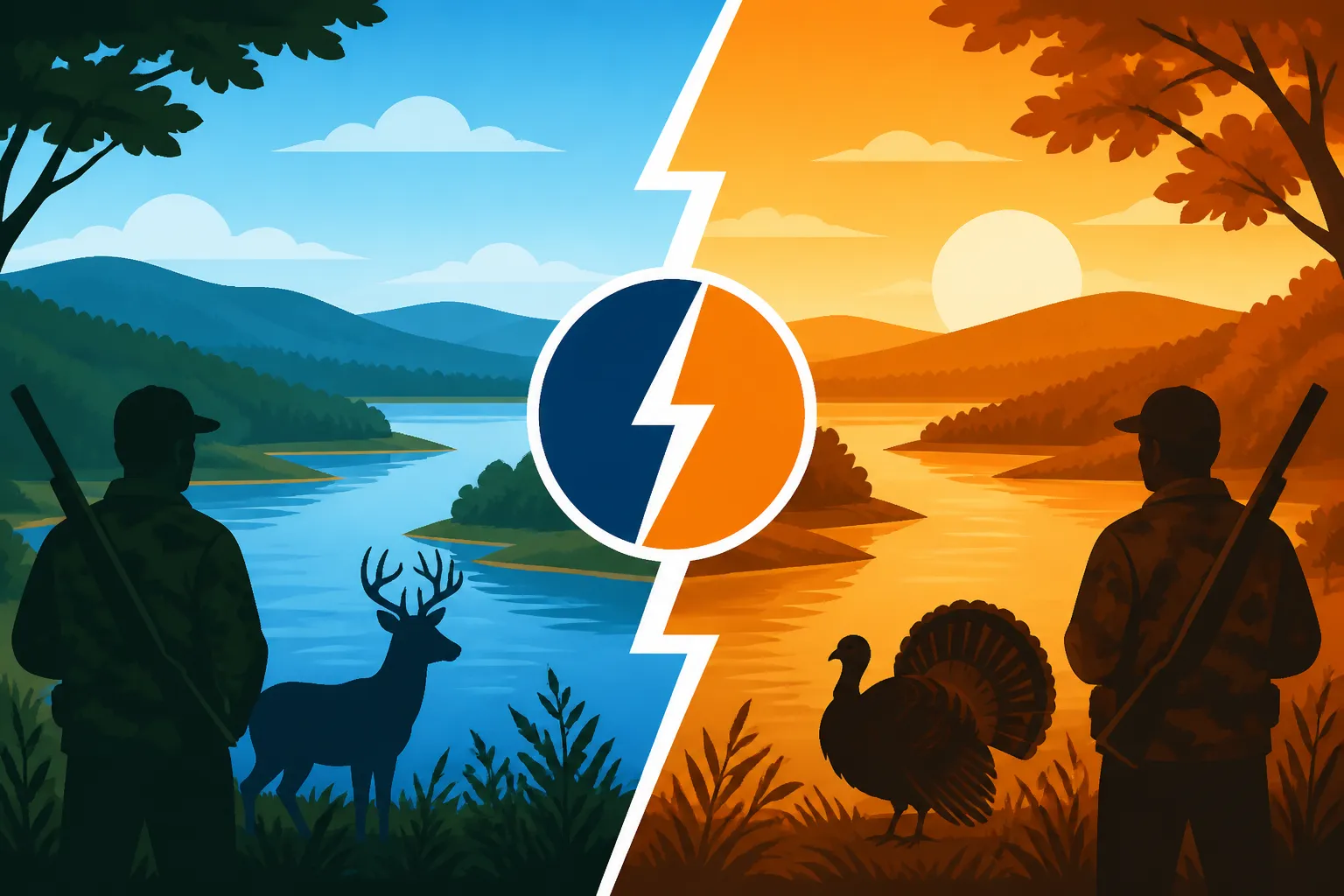
Kentucky Side Versus Tennessee Side of the Lakes
For many hunters, the massive, sprawling waters of Kentucky Lake and Lake Barkley represent an incredible opportunity, but also a complex decision. You’re looking at what feels like one continuous, rich hunting ground, yet it’s carved right down the middle by a state line. This isn't just a trivial detail; it means you're dealing with two entirely separate sets of rules, different management philosophies, and even subtle habitat differences that can make planning your trip a real headache. This guide is here to untangle that confusion, offering a realistic look at what to expect whether you choose the Kentucky or Tennessee side of these legendary lakes.
The Lakes Region: A Shared Resource with Distinct Rules
Imagine two siblings, sharing a massive toy box, but each having their own rulebook for what toys they can play with and when. That's essentially what you're dealing with when considering hunting the Kentucky and Tennessee portions of Kentucky Lake and Lake Barkley. While the waterways themselves, and the surrounding public lands like Land Between the Lakes, feel like one cohesive unit, the reality on the ground for a hunter is anything but unified. It's a critical distinction that can make or break your trip, from what licenses you need to the very season dates you can hunt.
Kentucky Lake and Lake Barkley Overview
These two massive impoundments, connected by the Barkley Canal, form one of the largest freshwater complexes in the eastern United States. Kentucky Lake, formed by damming the Tennessee River, is famous for its vast open waters and expansive timbered shorelines, creating a paradise for waterfowl and deer alike. Just to its east, Lake Barkley, a Cumberland River impoundment, offers a similar, yet subtly different, landscape with its own unique coves, islands, and river characteristics. Both lakes are flanked by the Land Between the Lakes National Recreation Area (LBL), a truly unique federal property spanning both states. This area alone is over 170,000 acres, providing an enormous chunk of public hunting ground that draws hunters from all over. The sheer scale of these areas means opportunities are abundant, but also means understanding the nuances of each state's approach is paramount.
Jurisdictional Lines and Their Impact
The state line is more than just a line on a map; it's a hard boundary that dictates almost every aspect of your hunt. While the waters might flow freely, the wildlife within and the land surrounding them are managed by two completely different state agencies: the Kentucky Department of Fish and Wildlife Resources (KDFWR) and the Tennessee Wildlife Resources Agency (TWRA). This dual jurisdiction leads to different season dates, bag limits, licensing structures, hunter education requirements, and even acceptable hunting methods. What's perfectly legal on the Kentucky side might land you in hot water if you mistakenly cross into Tennessee without understanding their regulations, and vice-versa. This is particularly crucial in areas like LBL, where you can literally walk or drive across the state line without realizing you've entered a different regulatory environment. It's not uncommon to hear stories of hunters, unfamiliar with the precise boundary, facing issues because they assumed consistency across the whole region.
Licensing and Permits: Navigating Dual State Requirements
One of the biggest headaches, and often the first hurdle, for anyone considering hunting the Kentucky Lake and Lake Barkley area is figuring out the licensing. It’s not just about buying a hunting license; it’s about buying the right hunting license for the right state, or potentially both, depending on your plans. This is where many out-of-state hunters, and even some Kentucky or Tennessee residents new to the cross-border opportunities, can get tripped up. Assuming one state’s license covers the entire complex is a quick path to a citation.
Resident vs. Non-Resident Costs and Packages
If you're a resident of Kentucky, you'll purchase your annual Kentucky Resident Hunting License Cost and any necessary permits (like deer or turkey permits) through the KDFWR. Similarly, Tennessee residents go through TWRA. The real challenge arises for non-residents. Both states offer non-resident licenses, and as you might expect, they come at a significantly higher cost than resident options.
Kentucky, for example, offers various non-resident license and permit combinations, including annual hunting licenses, specific deer or turkey permits, and even a Kentucky Three-Day Nonresident License Option which can be useful if you're only planning a short trip. Tennessee has its own comparable offerings. The key takeaway here is that if you intend to hunt both sides of the lake, you will need to purchase separate, full non-resident licenses and permits for each state. There's no reciprocal agreement that honors one state's license in the other, even for the federal lands of LBL. This can add up quickly, so budgeting for two sets of non-resident licenses is crucial if you want the flexibility to hunt both Kentucky and Tennessee waters and lands.
Specific Permit Requirements for LBL and WMAs
Beyond the standard state hunting licenses and species permits, certain areas within the Kentucky Lake/Lake Barkley region often require additional, specific permits. The most prominent example is the Land Between the Lakes National Recreation Area. While it’s a federal property, LBL’s hunting regulations largely defer to the respective state wildlife agencies, with some added layers.
For LBL, you’ll need your appropriate state hunting license and permits (Kentucky or Tennessee, depending on which part of LBL you're hunting). In addition to that, LBL itself typically requires an LBL-specific hunt permit. This LBL permit is a separate fee and is usually purchased directly from LBL or an authorized vendor. It grants you the privilege to hunt within the federal boundaries. Similarly, some state-managed Wildlife Management Areas (WMAs) outside of LBL but adjacent to the lakes, such as Ballard Wildlife Management Area on the Kentucky side, might have their own specific Kentucky WMA Permit Requirement or draw hunts, further complicating the permit landscape. Always double-check the KDFWR or TWRA website for the specific WMA you plan to visit, as well as the official LBL website, well in advance of your hunt. Ignoring these supplemental permits is a common mistake that can lead to fines and a ruined trip.
Understanding Deer Regulations and Season Structures
Deer hunting is a massive draw to the Kentucky Lake and Lake Barkley region, with both states boasting healthy populations and trophy potential. However, the excitement of chasing whitetails can quickly turn to frustration if you don't grasp the distinct regulatory frameworks governing deer seasons and bag limits on each side of the state line. What you can legally harvest, and when, varies significantly.
Antler Restrictions and Bag Limits
Kentucky and Tennessee both employ deer management strategies aimed at fostering healthy herds and providing quality hunting opportunities, but their specific rules can diverge. Kentucky utilizes a multi-zone system with varying antlerless bag limits depending on the county and zone. For example, some Kentucky counties in prime deer country might allow multiple antlerless deer, while others are more restrictive. You'll need to know How Many Antlerless Deer Your Zone Allows in Kentucky.
Tennessee also has its own system of units and corresponding bag limits, which might include specific antler point restrictions or earn-a-buck rules in certain areas. It’s not uncommon for Kentucky to have a more liberal antlerless harvest in some counties bordering the lake than Tennessee does in its adjacent counties, or vice-versa. This means that if you have a Kentucky deer tag and are hunting the Kentucky side, you might have different opportunities for harvesting does than if you were hunting the Tennessee side with a Tennessee tag. Always consult the most current KDFWR and TWRA hunting guides to confirm the precise antler restrictions and bag limits for the specific county or management unit you're hunting, particularly within the LBL where rules can sometimes have slight federal modifications.
Archery, Muzzleloader, and Gun Season Discrepancies
The timing of hunting seasons is arguably the most critical difference between the Kentucky and Tennessee sides. While both states offer archery, muzzleloader, and modern gun seasons, their opening and closing dates, as well as the length of those seasons, rarely align perfectly.
For instance, Kentucky's archery season generally kicks off in early September and extends well into January, offering a very long window for bowhunters, including a period that overlaps significantly with other weapon types. The Kentucky Archery Season Dates are quite generous. Its modern gun season, Kentucky Modern Gun Season Dates, typically runs for a shorter, concentrated period, often in mid-November. Muzzleloader seasons might be split into early and late segments, such as When Kentucky's Early Muzzleloader Weekend Falls or Kentucky Late Muzzleloader Tactics.
Tennessee, on the other hand, will have its own distinct calendar for each of these weapon types. Their archery season might start or end at different times, and their gun season dates could be staggered. This means a hunter planning a trip to the region absolutely needs to decide which state they want to focus on, or be prepared to respect two completely different calendars. You can’t just assume because gun season is open in Calloway County, Kentucky, it's also open in Stewart County, Tennessee, even if they share a border on LBL. These seasonal shifts can dramatically impact your hunt strategy, influencing everything from rut timing expectations to the amount of hunter pressure you'll encounter on any given weekend.
Waterfowl Hunting: Zones, Quotas, and Equipment
For many, the Kentucky Lake and Lake Barkley region is synonymous with incredible waterfowl hunting. Situated directly in the heart of the Mississippi Flyway, these vast bodies of water, along with their associated rivers and flooded timber, attract an immense number of migrating ducks and geese. But just like with deer, the pursuit of ducks and geese across the state line brings its own set of distinct regulations and practical considerations. It's not just about finding the birds; it's about knowing whose rules you're playing by.
Migratory Bird Zones and Season Splits
Both Kentucky and Tennessee manage migratory bird hunting based on federal guidelines, but they interpret and implement those guidelines into their own specific zones and season splits. Kentucky, for example, has designated waterfowl zones that dictate season dates, bag limits, and shooting hours. Understanding Kentucky Duck Zone Boundaries is crucial, as the season might open or close differently, or even have varying bag limits for certain species, depending on which zone you're in. This is especially relevant if you're hunting areas like Hunting Land Between the Lakes Waterfowl, as LBL itself spans both states and falls under both state's zones.
Tennessee similarly has its own waterfowl zones, and their season splits, particularly for ducks, can be structured differently. You might find a short early season, a longer main season, or even split seasons designed to maximize opportunity during peak migration periods. These differences mean that a specific species of duck, like a mallard or wood duck, might be legal to harvest on the Kentucky side on a given date, but out of season just a few miles south in Tennessee. Hunters need to pay close attention to the Kentucky Waterfowl Zones and Seasons and their Tennessee counterparts to ensure compliance, and also to strategically plan their hunts to align with optimal migration times within those specific season windows.
Blind Regulations and Decoy Spreads
Beyond the season dates, the practicalities of waterfowl hunting, particularly regarding blind construction and decoy usage, can also vary. Both states have rules about what constitutes a legal blind on public waters or lands. Kentucky, for instance, has regulations concerning permanent versus temporary blinds, and in some WMAs, like Ballard Wildlife Management Area, there might be specific blind draw rules or registration requirements. The use of natural vegetation for concealment, or manufactured blinds, is generally permitted, but the specifics can differ.
Tennessee will have its own set of rules regarding blind placement, construction, and ownership on public waters or specific WMAs. For instance, some states might have restrictions on leaving blinds overnight, or rules about who can hunt a blind once it's established. When it comes to decoy spreads, while the general principle of attracting birds is universal, considerations such as the use of motorized decoys (spinners) or even specific numbers of decoys might have subtle differences, especially in pressured public areas or those with specific management plans. If you're planning to set up a significant spread on public water or land, whether it's Layout Blind Hunting Western Kentucky Fields or Hunting Land Between the Lakes Flooded Timber, it's imperative to consult both KDFWR and TWRA regulations to ensure your setup is fully legal on whichever side of the lake you choose.
Public Land Access and Management Philosophies
The allure of the Kentucky Lake and Lake Barkley region, especially for hunters without private land access, lies in its vast tracts of public hunting ground. But "public land" isn't a monolithic concept here; it comes with different management philosophies, usage rules, and access points depending on whether you're on the Kentucky or Tennessee side, and even whether it's federal or state-managed property. Understanding these differences is key to effectively scouting and hunting these expansive areas.
Land Between the Lakes National Recreation Area Management
Land Between the Lakes (LBL) is a true gem for public land hunters, a unique peninsula tucked between Kentucky Lake and Lake Barkley. As a federal recreation area managed by the USDA Forest Service, it offers enormous opportunities for deer, turkey, small game, and waterfowl. However, LBL operates under a dual management structure, where state hunting regulations apply to the respective portions of LBL, but LBL itself often has overlaying rules for specific activities.
For example, LBL requires its own hunt permit, which is separate from your state license. They also have specific rules regarding vehicle access, camping, Treestand Setups in Daniel Boone National Forest (relevant for LBL's dense timber, though LBL is not DBNF), and Trail Camera Rules on Kentucky Public Land (which would apply to the Kentucky side of LBL). These rules can sometimes be more restrictive or simply different from typical state WMA regulations. The sheer size of LBL means that while there's plenty of room, navigating it requires detailed mapping. Tools like onX Layers for Kentucky Land Status are invaluable here, as they can clearly show federal boundaries, road access, and even the state line as it bisects LBL, preventing accidental cross-state violations.
State Wildlife Management Areas and Their Rules
Beyond LBL, both Kentucky and Tennessee maintain numerous state-owned and state-managed Wildlife Management Areas (WMAs) along the lakeshores and in the surrounding counties. These WMAs are typically managed by the respective state wildlife agencies with their own specific regulations and sometimes special hunts.
On the Kentucky side, WMAs like Sloughs WMA, Peabody WMA, or the previously mentioned Ballard WMA, each offer distinct habitats and hunting opportunities. These areas are managed primarily for game species, often with habitat projects like prescribed burns or food plots designed to enhance wildlife populations. Many Kentucky Wildlife Management Areas will have unique rules regarding methods of take, specific dates for certain species, or even requirements for Using a Ground Blind on Kentucky Public Land.
Tennessee's WMAs will have their own set of rules and management approaches. It's not uncommon for a WMA in one state to allow certain activities (like target shooting or specific types of camping) that might be prohibited in a WMA across the state line. The level of hunter access, the presence of designated trails, or even the type of timber management can vary significantly. Therefore, relying solely on your experience with a Kentucky WMA when planning a hunt in a Tennessee WMA is a recipe for confusion. Always dive deep into the specific rules for the WMA you intend to hunt, as well as checking tools like the Using the Kentucky Hunt Fish Map Tool for Kentucky's WMAs or the corresponding TWRA mapping resources for Tennessee.
Hunter Experience: Pressure, Amenities, and Local Culture
Beyond the hard rules and regulations, the actual feel of a hunt can vary between the Kentucky and Tennessee sides of the lakes. This often comes down to factors like hunter density, the types of amenities available, and even the local hunting culture that has evolved over time. These elements, while not regulatory, can significantly impact your enjoyment and success.
Comparing Hunter Density and Opportunity
Let's be realistic: public land anywhere that holds good game is going to see some hunter pressure. However, the intensity and distribution of that pressure can sometimes feel different between states. Both Kentucky and Tennessee have a strong hunting heritage, and the popularity of the Kentucky Lake/Lake Barkley region means it's a known destination.
On the Kentucky side, areas like the Kentucky portion of LBL or popular WMAs might experience significant crowds, especially on opening weekends or during peak rut for deer. Opening Weekend Crowds on Kentucky Public Land are a known factor. However, Kentucky also has vast tracts of less accessible public land, especially in parts of LBL, where hunters willing to walk a bit further can often Finding Ground Others Walk Past. Tennessee offers similar dynamics, but the specific distribution of hunters might differ. Perhaps one state's seasons align better with local school breaks, leading to more youth hunters, or one side's terrain is generally steeper, naturally filtering out some hunters. The overall deer density in certain counties might also influence pressure, as hunters flock to areas known for higher numbers or trophy potential. It's less about one side being "better" and more about understanding where to look for solitude versus where to expect company.
Local Resources and the Hunting Community
The hunting community and local amenities around Kentucky Lake and Lake Barkley are vibrant, but they cater to their respective state's hunters. On the Kentucky side, towns like Murray, Benton, and Grand Rivers offer a full range of services, from sporting goods stores to local eateries that understand a hunter's needs. You'll find bait shops, archery pro shops, and general stores where folks are happy to talk hunting. Kentucky Deer Camp Traditions are alive and well here. These communities are well-versed in KDFWR regulations and can be a great source of local insights.
Crossing into Tennessee, towns like Dover, Paris Landing, or Camden will similarly have their own infrastructure, but it's important to remember they'll be operating under TWRA rules and local customs. Local guides, outfitters, and even the staff at a small-town diner will likely be more familiar with Tennessee-specific regulations and nuances. If you're planning an extended trip, consider the logistics of where you'll stay, get supplies, and process game. Do you prefer the feel of the Kentucky communities or those on the Tennessee side? Each offers a slightly different flavor, and sometimes, that comfortable fit with local resources can make all the difference in a successful and enjoyable hunt.
Targeting Key Species: Deer and Waterfowl
When it comes to the prime game in the Kentucky Lake and Lake Barkley region, deer and waterfowl reign supreme. Both sides of the state line offer fantastic opportunities for these species, but the specific strategies you employ and the challenges you face can be influenced by the subtle differences in habitat and regulations unique to Kentucky and Tennessee. It’s not just about what’s there, but how you can effectively hunt it within each state’s framework.
Deer Hunting Strategies: From Ridges to Bottomlands
Deer hunting in the Kentucky Lake and Lake Barkley area presents a diverse landscape, from rolling hills and steep ridges to expansive bottomland hardwoods and agricultural fields. On the Kentucky side, especially within LBL, you’ll encounter plenty of mature timber, deep hollows, and ridges that funnel deer movement. Strategies like Still-Hunting Eastern Kentucky Ridges or finding a Ridge-Top Saddle for Rutting Bucks are often productive. In agricultural areas adjacent to the lakes, you might find deer using Entry Routes Through Standing Beans or Hunting a Standing Cornfield in Farm Country. The longer archery season in Kentucky, as highlighted in How Kentucky's Archery Season Runs Into January, also offers more opportunities to adapt to changing food sources and rut activity.
On the Tennessee side, while many of the habitat types are similar, the specific distribution and hunter pressure might necessitate different approaches. You might find more distinct changes in elevation or different types of farming practices dictating deer movement. Scouting is always critical, and tools like Reading Aerial Photos for Eastern Kentucky Deer (even if applied to the slightly different terrain of the lakes region) or using a mapping app like GoHunt to mark potential Scrape Lines Along a Logging Road will be invaluable regardless of the state. Understanding which side might offer more broken terrain versus larger open timber can help you decide if you prefer still-hunting, setting up a ground blind, or utilizing a treestand.
Waterfowl Hunting: Zones, Blinds, and Flights
Waterfowl hunting is a signature experience in this region, with huge numbers of ducks and geese using the lakes as a critical stopover on the Mississippi Flyway. The vastness of Kentucky Lake and Lake Barkley provides ample habitat, from flooded timber to open water and agricultural fields.
On the Kentucky side, you might focus on areas like the flooded timber within LBL or the extensive backwaters of the Ohio and Tennessee Rivers. Hunting Land Between the Lakes Flooded Timber is a classic experience, often requiring chest waders and a keen understanding of bird movement through the trees. The Kentucky Duck Zone Boundaries and Kentucky Goose Season Dates will dictate when and where you can hunt. Many hunters utilize layout blinds in cut agricultural fields for geese or field-feeding ducks, a tactic often seen when Layout Blind Hunting Western Kentucky Fields. Decoy spreads need to be effective for the species you’re targeting, whether it's a large spread for Canada geese or a more compact setup for Kentucky Lake Diver Ducks.
Tennessee’s waterfowl opportunities mirror Kentucky’s in many ways, but with its own zone-specific season dates and potential nuances in blind regulations. Waterfowl might congregate in different areas based on prevailing winds, food sources, or refuge locations specific to the Tennessee portion of the lakes. Hunters might find success Reading a Bottomland Slough for a Morning Flight or setting up in specific coves. The availability of Setting Decoys on a Farm Pond might also vary depending on land ownership patterns. The key for waterfowl, regardless of the state, is meticulous scouting, understanding migration patterns (often tracked via Kentucky Waterfowl Migration Timing), and being adaptable to changing conditions.
Practical Considerations for Planning Your Hunt
So, you've weighed the pros and cons of the Kentucky and Tennessee sides, considered the regulations, and thought about the type of hunt you want. Now, let's talk practicalities. Planning a hunting trip to a multi-state region like the Kentucky Lake and Lake Barkley area involves more than just picking a date and buying a license. It’s about leveraging technology, understanding logistics, and integrating yourself, however briefly, into the local scene.
Mapping and Navigation Tools
In an area as vast and boundary-dense as the Kentucky Lake and Lake Barkley region, reliable mapping and navigation are non-negotiable. Forget paper maps in many instances; digital tools are your best friend. Both states offer online resources, like the Using the Kentucky Hunt Fish Map Tool for Kentucky, which provides detailed WMA maps, property boundaries, and access points. Tennessee has similar digital mapping resources through TWRA.
However, for truly seamless navigation across the state line and within federal lands like LBL, a dedicated hunting app is invaluable. This is where brands like onX Hunt truly shine. Using onX Layers for Kentucky Land Status (or the Tennessee equivalent) allows you to see property ownership, state lines, public land boundaries, roads, trails, and even topographic features, all on your phone or tablet. You can mark waypoints, track your movement, and download maps for offline use, which is critical in areas where cell service might be spotty. GoHunt is another excellent resource for planning, especially when considering detailed species information and potential draw odds, though its primary focus might be on western big game, its mapping functionalities can still be very helpful for general navigation. Without a robust mapping solution, you’re essentially hunting blind and risking inadvertently crossing into a different regulatory zone or private property.
Lodging, Amenities, and Local Support
The Kentucky Lake and Lake Barkley region is a popular tourist destination, meaning there are abundant lodging and amenities available on both sides of the state line. From rustic cabins and campgrounds within LBL to comfortable hotels and vacation rentals in towns like Grand Rivers, Kentucky, or Paris, Tennessee, you'll find options to fit any budget and preference. Many accommodations cater specifically to hunters and anglers, offering amenities like boat charging stations, early breakfast hours, or game processing facilities.
Think about what kind of support you'll need. Will you be processing your own deer, or do you need a local butcher? Do you plan to eat out every night, or will you be cooking at your lodging? Access to bait shops, ammunition stores, and sporting goods retailers is also important. The communities on both sides are generally very welcoming to hunters, but it's worth considering the drive times to your chosen hunting spots from your lodging. If you plan to hunt multiple spots across the state line, staying in a central location, perhaps near the middle of LBL, might be a smart move to minimize travel. Don't underestimate the value of a local pro shop or a friendly face at the gas station who can offer up-to-date local intelligence on deer movement or duck flights.
Preparing for Cross-State Travel
If you decide to split your time hunting both the Kentucky and Tennessee sides, or if your hunting area simply straddles the state line (as LBL does), you need to be prepared for cross-state travel. This isn't just about driving; it's about understanding the implications of transporting game, firearms, and other equipment between jurisdictions.
For harvested game, both states have rules regarding the transport of unskinned, unbutchered animals. If you harvest a deer in Kentucky and plan to take it back to Tennessee (or vice versa), ensure you understand the telecheck requirements for the state of harvest and any carcass movement restrictions, especially if either side is within a Kentucky's Chronic Wasting Disease Surveillance Zone. Some states may require game to be caped or quartered before crossing state lines. Firearms laws can also vary, though generally, federal protections for interstate transport of firearms apply. However, specifics like carrying loaded firearms in vehicles or magazine capacity limits can sometimes differ, so it's always wise to be informed. Planning your routes, understanding where the state line truly lies, and having all your necessary licenses and permits readily accessible for both states will make your multi-state hunting adventure smooth and enjoyable.
Disclaimer
This article is for general informational purposes only and does not constitute professional advice. Laws, prices and regulations vary by location and change over time. Consult a qualified professional for guidance on your specific situation.