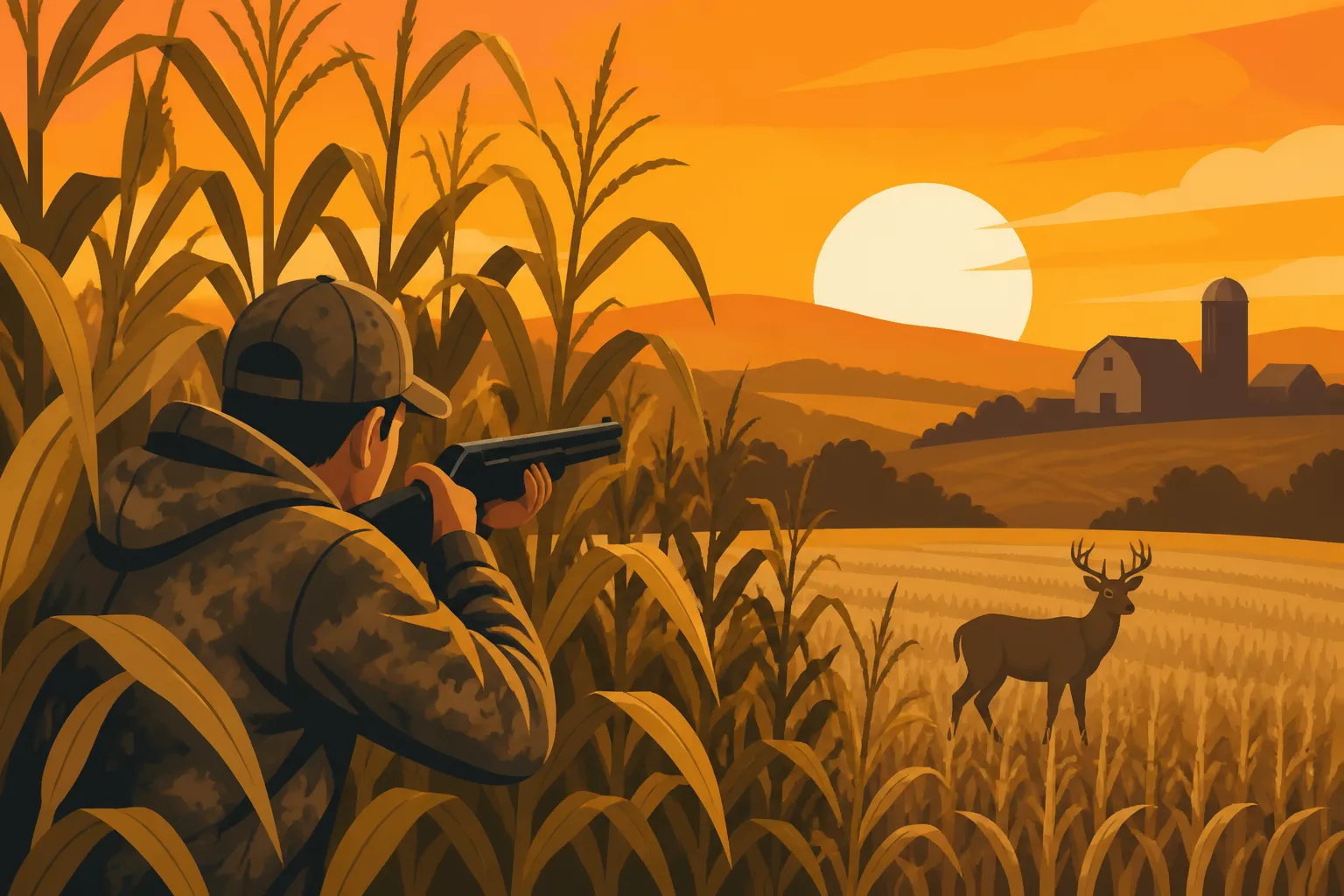
Hunting a Standing Cornfield in Farm Country
Hunting standing cornfields in Kentucky farm country can feel like trying to find a needle in a haystack – or more accurately, a trophy buck in a maze of stalks that tower over your head. It's a common frustration, especially when you know those big whitetails are absolutely living it up in there, hidden from sight and seemingly untouchable. This guide is here to unravel the mysteries of hunting these agricultural sanctuaries, offering practical advice and tactics to help you navigate and effectively hunt those elusive deer in the golden fields.
Understanding Deer Behavior in Standing Corn
Deer don't just "like" standing corn; they absolutely thrive in it. For a whitetail, a mature cornfield is the ultimate hideaway, offering everything they need to survive and avoid detection, especially during hunting season. Trying to hunt these areas without understanding why and how deer use them is a recipe for frustration.
Why Deer Love Standing Corn
First and foremost, standing corn offers an incredible amount of cover. Picture yourself trying to spot a deer from even 20 yards away when the stalks are eight feet tall and dense. It's nearly impossible. This dense vegetation provides deer with a profound sense of security from predators, including us hunters. They can move around, bed down, and feed without feeling exposed. It’s like their own personal fortress.
Beyond security, standing corn is a literal all-you-can-eat buffet. Those kernels are a high-energy food source, absolutely crucial for deer bulking up before the cold Kentucky winter or recovering from the rigors of the rut. Deer will bed right in the field and simply stand up to munch on nearby ears, expending minimal energy. This readily available food source can keep deer locked down in a cornfield for weeks on end, making them incredibly difficult to intercept anywhere else.
Finally, corn provides excellent thermal regulation. On hot early season days, the dense canopy creates shade and often holds more moisture, offering a cooler respite. Conversely, on cold, windy days later in the season, the thick stalks can break the wind and trap radiant heat, providing much-needed warmth. This makes cornfields prime bedding areas regardless of the weather conditions.
Movement Patterns Within the Corn
Deer aren't just aimlessly wandering through a cornfield; they create and utilize distinct movement patterns. Understanding these patterns is key to intercepting them. They'll often establish well-worn trails that run parallel to field edges, serving as main travel corridors. These trails might also cut diagonally across the field, connecting different bedding or feeding areas, or leading to an escape route.
Don't forget the edges themselves. The border where the cornfield meets a woodline, a fencerow, or a creek bottom is a transition zone that deer frequently use. They'll skirt these edges, often just inside the corn, before popping out into the open or disappearing into thicker cover. These interfaces are high-traffic areas, perfect for ambush points.
Deep inside a large cornfield, deer will establish pockets or islands of bedding. These aren't just random spots; they're often in areas with a slight elevation change, a denser patch of weeds, or even just a particularly thick section of corn where they feel most secure. Bucks, especially, will often seek out these interior strongholds. Spotting these subtle features on an aerial map, perhaps using a tool like GoHunt, can provide huge clues for where to focus your efforts. These are the places where they spend the majority of their day, only emerging when hunger truly calls or under the cover of darkness.
Scouting and Planning Your Hunt
You can’t just walk into a standing cornfield and expect success. These hunts demand meticulous scouting, strategic planning, and a deep understanding of how deer use the terrain and cover. It's about working smarter, not harder, to uncover those hidden patterns.
Pre-Season Reconnaissance
Your preparation for hunting standing corn starts long before the season opener, ideally before the corn is even planted, or at least before it reaches its full height. This is where aerial photos become your best friend. Utilize mapping apps like GoHunt to pore over satellite imagery. Look for features that will guide deer movement: ditches, ravines, small patches of woods or brush within or adjacent to the field, old homesteads, or even distinct changes in soil type that might indicate varied cover. Identify potential entry and exit points for deer – where the cornfield naturally bottlenecks into a woodline, crosses a creek, or meets another food source. Mark these on your map.
Think about how deer will move into the corn from nearby bedding areas and out of the corn to other food plots or water sources. Are there logging roads nearby that they might use? Consider the lay of the land; even slight changes in elevation can dictate a deer’s path. While the corn is still low, or even after it’s harvested, take the opportunity to walk the perimeter and identify these features on the ground. This "boots on the ground" intel combined with your digital scouting provides an invaluable blueprint for later. Remember that deer are creatures of habit, and while standing corn offers new opportunities for hiding, they'll often revert to established travel corridors once the corn is cut.
In-Season Sign Reading
Once the corn is standing tall, finding fresh sign becomes a much more intimate affair. You're not going to see deer from afar, so you need to look for subtle clues. Start by walking the edges of the field at first light or last light, when deer are most likely to be moving. Look for fresh tracks where deer enter and exit the corn, especially where it meets another habitat type like a woodline or a fencerow. Pay attention to the size of the tracks – bigger deer, bigger tracks.
Also, keep an eye out for fresh droppings. A pile of fresh scat is a clear indicator that deer are actively using that entry or exit point. If you’re feeling adventurous, or if the field is small enough, you might make a stealthy midday foray a few rows deep into the corn to look for bedded areas. These will be distinguishable by flattened stalks and an impression in the soil. You might also find fresh rubs or scrapes along the cornfield edges, indicating that a buck is actively marking his territory as he moves in and out of the dense cover. Remember that deer often create intricate networks of trails inside the corn, almost like tunnels, which can be hard to spot without literally walking through them.
Wind and Entry/Exit Strategies
The wind is your absolute master when hunting standing corn. Because you're often hunting tight quarters or trying to get close to bedded deer, scent control and wind direction are paramount. A shifting wind can instantly blow your cover and send every deer in the field scattering. Always hunt with the wind in your favor, blowing your scent away from where you expect deer to be.
Your entry and exit routes need to be just as carefully planned as your stand location. You can’t just crash through the corn rows or walk across an open field. Plan to approach your stand or blind from a direction that keeps you out of sight and downwind of any potential deer activity. Use natural cover like ditches, creek beds, or dense brush to conceal your movement. If you're hunting an edge, consider walking a path just inside the timber line or a brushy fencerow rather than exposed along the field. This minimizes disturbance and increases your chances of encountering an unsuspecting deer. This strategic approach is just as important as the hunt itself, especially when you are Hunting the Kentucky Rut in Early November, where bucks are notoriously on the move.
Effective Hunting Tactics for Standing Corn
Once you've done your homework and understand how deer are using the corn, it's time to put those insights into action. Hunting standing corn requires specific tactics that differ from hunting open woods or traditional food plots. Patience, stealth, and knowing when to be aggressive are your best tools.
Hunting the Edges and Funnels
The most common and often most productive strategy for standing corn is to focus on the edges and funnels. Deer love these transition areas. They offer the security of the corn but also allow them to quickly access other habitat types or open fields. Think about where the cornfield meets a dense woodline, a brushy fencerow, a creek, or even a small patch of timber that creates a natural pinch point. These are prime locations for a treestand or a well-brushed-in ground blind.
Set up your stand or blind just inside the tree line, or on the edge of the corn, allowing you to see where deer are entering and exiting. Pay particular attention to corners of the field or points where a finger of timber extends into the corn, creating a natural funnel. Deer will often follow the path of least resistance, and these funnels guide their movement right past your setup. Consider hunting these spots during morning and evening movements, as deer typically stage in the corn and then move out to feed, or vice versa. During the later stages of the season, these cornfields often get harvested, changing deer patterns dramatically. Understanding Hunting the Late-Season January Lull becomes crucial when the fields are cut and deer are forced to find new cover.
Still-Hunting the Rows
For the more adventurous hunter, still-hunting the rows can be incredibly effective, albeit challenging. This isn't a tactic for everyone, but with patience and extreme stealth, you can surprise a deer bedding deep inside the corn. The key is to move incredibly slowly, taking only a few steps at a time, and then pausing for several minutes to observe and listen. Use the rows themselves as your guide.
Walk against the wind, always. This helps prevent your scent from spooking deer ahead of you. Keep your eyes peeled for any unusual shapes, movement, or color breaks in the uniform stalks. Deer often bed with their backs to the wind, so if you're walking into the wind, you might approach them from behind. The noise is your biggest enemy here. Wear soft clothing, take deliberate, quiet steps, and avoid brushing against stalks. It's a game of inches and extreme patience. This method demands focus and a calm demeanor, much like Still-Hunting Eastern Kentucky Ridges, where stealth is your most important tool.
If you encounter a deer, freeze. Let it make the first move. Sometimes they won't even know you're there until you get very close. Be ready to take a quick shot if an opportunity presents itself. This is a very active form of hunting, requiring you to be constantly engaged and aware of your surroundings.
Strategic Deer Drives
In larger standing cornfields, especially those that have been hunted hard or where deer are particularly stubborn about staying inside, a strategic deer drive can be the answer. This isn't about running through the field yelling; it's a controlled, coordinated effort that pushes deer in a specific direction towards waiting standers. This is especially effective when you have a small group of hunters. For example, Deer Drives With Three or Four Hunters can be very productive.
Designate one or two "drivers" to walk slowly and deliberately through a section of the corn, making just enough noise to encourage deer to move. The remaining hunters, the "standers," position themselves at predetermined escape routes – typically the field edges, funnels, or corners where deer are most likely to exit. It's crucial for standers to be in position and ready before the drive begins. Communication between the drivers and standers is key, often using two-way radios or pre-arranged signals. Safety is paramount here; everyone involved must know each other's positions and designated shooting lanes. Never shoot towards another hunter. The goal is a quiet, controlled push, allowing deer to move naturally rather than sprinting out of the field in a panic.
| Tactic | Pros | Cons | Best Conditions |
|---|---|---|---|
| Hunting the Edges | High traffic, relatively easier setup, good visibility | Deer can be wary of open edges, can be crowded | Morning/Evening, near bedding/feeding, consistent wind |
| Still-Hunting Rows | Deep penetration, can find bedded bucks, high reward | Extremely challenging, requires intense stealth, low visibility | Mid-day, steady wind, thick corn, minimal hunting pressure |
| Strategic Deer Drive | Can push out otherwise unmovable deer, group activity | Requires multiple hunters, safety concerns, can educate deer | Large fields, mid-day, good communication, specific escape routes |
Gear and Safety Considerations
Hunting standing corn, particularly in the dense agricultural landscapes of Kentucky, calls for specific gear choices and an unwavering commitment to safety. The unique environment of a cornfield presents its own set of challenges that can be mitigated with the right preparation.
Essential Gear for Cornfield Hunts
When heading into the maze of a cornfield, your gear can make or break your hunt. Optics are crucial, even in thick cover. While a long-range rifle scope might not be your primary tool for a 20-yard shot in dense corn, a good pair of binoculars (8×42 or 10×42 are excellent choices) can help you pick out details or movement in the rows. A rangefinder is also helpful for quickly gaging distances, especially when still-hunting, as distances can be deceiving in the uniform rows.
Clothing should be quiet and durable. Think about fabrics that won't snag or rustle excessively against dry corn stalks. Layering is always smart for Kentucky's variable weather. Perhaps most importantly, scent control gear is a non-negotiable. With deer often bedding or moving very close to you, minimizing your human odor is critical. Scent-eliminating sprays, carbon clothing, and meticulous attention to hygiene will all play a role. Using a reliable mapping app, like GoHunt, on your phone or a dedicated GPS unit is also invaluable for navigation. It's incredibly easy to get disoriented in a large cornfield, especially if you're still-hunting deep inside. Marking your entry point and planned route can literally prevent you from getting lost. If you're going to be in a treestand, remember that Treestand Safety Gear for Steep Ground is essential, even if the ground below looks flat.
Safety First in Thick Cover
Safety should be your top priority, especially when hunting in the low visibility conditions of a standing cornfield. The most critical piece of safety gear is blaze orange. Kentucky law dictates specific requirements for wearing blaze orange during modern gun seasons, and even during archery season if a firearm season is open concurrently. Always wear more than the minimum, especially if you're still-hunting or participating in a drive. A blaze orange vest and hat are the bare minimum. You can find out more about Kentucky's Blaze Orange and Pink Options to ensure you're compliant and safe.
Communication is vital, particularly during deer drives or when hunting with partners. Handheld two-way radios are excellent for this, allowing you to coordinate movements and confirm positions. Before starting any hunt, especially a drive, everyone involved should be fully aware of each other's locations, planned movements, and designated shooting lanes. When still-hunting alone, always tell someone where you are going and when you expect to return.
Additionally, always be aware of your background before taking a shot. In a cornfield, it's easy to lose track of what's beyond your target. Make sure you have a clear, safe backstop. With all the variables at play, including the difficulty of Blood Trailing After Dark in Kentucky in dense cover, making a clean, ethical shot is even more important.
Hunting standing cornfields in Kentucky can be one of the most rewarding challenges a deer hunter faces. It takes patience, diligent scouting, a good understanding of deer behavior, and the right approach. With these strategies, you'll be well on your way to punching your tag in farm country.
Disclaimer
Please remember that hunting regulations and seasons can change. Always consult the most current Kentucky Department of Fish and Wildlife Resources (KDFWR) regulations before planning any hunt. This guide is for informational purposes only and does not supersede official KDFWR rules and guidelines.