Scrape Lines Along a Logging Road
Hunting in Kentucky can sometimes feel like trying to solve a puzzle in a dense fog. You walk for miles, searching for consistent deer sign, only to find sparse rubs or a single, forgotten scrape. It’s frustrating, especially when you know big bucks are roaming these woods. This guide aims to pull back the curtain on one of the most overlooked, yet consistently productive, hotspots for deer activity: scrape lines along logging roads. We'll delve into why these routes are so crucial to whitetails and how you can use this knowledge to your advantage, especially as the rut approaches.
Why Logging Roads Are Scrape Magnets for Kentucky Whitetails
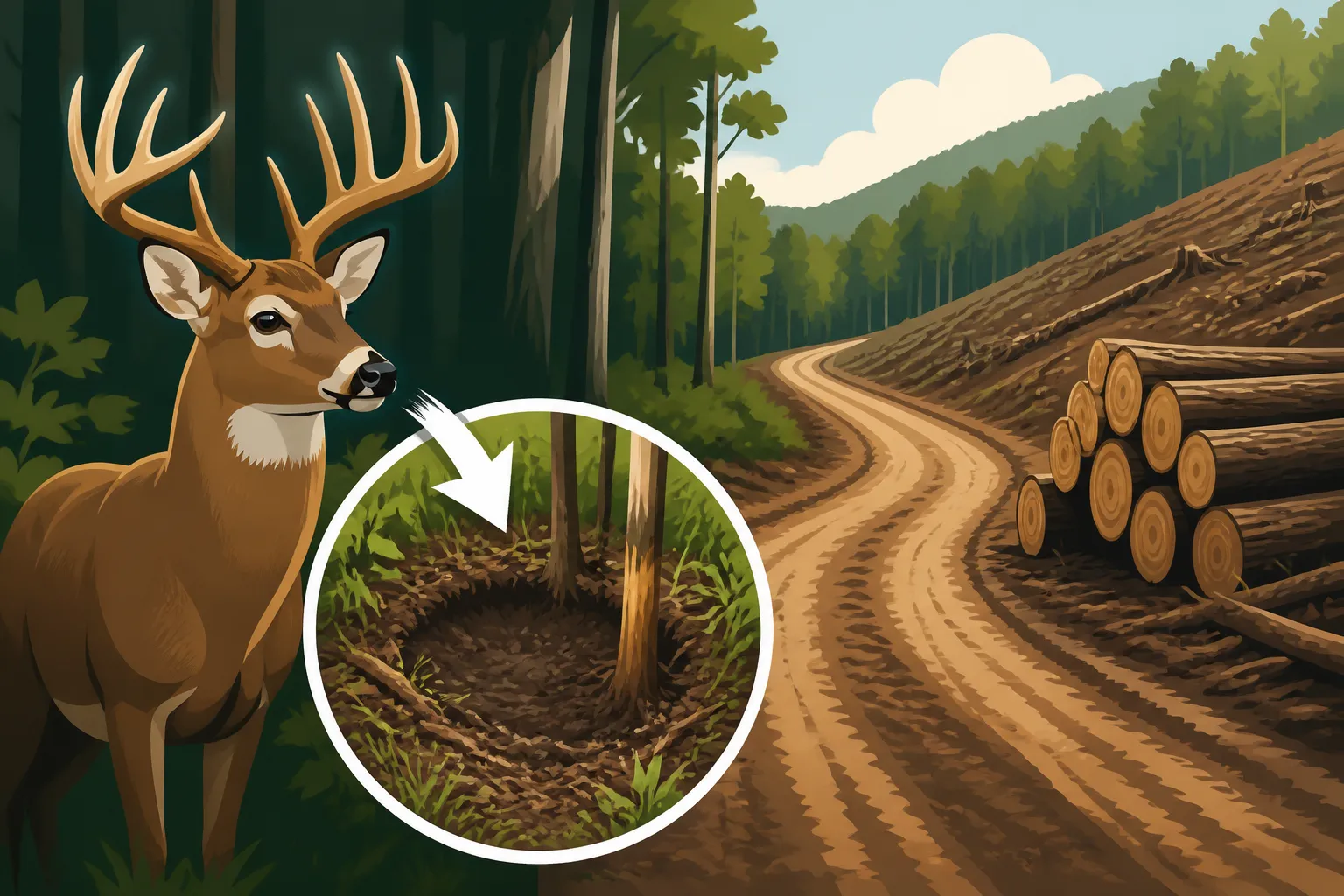
Logging roads, whether active or long-abandoned and overgrown, are far more than just paths for timber removal. In the deer world, especially here in Kentucky's diverse terrain, they function as communication highways and key travel corridors. They represent a blend of convenience and visibility that deer can't resist, making them prime locations for laying down those tell-tale scrape lines.
Ease of Travel and Visibility for Deer
Imagine navigating the thick, tangled undergrowth of an Eastern Kentucky ridge or the dense honeysuckle of a Western Kentucky creek bottom. It’s slow, noisy work. For a deer, a logging road offers a clear, relatively open path, allowing for faster, quieter movement. Bucks, in particular, will use these roads to cover ground efficiently while patrolling their territory. This ease of travel isn't just about speed; it's about reducing energy expenditure and minimizing noise, which are vital for survival.
Furthermore, these roads often provide a visual lane through otherwise dense timber. While deer generally prefer cover, a logging road offers a strategic advantage. It allows them to see and be seen, or more importantly, to observe their surroundings with less obstruction. This increased visibility makes them feel more secure when moving from bedding to feeding areas, or when actively seeking does. When you combine this with the sheer volume of deer traffic, it becomes clear why a buck might choose to leave his scent mark here. These roads are like the main street of a deer town, and what better place to post your personal ad than on Main Street?
Scent Dissemination and Communication Hubs
Scrapes are, at their core, communication devices. They are a buck’s way of saying, "I'm here, I'm ready, and this is my territory." A logging road, with its open canopy and often consistent air currents, is an ideal place for these scent messages to spread far and wide. The exposed soil of a scrape, churned up by a buck’s hooves, holds urine and glandular scents particularly well. When other deer, both bucks and does, pass by, they can readily detect these chemical signals.
The soil itself, often a mix of disturbed earth, gravel, and leaf litter, acts like a sponge for these odors. Rain can even help spread the scent further down the road, creating a prolonged olfactory beacon. This makes logging roads veritable "post offices" for deer communication. Bucks will often revisit these scrapes to freshen them, checking for new scent deposits from other deer. They're constantly reading the "mail" left by competitors and potential mates. A scrape along a logging road acts as a central hub for this complex social interaction, pulling deer from adjacent cover to check in and leave their own mark. Understanding this crucial function can help you predict deer movement and pinpoint exactly where those interactions are most likely to occur.
Edge Habitat and Food Sources Along the Road
Logging roads inherently create edge habitat. One side might be mature timber, while the other could be new growth, a clear-cut, or even a food plot if you're on private land. These edges are biological hotspots, offering a diverse array of food sources and cover that deer absolutely thrive on. Sunlight penetrates more deeply along these road edges, encouraging the growth of browse, saplings, and briars that deer love to munch on.
In areas like the Daniel Boone National Forest, you might find logging roads bordered by regenerating clear-cuts or areas where select timber has been harvested. These areas quickly fill with lush, nutritious forage that acts as a magnet for deer. Acorns dropping from mature oaks on the edge, wild berries, or even fallen branches providing tender shoots – all become available directly along these travel corridors. Bucks will often establish scrapes where these feeding opportunities intersect with their preferred travel routes. It’s a perfect storm of resources: easy travel, good food, and a visible place to leave their scent. This combination makes these logging road edges not just a place to travel, but a destination in themselves, drawing deer to them for feeding, browsing, and, inevitably, communication through scrapes.
Identifying Prime Scrape Line Locations on Kentucky Logging Roads
Not every logging road is created equal when it comes to finding productive scrape lines. While deer will use many parts of these paths, certain features and topographical elements act as undeniable magnets for bucks creating and tending scrapes. Knowing how to read these signs and understand why deer choose these specific spots can drastically increase your scouting efficiency and hunting success.
Intersections and Bends in the Road
Think of a logging road network as a series of veins and arteries. The intersections and sharp bends are like the major organs or junctions – places where multiple travel routes converge or where deer traffic naturally funnels. A buck will almost instinctively place a scrape at these strategic points. An intersection means more deer will pass by, increasing the chances of his scent being detected and new scent being left for him to discover. It’s the busiest bulletin board in the woods.
Similarly, a sharp bend in a logging road acts as a natural choke point. Deer often slow down as they navigate these turns, and their attention might be more focused on what's around the bend rather than pushing straight ahead. This momentary pause provides a perfect opportunity for a buck to check a scrape or create a new one. These locations also frequently offer slightly more cover or an overhanging branch, which is a classic feature of a primary scrape. When you're Scouting Kentucky Public Land Before Season, mark every intersection and sharp bend on your topo map or a mapping app like GoHunt. These are high-probability areas for a buck to leave his mark.
Rub Lines and Overhanging Branches
Scrapes rarely exist in isolation. They are almost always part of a larger communication system that includes rubs. When you find a line of rubs paralleling a logging road, especially heading towards an intersection or bend, you can bet a scrape line isn't far away. Rubs signify a buck's presence and dominance, and they often lead directly to or from a primary scrape. It’s like following breadcrumbs to the main event.
The classic scrape has an "overhanging licking branch" directly above it. This branch is crucial. Deer will chew, lick, and rub their preorbital glands on it, depositing even more scent. Bucks will also urine-mark the ground below while simultaneously working the licking branch. Look for low-hanging branches that are obviously broken, frayed, or discolored from deer interaction. Sometimes these branches will have a distinct, polished appearance from repeated licking. If a logging road provides such a branch at a strategic spot, it's almost guaranteed to be part of an active scrape. Many hunters attest that if there’s no licking branch, it’s likely just a casual pawing, not a primary scrape the buck will revisit. This visual sign is as important as the ground disturbance itself.
Adjacent Cover and Escape Routes
Even on a logging road, deer, especially mature bucks, are constantly thinking about security. A prime scrape location will not be out in the wide open, exposed and vulnerable. Instead, it will often be situated where the logging road brushes up against dense cover, thickets, or a steep hollow. This adjacent cover provides an immediate escape route should danger arise. A buck feels confident depositing his scent here because he knows he can quickly vanish into the surrounding timber.
Consider the topography of Kentucky. Many logging roads traverse ridge tops or follow contours along hillsides. A scrape might be found where the road edges a thick pine stand, a dense patch of multiflora rose, or the top of a steep bank dropping into a hollow. This combination of an open travel path and immediate sanctuary makes these spots incredibly attractive. When studying aerial photos, perhaps using your GoHunt app to zoom in on different parcels, look for logging roads that parallel dense thermal cover or dense bedding areas. A buck will travel from his bed, check scrapes along a convenient logging road, and then continue towards a feeding area, always keeping that escape cover within easy reach. Positioning yourself with the wind in your favor, overlooking such a setup, can be incredibly productive, as deer will often pause, check the scrape, and then move off into the security of the trees. You might find a great spot by reading aerial photos for Eastern Kentucky deer, identifying these key transitions.
Hunting Strategies for Logging Road Scrapes
Finding a promising scrape line along a logging road is just the first step. The real challenge, and the true art of hunting, lies in how you approach, set up, and execute your hunt to capitalize on these deer hotspots. Without a well-thought-out strategy, even the hottest scrape line can leave you empty-handed.
Stand Placement and Wind Consideration
Your stand placement around a logging road scrape line is absolutely paramount. Deer will often approach scrapes cautiously, circling downwind to smell for danger before stepping into the open. Therefore, your number one priority must be to position your stand downwind of the anticipated deer approach, but also where your scent is carried away from the scrape itself. This often means getting off the logging road entirely and into the adjacent timber.
Consider setting up 20-30 yards into the thick cover, parallel to the road, rather than directly on the road itself. This allows deer to come and go from the scrape without busting you as they scent-check. You’ll want to have shooting lanes cleared, but maintain as much natural cover as possible for concealment. When selecting a tree, look for one that offers a good backdrop to break up your silhouette. Remember, the wind in Kentucky, especially on ridges and in hollows, can be tricky. Always pay close attention to the prevailing wind and micro-thermals. A slight breeze can swirl unpredictably, so a quality wind checker is your best friend. For those setting up in deep woods, understanding Wind and Thermals on a Kentucky Ridge is not just important, it's critical. If you're using a mobile setup, consider a saddle for maximum flexibility in tree choice and angle, allowing you to quickly adapt to changing wind conditions.
Calling and Decoy Tactics for Scrape Lines
Once you've got your stand perfectly placed, you can enhance your chances by incorporating calling and decoy tactics. A logging road scrape line, being a communication hub, is an ideal place to simulate deer activity and draw bucks in.
- Grunt Calls: A simple tending grunt or a series of aggressive grunts can pique a buck's interest, especially during the pre-rut and rut. If he hears another buck "talking" near his scrape, his territorial instincts might kick in, compelling him to investigate. For effective use of these, knowing your Grunt Calls in Mature Kentucky Timber can make all the difference. Keep your calls realistic and don't overdo it. A few well-placed grunts, followed by silence, often works best.
- Rattling: If you're in an area with a good buck-to-doe ratio and you know mature bucks are present, light rattling can also be effective. Mimic a sparring match near the scrape, as if two bucks are fighting over the territory or a hot doe. However, be mindful of the noise level; Rattling Volume in Thick Cover is important. Too loud, and you might scare deer away.
- Decoys: A buck or doe decoy placed strategically near the scrape can be a game-changer. A young buck decoy might challenge a dominant buck, while a doe decoy could lure in a seeking buck. Position the decoy so that any approaching deer will present a shot opportunity before they can wind you. Ensure your decoy is visible from a distance along the logging road without being too exposed or looking unnatural. Always consider the wind direction when placing a decoy, too, as you want the buck to approach from a direction that favors your shot.
Monitoring and Timing Your Hunt
Scrape lines along logging roads are not always active. Deer activity ebbs and flows with the season and even daily conditions. Consistent monitoring, often with trail cameras, is crucial. Place cameras overlooking the scrapes (but far enough back not to spook deer) to understand when bucks are visiting, how often, and what time of day. This intelligence helps you time your hunts for maximum effectiveness.
During the early season, scrapes might be sporadically visited, mostly at night. As the pre-rut kicks in, you’ll see an increase in daytime activity. The peak rut, often in early November here in Kentucky, is when these scrapes will be most heavily utilized, sometimes multiple times a day. If you're tracking these patterns, you'll want to hone your focus on Hunting the Rut in Early November. However, even during the rut, weather plays a role. Cold fronts and clear, crisp days often stimulate deer movement. Avoid hunting these scrapes on warm, rainy, or windy days when deer activity is typically lower. Instead, save your pressure for those prime windows revealed by your camera data and weather forecasts. You don't want to burn out a good spot by hunting it when the odds are stacked against you. Patience and precise timing are key to connecting with a logging road buck.
Seasonal Nuances and Scouting Tips for Logging Road Scrapes
Understanding how logging road scrape activity changes throughout the year, and employing smart scouting techniques, will keep you ahead of the game. Deer are creatures of habit, but their habits shift with the seasons, driven by breeding cycles and food availability. Adapting your approach based on these nuances is essential for consistent success.
Early Season Versus Rut Scrapes
Scrapes, even on logging roads, have different meanings and levels of activity depending on the time of year.
- Early Season (September-October): In the early archery season, you might find "pre-rut" or "casual" scrapes. These are often small, somewhat inconsistently visited, and primarily serve as a low-key communication tool. Bucks are just beginning to feel the urge, testing the waters, and establishing their presence. They might check these scrapes mostly at night or during twilight hours. These early scrapes are great for identifying which bucks are in the area, but they don't necessarily indicate a high-traffic daytime hunting spot just yet. They're more about getting a census of local deer rather than an immediate shot opportunity. They can tell you where a particular buck likes to roam.
- Peak Rut (Late October-Mid November): This is when logging road scrapes truly come alive. As the does come into estrus, bucks become obsessed with communication and breeding. These scrapes will be pawed clean, often with fresh urine, and the licking branches will be heavily worked. You’ll see a massive increase in daytime activity, as bucks are actively patrolling their scrape lines, searching for does. This is the window to hunt these spots aggressively. Does also visit these scrapes to leave their own scent, indicating their readiness to breed, which further fuels buck activity. This period demands your full attention, as the right buck could appear at any moment. You might even observe deer using Entry Routes Through Standing Beans to get to these scrapes.
Here's a quick comparison:
| Feature | Early Season Scrapes (Sept-Oct) | Peak Rut Scrapes (Late Oct-Mid Nov) |
|---|---|---|
| Appearance | Smaller, less defined, sometimes overgrown | Large, fresh, pawed clean, often wet |
| Licking Branch | Lightly used, might show some chewing/rubbing | Heavily worked, frayed, polished, strong scent |
| Frequency of Visit | Sporadic, mostly at night | Frequent, often during daylight, multiple bucks/does |
| Primary Function | Low-key communication, territorial marking, buck inventory | Intensive communication, doe detection, breeding activity |
| Hunting Potential | Lower, good for scouting, identifying resident bucks | High, prime time for actively hunting the scrape line |
Post-Season Scouting for Next Year's Advantage
The time to truly gain an advantage on logging road scrape lines isn't just during the season; it's after the season closes. Once the pressure is off and the leaves have fallen, these locations become crystal clear, allowing you to thoroughly dissect the sign without disturbing deer. This is when you can confirm active scrape lines, identify patterns, and plan for the following year.
Walk every logging road in your hunting area, paying close attention to old, dried-up scrapes and heavy rub lines. These lingering signs from the previous season tell you exactly where the dominant bucks were operating. You can use your GPS or mapping app, like GoHunt, to mark every piece of sign: old scrapes, rub lines, potential bedding areas, and funnels. This digital map becomes an invaluable resource for next year's planning. Look for natural funnels near these scrape lines, such as a narrow pinch point where two hollows meet. These are perfect ambush points. Knowing where a funnel between two hollows intersects a logging road scrape line is golden. This kind of detailed reconnaissance, combined with insights on Late-Season Food Sources for Kentucky Whitetails, will give you a significant leg up when next fall rolls around. You can identify the specific trees that would be ideal for a stand, note any necessary limb trimming, and develop precise entry and exit routes that keep you undetected.
Using Technology for Scrape Mapping and Analysis
In today's hunting world, technology is a powerful ally, and nowhere is this more apparent than in scouting and analyzing scrape lines. Gone are the days of just a paper map and compass. Modern hunting apps have revolutionized how we understand and approach these deer hotspots.
Tools like the GoHunt app are indispensable for mapping logging roads and identifying potential scrape line locations. You can use aerial imagery to pinpoint old logging roads that might not even be on official forest service maps anymore. Look for faint lines through the timber, slight changes in canopy density, or even linear clearings. Overlaying topo maps helps you visualize how these roads relate to elevation changes, ridge lines, and hollows, which are all critical factors in deer movement. You can mark observed scrapes, rubs, and deer trails directly on your digital map, creating a detailed historical record of deer activity.
Furthermore, some apps allow you to track wind direction in relation to your stand locations and identified scrapes, helping you determine the best times to hunt. You can record camera pull dates, deer sightings, and even integrate historical weather data to understand what conditions correlate with peak scrape activity. This level of data analysis is truly transformative. It allows you to make informed decisions, reducing guesswork and increasing your chances of success significantly. For example, if you know where Daniel Boone Forest bucks bed, you can connect those bedding areas to logging road travel corridors and potential scrape lines with remarkable precision, all from your phone or computer. Leveraging these digital tools means you're not just hunting, you're strategically planning your success.
Disclaimer
Always consult the latest Kentucky Department of Fish and Wildlife Resources regulations before hunting. Hunting laws and seasons can change, and it is the hunter's responsibility to ensure compliance with all applicable rules and obtain the necessary licenses and permits.