Setting Decoys on a Farm Pond
For many waterfowlers in the Bluegrass State, the romantic vision of hunting expansive lakes or flooded timber isn't always the reality. Instead, we often find ourselves looking at that unassuming farm pond – maybe it's in a cattle pasture, tucked behind a cornfield, or sitting pretty as a solitary jewel in a landscape of rolling hills. It can be incredibly frustrating when you've done all the work to scout, set up, and get in position, only to watch ducks flare off without even giving your spread a second look. This guide will walk you through the nuances of setting decoys on a farm pond, helping you turn those challenging situations into more consistent success.
Understanding Farm Pond Dynamics and Duck Behavior
Hunting a farm pond is a different beast entirely compared to a major river or a vast reservoir. The intimate scale of these waters means that every decision you make, from your decoy placement to your personal concealment, is magnified. You're not just throwing out decoys; you're creating a convincing illusion in a small, often highly visible setting.
Why Farm Ponds Attract Waterfowl
Farm ponds, despite their humble size, are absolute magnets for waterfowl under the right conditions. They offer a unique combination of resources that larger bodies of water sometimes lack or that become too pressured during the season. Understanding these draws is your first step to an effective decoy spread.
Firstly, food sources are a huge factor. Many Kentucky farm ponds are surrounded by agricultural fields – corn, soybeans, winter wheat – which provide a bounty of waste grain after harvest. Ducks, especially dabblers like mallards, absolutely love to feed in these fields, and a nearby pond offers a convenient place to rest, preen, and drink fresh water. Beyond the fields, the ponds themselves often boast submerged aquatic vegetation and various invertebrates that ducks relish. Secondly, farm ponds often offer a level of seclusion not found on public hunting areas. While some ponds might be visible from a road, many are tucked away, offering weary birds a safe haven from relentless hunting pressure. This makes them ideal for loafing during the midday hours or even for roosting overnight, especially during cold fronts. Lastly, their typically shallower depths and often irregular shorelines, complete with cattails, brush, or overhanging trees, provide excellent cover and accessible water for dabbling ducks that prefer to feed in less than a foot or two of water. These areas can be goldmines for wood ducks, especially in the early season.
Reading the Pond: Size, Shape, and Surroundings
Before you even think about tossing a single decoy, take a good, long look at the pond itself. Its physical characteristics will dictate almost everything about your setup. This is where scouting, even just a quick drive-by or a detailed look on a mapping app like GoHunt, pays off immensely.
Small ponds, say less than an acre, leave very little room for error. You can't just toss out two dozen decoys and expect it to look natural. The goal here is realism and simplicity. A handful of well-placed decoys, mimicking a small, comfortable flock, will often be far more effective than an overcrowded spread. On larger farm ponds, perhaps several acres in size, you have a bit more flexibility. You can spread out your decoys more, but you still need to be mindful of the natural proportions. The banks and surrounding cover are also crucial. Look for natural blind spots – a stand of cedars, a brushy fencerow, or a rise in the land – that can provide excellent concealment for your blind. Always consider the sun's angle. You ideally want the sun at your back or to your side, preventing ducks from having to look directly into it as they approach and, more importantly, keeping your blind from being backlit and silhouetted. Finally, pay attention to any nearby agriculture. A pond next to a standing cornfield will likely see different duck movement than one beside a cattle pasture. Wind direction is the absolute king here; ducks almost always land and take off directly into the wind, so your entire decoy spread needs to be oriented around providing a welcoming landing zone that allows them to do just that, right in front of your hidden position.
Essential Decoy Selection and Setup Strategies for Ponds
Once you've done your homework on the pond itself, it's time to think about the hardware: your decoys. It's not just about throwing them out; it's about making them tell a convincing story to wary birds.
Decoy Species and Numbers
When hunting farm ponds in Kentucky, your decoy selection should reflect the birds you expect to see most often. Mallards are almost always a safe bet; they are the bread and butter of many duck hunters. But don't forget about other local species. Wood ducks are incredibly common in wooded creek bottoms and often utilize smaller ponds, especially in early season. If Canada geese frequent the area, a handful of goose decoys can add another layer of realism and confidence to your spread, especially if they are commonly seen loafing near the pond. The key is to portray a natural scene.
For numbers, resist the urge to overdo it, particularly on smaller ponds. A dozen mallard decoys, perhaps with a couple of pintails or gadwalls mixed in for variety, is often more than enough. On a tiny half-acre pond, even six to eight well-placed decoys can be incredibly effective. Too many decoys in a small space can look unnatural and spook birds. Think about how many ducks naturally land on this pond. A tool like GoHunt can provide excellent aerial imagery and topographic maps that help visualize the pond's size and shape, allowing you to plan a realistic number of decoys and their general placement before you even leave home. This pre-planning can save valuable time and effort on hunt morning.
Common Spreads and Their Purpose
Decoy spreads are not just random arrangements; they are designed to communicate something specific to approaching waterfowl. For farm ponds, simplicity and realism are usually the winning tickets.
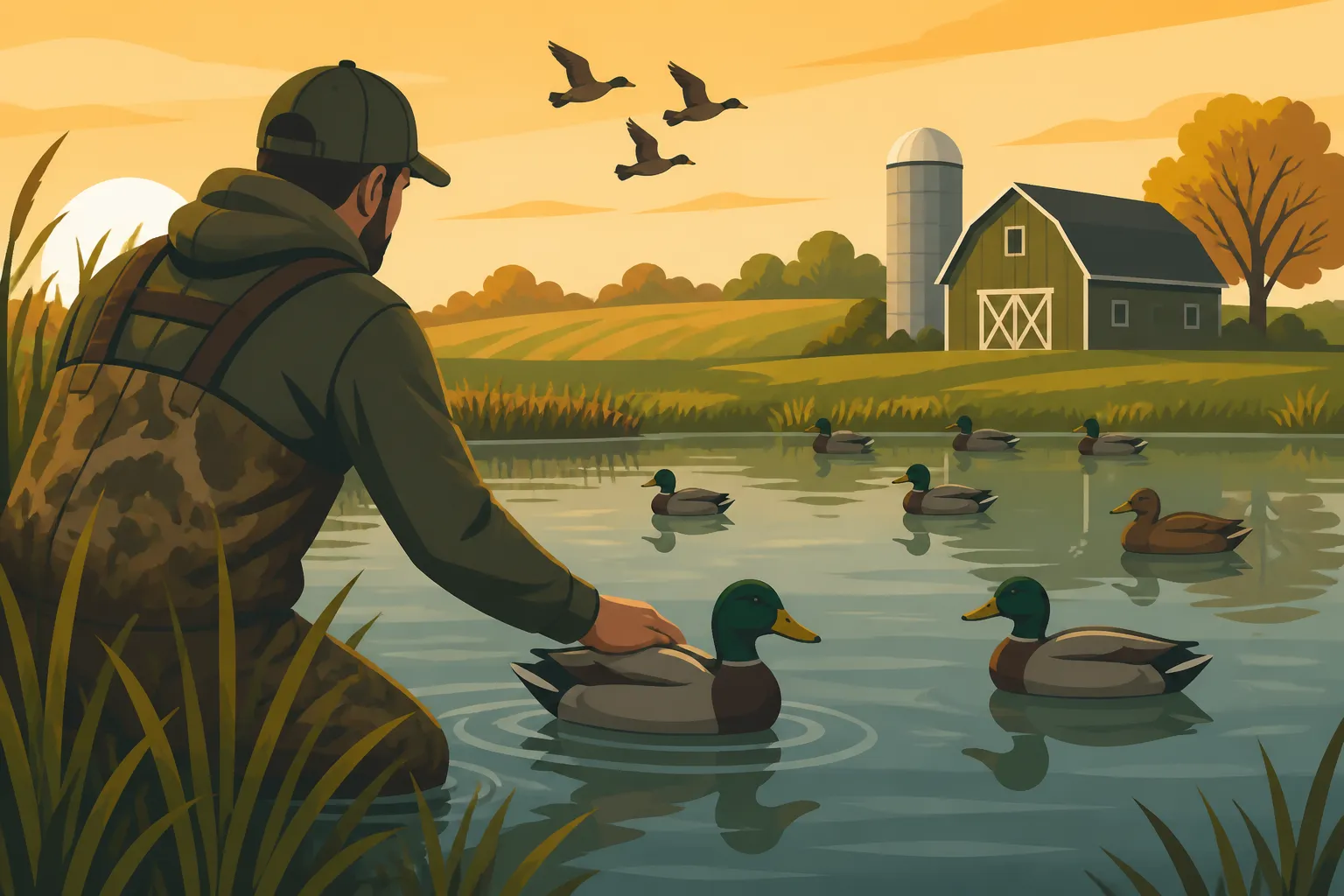
The "J-hook" or "U-shape" spread is a classic for a reason. Imagine the hook of a 'J' or the curve of a 'U' with the open end facing into the wind. This creates a clear, inviting landing zone directly in front of your blind. Ducks will naturally want to land into the wind, so they'll swing into that open water, setting themselves up for a shot. Another effective strategy is to mimic small, natural groups. Instead of one large cluster, break your decoys into pairs or small groups of three or four. Ducks are social, but on smaller, less protected waters, they often land in smaller, more cautious groups. You might place a couple of decoys near a brush pile, a pair in the middle, and a small group near the bank, all oriented to guide birds towards your landing hole. Don't forget to add some loafing decoys on the bank if appropriate – ducks often sit out of the water to preen or rest. Utilizing motion is also critical. A simple jerk string or even a battery-operated spinning-wing decoy can add incredible realism, especially on calm days when static decoys look lifeless. While spinning-wing decoys can be controversial for some, they undeniably draw attention and can be a game-changer on a slow morning. Just be mindful of local regulations on motion decoys.
Placement for Optimal Landing and Visibility
Even the best decoys and spread patterns are useless if they're not placed strategically. Every decoy's position should serve a purpose: to be seen, to look natural, and most importantly, to guide ducks into your kill zone.
Always, always leave a clear, calm area in front of your blind for a landing zone. This is non-negotiable. Ducks need space to land, and they want to land where they perceive it to be safe and clear of obstacles. Remember the upwind approach; all your decoys should subtly funnel birds into this zone. Ensure your decoys are easily seen from common flight paths. If you've been scouting, you'll know roughly where ducks are flying when they approach the pond. Place some of your decoys on the downwind side of the pond where they will be seen first by incoming birds, giving them a visual cue to swing around. You might even consider placing a few "confidence decoys" further out from the main spread if the pond is large enough, just to draw distant attention. When using a mapping tool like GoHunt, you can drop pins where you anticipate ducks approaching and where your blind will be. Then, draw lines to visualize your spread and landing zone, ensuring your decoys have maximum visibility from the probable approach vectors and that the open water funnels birds effectively. For instance, if you're hunting a pond in Christian County, known for its mix of agriculture and timber, understanding how ducks approach from different flight corridors based on wind is vital. Looking up "Layout Blind Hunting Western Kentucky Fields" might also give you some ideas for concealment in open settings.
Adapting to Conditions and Maximizing Your Pond Hunt
No two hunting days are exactly alike, and being able to adapt your strategy on the fly is what separates a good hunt from a great one. This is especially true on farm ponds where conditions can change rapidly.
Wind, Sun, and Changing Weather
The weather is your most influential, and often most unpredictable, hunting partner. You need to be able to "read" it and adjust. Wind, as we've discussed, is paramount. Not only does it dictate the ducks' landing approach, but it also provides natural movement for your decoys. On a dead calm day, still decoys look flat and lifeless. A jerk string, or even just occasionally wading out to stir things up, can be incredibly effective. If the wind shifts, be prepared to adjust your spread or, at minimum, rotate your landing zone.
The sun's position can be a blessing or a curse. Early morning sun directly in your face will make it impossible to see incoming birds and will silhouette you against the sky. Position your blind so the sun is at your back or to your side. This illuminates your decoys beautifully and keeps you in the shadows. Rain or snow often brings ducks down, making them more willing to commit to a pond. Don't be afraid to hunt in less-than-ideal human weather. A hard cold front can be a major duck mover, pushing birds south and often concentrating them on smaller, accessible water like farm ponds. Learning about "Kentucky Waterfowl Migration Timing" can help you anticipate these movements.
Concealment and Calling
On a farm pond, you are often hunting in a relatively exposed environment. Your concealment, therefore, becomes even more critical than on larger, more forgiving waters. Ducks have incredible eyesight, and if they see you, your hunt is over.
Your blind location is everything. Natural cover is always best – a thick fencerow, a clump of cedars, a brushy point. Avoid setting up where you'll be silhouetted against the skyline. If natural cover is scarce, you'll need to create your own. A portable ground blind or even a simple layout blind brushed in with natural materials like cattails, cornstalks, or tree branches can work wonders. Spend the extra time to brush in your blind meticulously; make it look like part of the natural landscape. Think of it as an art form. When it comes to calling, less is often more on pressured farm ponds. Ducks that frequent these smaller waters are usually warier and have heard every highball and comeback call in the book. Soft, natural quacks, a contented feed chuckle, or a simple single quack can be far more effective. Use calls to get their attention, then let your realistic spread and good concealment do the rest. Aggressive calling can sometimes send wary birds flaring out of the county. You might find additional insights on effective calling by looking into specific strategies like "Reading a Bottomland Slough for a Morning Flight."
Scouting and Post-Hunt Adjustments
The most successful hunters are also the best scouts. You can't just show up on opening morning and expect magic to happen. Pre-season scouting is absolutely essential for identifying key ponds that birds are using and understanding their general flight patterns. Observing where ducks naturally land, where they feed, and how they react to different winds will inform your setup.
Even after you've hunted, the work isn't over. Take time for post-hunt adjustments. What worked? What didn't? Did birds flare off a particular side of the pond? Did they prefer to land closer or further from your spread? Make notes, either mentally or using a mapping app. If ducks are consistently flaring, it might mean your blind is too visible, your spread looks unnatural, or you're calling too much. Don't be afraid to change your spread, move your blind, or even try a completely different pond. Every hunt is a learning experience. Using the mapping features of GoHunt to mark successful spots, note wind directions, or even track observed duck behavior can build a valuable database for future hunts. Also, ensure you understand all "Kentucky Duck and Goose Zone Rules" and have your "Kentucky HIP Certification for Bird Hunters" up to date before heading out.
| Strategy Component | Small Pond Decoy Setup | Large Pond Decoy Setup |
|---|---|---|
| Number of Decoys | 6-12 decoys, focusing on realism and natural grouping. | 12-24 decoys, allowing for more spreading out and variety. |
| Species Mix | Mostly mallards, wood ducks; perhaps a few teal/pintail. | Mallards, pintails, gadwalls, teal; consider a few divers or geese if present. |
| Spread Pattern | Simple J-hook, small pairs/groups; focus on clear landing zone. | J-hook, U-shape, or broken clusters; larger, more inviting landing zone. |
| Motion Decoys | Jerk string highly effective; spinning wing if subtle. | Jerk strings, spinning wings, confidence feeders. |
| Concealment Focus | Absolute paramount; blend completely into natural bank cover. | Critical; utilize existing cover or well-brushed blinds. |
| Calling Intensity | Soft, subtle, natural quacks and feed chuckles. | Can be slightly more aggressive if birds are distant, but still cautious. |
| Landing Zone | Small, tight pocket directly in front of the blind, into the wind. | Larger, more defined open water area, accommodating bigger groups. |
| Visibility | Close-range drawing power; decoys seen from short approach. | Decoys placed for longer-range visibility to pull birds from afar. |
Disclaimer
Hunting and trapping regulations can change. It is crucial to consult the latest Kentucky Department of Fish and Wildlife Resources (KDFWR) regulations before every season and every hunt to ensure compliance. This guide is for informational purposes only and does not supersede official regulations.