Dragging a Deer Out of a Steep Hollow
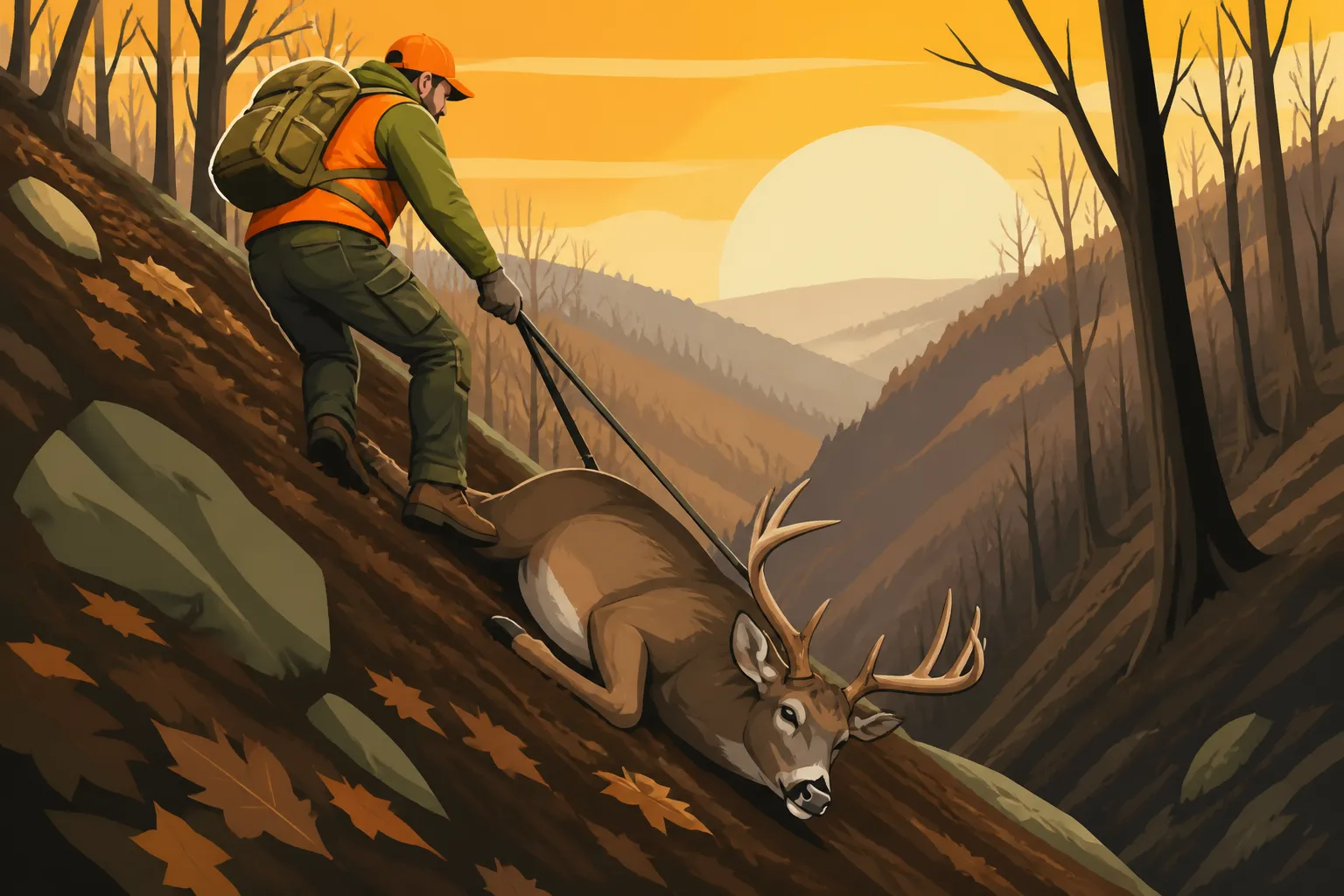
You've put in the time, braved the cold, and finally, there it is – your hard-earned Kentucky whitetail. But the rush of adrenaline quickly fades as you realize it's lying at the bottom of a steep, leaf-choked hollow, miles from the nearest trail. Dragging a deer out of challenging terrain can quickly turn celebration into pure exhaustion, leaving you wondering if you'll ever get it out. This guide is here to help you strategize and prepare for those inevitable, brutal recoveries, ensuring you get your game home safely and without throwing out your back.
Assessing the Recovery Challenge Before the Drag
Before you even touch that deer, take a moment. I know, I know, the excitement is still pumping, but a little clear-headed assessment right now can save you a world of hurt and effort later. Think of it as your pre-drag reconnaissance mission. You wouldn't charge into an unknown hunting spot without scouting, right? The same goes for one of the toughest parts of the hunt: getting your animal out.
Understanding the Terrain and Your Location
The first, and perhaps most critical, step is to truly understand what you're up against. Look around you. Is the hollow a gradual slope, or does it drop off like a cliff face? Are you dealing with thick rhododendron patches, or relatively open timber with a lot of leaf litter? You might be miles deep in the rugged expanse of the Daniel Boone National Forest Hunting grounds, or perhaps in the equally challenging, but different, landscape found when Hunting Eastern Kentucky Coalfield Country. Each type of terrain presents its own unique set of obstacles and potential advantages.
Consider the route back to your vehicle. Is there an old logging road nearby, or are you looking at a straight-line scramble up a ravine? Often, the path of least resistance isn't the most direct one. Scouting with mapping apps like GoHunt before your hunt can be a lifesaver here, allowing you to pre-mark potential extraction points or gentler slopes. These apps provide invaluable topographical data, showing you elevation changes and contours you might not notice on the ground until it's too late. It’s always better to know the lay of the land before you’re staring at a dead deer and a seemingly impossible ascent.
Obstacles like fallen trees, dense briar patches, or rocky outcrops can turn a simple drag into a wrestling match. If you can see a way to skirt these formidable hurdles, even if it adds a little distance, it might save you significant time and energy. Remember, you're not just moving yourself; you're moving a substantial amount of dead weight that doesn't bend, pivot, or jump over logs. Every inch you gain on a steep, obstacle-ridden slope will feel like a mile. Take the time to identify these challenges now, while your mind is still relatively fresh.
Evaluating the Deer and Your Physical Condition
Let's be honest, not all deer are created equal, especially when it comes to dragging. A hefty Kentucky buck, particularly a mature one that's been putting on weight all summer and fall, can easily tip the scales at well over 150 pounds, sometimes pushing 200 pounds or more dressed out. Throw in a few hundred feet of elevation gain, and that "successful harvest" can quickly feel like an insurmountable challenge. Don't underestimate the physical toll this kind of work takes. If you're already exhausted from a long morning of still-hunting Eastern Kentucky ridges, your reserves might be lower than you think.
Be realistic about your own physical condition and energy levels. Are you hunting solo, or do you have a buddy nearby? If you're alone and facing a monster buck in a deep hollow, it might be time to swallow your pride and consider calling for help. There's no shame in it; even seasoned hunters know their limits. Trying to be a hero can lead to injury, which is far worse than admitting you need an extra set of hands. A pulled back or twisted ankle out in a remote area is not just painful, it can be downright dangerous.
Think about the conditions too. Is it a warm early-season day? Then speed might be of the essence to preserve the meat. Is it freezing cold? You might have a little more time, but exposure becomes a factor if you're straining yourself for hours. Staying hydrated is always critical, no matter the temperature. Many a hunter has found themselves cramping up halfway through a drag, simply because they didn't bring enough water or forgot to drink it. This isn't the time to push past the point of exhaustion; it’s the time to work smart and conserve your energy.
The Importance of a Good Blood Trail
While it might seem like a separate issue from dragging, a strong, consistent blood trail is inherently tied to an easier recovery, especially when you're hunting in challenging terrain. When a deer drops right where it's shot, you've hit the jackpot. But more often than not, even a well-placed shot can lead to a deer running a short distance, sometimes into the nastiest, thickest cover imaginable. This is where a clear blood trail becomes your absolute best friend.
Without a good blood trail, you can spend hours, even days, painstakingly searching for your downed animal. Every minute you spend tracking is time and energy you could be using for the actual drag. In dense Kentucky hardwoods or pine thickets, a lost blood trail means you're crawling on your hands and knees, staring at every leaf and twig, hoping for a speck of red. This is particularly frustrating in a steep hollow, where the ground can be uneven and covered in deep leaves, making visual tracking incredibly difficult. Being proficient at Blood Trailing After Dark in Kentucky is a skill every hunter should cultivate, as daylight often runs out before the recovery is complete.
So, how does this relate to dragging? Simple: the less time you spend searching, the more energy you have for the arduous task of extraction. A strong blood trail also gives you confidence in the direction the deer traveled, allowing you to focus on the best route for recovery rather than second-guessing every step. When you know exactly where your deer is, you can mentally map out the drag, anticipate challenges, and even scout a path to the deer that minimizes unnecessary climbs or descents. Prioritizing that blood trail immediately after the shot is an investment that pays huge dividends when it comes time for the heavy lifting.
Essential Gear and Techniques for a Steep Hollow Drag
Once you've located your deer and assessed the immediate situation, it's time to get down to business. Dragging a deer, especially from a steep hollow, isn't about brute force alone. It's about leveraging the right tools and employing smart techniques to make a grueling task manageable. The goal is to save your back, conserve your energy, and move that deer efficiently without creating more problems for yourself.
Dragging Aids That Save Your Back
Let's face it, trying to drag a deer by its antlers or front legs directly on the ground is a recipe for exhaustion and potential injury. The friction is immense, the deer's body snags on every twig, and the effort required is simply monumental. This is where purpose-built dragging aids come into their own. A good deer sled or game cart can drastically reduce the effort. Plastic sleds, for instance, are incredibly popular because they create a smooth, low-friction surface that glides over leaves, snow, and even some mud, much more easily than fur and hide. They protect the carcass from dirt and debris, too.
There are various types of sleds, from simple, rigid plastic ones to more flexible fabric or tarp-like designs that roll up for easy transport. For truly rugged or steep terrain, a more robust, often rigid, sled is preferable as it offers better control and protection. When considering a deer sled for Ridge Country, look for models with strong attachment points and perhaps a slightly narrower profile that can navigate between trees more easily. Some hunters even fashion homemade sleds from heavy-duty plastic sheeting, which can be surprisingly effective for short, brutal drags.
Beyond the sled itself, the attachment to your body is key. A simple rope over your shoulder will dig in and tire you out quickly. Invest in a proper drag harness – either a shoulder harness that distributes the weight across your upper back and shoulders, or a waist harness that engages your core and legs. Many hunters prefer a waist harness as it frees up their arms and allows for more powerful leg-driven pulling. Heavy-duty ropes (not thin twine that will cut into your hands) are also crucial, allowing you to get a good grip and distribute the pull. Sometimes, using two ropes, one attached to each side of the deer's head/neck area, can help stabilize the animal in a sled and prevent it from flipping on its side during a difficult descent or ascent.
| Dragging Aid | Pros | Cons | Best Use |
|---|---|---|---|
| Plastic Sled | Reduces friction significantly, protects carcass from dirt/debris, durable, often affordable. | Can be bulky to carry into the woods, might be difficult to maneuver in very dense brush or extremely steep, rocky terrain where it might hang up. | Long, moderate-slope drags, snow, leaf litter, open timber. |
| Fabric Sled/Tarp | Lightweight, compact (folds up), good for reducing friction on uneven ground, often inexpensive. | Less protection for carcass from sharp objects, can tear, harder to control on steep descents, doesn't offer rigidity. | Short to moderate drags, less rugged terrain, pack-in situations, good for protecting meat if boned out. |
| Shoulder Harness | Distributes weight across shoulders/back, frees hands, generally comfortable for moderate pulls. | Can restrict arm movement, still puts strain on upper body, less effective for very heavy loads. | Moderate drags, when a sled is used, helping to reduce upper body fatigue. |
| Waist Harness | Leverages leg power, frees hands completely, excellent for heavy loads, superior ergonomic design. | Can be more expensive, might feel bulky to wear when not dragging, some hunters find it less natural initially. | Steep inclines/declines, heavy deer, long distances, when maximizing pulling power and minimizing back strain is crucial. |
| Ropes | Versatile, can be used to pull directly or as part of a sled/harness system, good for leverage. | Can cut into hands, direct pulling by rope alone causes high friction, not ergonomic. | Supplemental to other aids, getting over logs, securing deer in a sled, quick short pulls. |
Strategic Movement and Rest
Dragging a deer out of a steep hollow is not a sprint; it's a grueling marathon. Trying to power through it without strategy will only lead to exhaustion and potential injury. When you're facing a steep incline, attempting to drag straight up is often inefficient and incredibly taxing. Instead, employ a zig-zag pattern, much like you would if you were hiking a switchback trail. This lengthens your route slightly but significantly reduces the gradient you're pulling against at any given moment. It allows you to use your leg muscles more effectively and provides better traction, especially on loose soil or wet leaves.
On declines, the challenge shifts from pulling to controlling. A deer in a sled can pick up speed quickly on a steep downhill, potentially dragging you with it or crashing into trees. Use the zig-zag method here too, but also leverage trees or natural obstacles to slow your descent. Wrap a rope around a sturdy tree to create a makeshift anchor, allowing you to lower the deer in controlled stages. Always maintain good footing and be aware of what's downhill from you. Losing control of a large deer on a steep slope can be dangerous, not just for you but also for the integrity of the carcass.
Frequent, short rests are non-negotiable. Don't wait until you're completely gassed to take a break. Stop for 30-60 seconds every few minutes, especially on inclines. This allows your muscles to recover, your heart rate to come down, and your mind to stay focused. Use these breaks to scout the next section of your route, take a sip of water, or simply catch your breath. Breaking the drag into smaller, manageable segments makes the overall task less daunting mentally and physically. For example, tell yourself, "I'm just going to get it to that big oak," and once you reach it, reassess and set a new, short-term goal. Sometimes, the easiest way to traverse difficult terrain is by Hunting a Funnel Between Two Hollows, as these natural pathways often represent the path of least resistance for both deer and hunters.
Utilizing Natural Terrain to Your Advantage
Kentucky's varied topography, particularly in its more rugged regions, can either be your biggest foe or your best ally during a deer drag. Learning to "read" the land and use its features to your advantage is a skill that comes with experience, but it's one that can drastically cut down on your effort. Look for natural ramps or subtle benches in the terrain that offer a brief reprieve from the steepness. A slight rise, even just a few feet high, can provide a momentary rest point for you and the deer, allowing you to reposition for the next push.
Fallen logs and stumps, often seen as nuisances, can actually become helpful tools. If you need to stop on an incline, a log can act as a natural brake, preventing the deer from sliding back down. On a decline, a sturdy, well-placed log can be used to brace yourself or even to momentarily lever the deer over a particularly rough spot. Similarly, small clearings or patches of less dense undergrowth offer opportunities for easier passage and a chance to stretch out and get a better grip. These aren't always obvious, but a careful scan of your immediate surroundings can often reveal these subtle advantages.
Don't be afraid to adjust your route on the fly. While you might have a general idea of your exit strategy from your initial scouting, the ground-level reality can be different. If you encounter an unexpected patch of impenetrable briars or a rock slide, it’s far better to detour a few extra yards than to fight through it. Sometimes, even a slight alteration in your angle of ascent or descent can make a world of difference. Being adaptable and creative, rather than blindly sticking to a predetermined path, is a hallmark of a smart hunter when facing a challenging recovery.
When to Call for Backup (and How to Do It Safely)
As hunters, we often pride ourselves on self-reliance and the ability to get things done on our own. But there's a fine line between rugged independence and sheer foolishness, especially when you're alone in a remote hollow with a hundred-plus pounds of venison. Knowing when to call for help isn't a sign of weakness; it's a sign of wisdom, experience, and prioritizing safety.
Recognizing Your Limits and Asking for Help
One of the hardest lessons to learn in hunting, or really in life, is knowing when you've reached your physical and mental limits. The adrenaline of the hunt can mask fatigue and pain for a while, but eventually, your body will rebel. If you find yourself repeatedly struggling to move the deer even a few feet, feeling dizzy, experiencing muscle cramps, or if the terrain simply seems insurmountable alone, that's your cue. Pushing past these warning signs can lead to serious injury – a pulled muscle, a sprained ankle, or worse. Imagine trying to hike out of a deep hollow with a bad leg in the fading light. It's a dangerous scenario no hunter wants to face.
Hypothermia is another very real concern, especially if you're straining in cold, wet weather and your body temperature starts to drop due to exhaustion. Making the call for help could mean the difference between a successful, albeit late, recovery and a truly miserable, or even dangerous, ordeal. Remember, your primary goal after the shot is to safely and efficiently recover the animal. If doing that solo puts your well-being at risk, then asking for assistance is not just acceptable, it's the responsible choice. There are countless stories in Kentucky Deer Camp Traditions of hunters getting help from friends or family when faced with a particularly stubborn drag.
Don't let pride get in the way. It’s a common fallacy that needing help somehow diminishes the accomplishment of the hunt. Quite the opposite: a hunter who knows their limits and acts responsibly is a smart hunter. Most fellow hunters are more than willing to lend a hand, especially if it means ensuring good meat doesn't go to waste. A quick text or phone call to a buddy, letting them know your general location and situation, is a smart play. Be specific about the challenge – "I've got a big buck down in a really steep hollow about a mile east of the old logging road, and I could use an extra set of hands with a deer cart." Clear communication makes it easier for them to help you effectively.
Coordinating a Group Drag
When help arrives, or if you started your hunt with a group, coordinating a group drag efficiently is key to making the most of those extra hands. Simply having more people pulling without a plan can sometimes lead to disorganization and wasted effort. Before you all put hands on the deer, take a moment to discuss the best route you've identified and assign roles. Who will be at the front pulling, who will be on the sides helping to lift over obstacles or steer, and who might be in the rear providing extra pushing power on inclines?
Communication is paramount during a group drag, especially in steep or brushy terrain where not everyone can see the lead. Simple commands like "Pull!", "Lift!", "Stop!", or "Clear!" can prevent missteps and ensure everyone is working in unison. If you're using Two-Way Radios on a Deer Drive, establish clear communication protocols beforehand. This is particularly useful if your group is spread out along the drag route, tackling different sections or clearing obstacles ahead. GoHunt's mapping features can be a great way to visually show everyone the planned route and potential challenges.
For really heavy deer or particularly steep sections, consider using multiple drag ropes or harnesses. Two people pulling in tandem from the front, perhaps with one on each side of the deer, can distribute the load and provide better control. If you're on a very steep descent, one person might act as an anchor from behind, slowing the deer's momentum while others guide it down. The key is to work together, anticipate each other's movements, and constantly communicate to ensure safety and efficiency. A well-coordinated group drag can turn an impossible task into a challenging, but ultimately rewarding, team effort.
Safety Considerations in Remote Areas
Beyond the physical exertion of dragging, hunting in remote Kentucky areas, especially in places like the Daniel Boone National Forest, comes with its own set of safety concerns. Poor cell service is often the norm, meaning your ability to call for help might be severely limited. This is why thorough preparation is so crucial. Always let someone know where you're going, your planned route, and when you expect to be back. This simple step can be a lifesaver if things go sideways.
Carrying a reliable GPS device, or at least a mapping app with offline capabilities like GoHunt, is non-negotiable. Knowing your exact location, especially when you're disoriented or tired, can be the difference between a quick recovery and a lost night in the woods. These tools also allow you to mark your vehicle's location and track your route, making the return trip much simpler. If you've been Hunting Pine Mountain Ridgelines all day, you know how quickly the landscape can look different when you're exhausted and pushing a deer.
Finally, never head into the backcountry without a basic First Aid Kits for Remote Daniel Boone Forest Ground. A small cut, a nasty thorn, or a twisted ankle can all become much more serious if not treated promptly. Include essentials like bandages, antiseptic wipes, pain relievers, and any personal medications. Remember to carry a headlamp, even if you plan to be back before dark, because a difficult drag can easily extend past sunset. An extra layer of clothing, some high-energy snacks, and plenty of water will also help you stay safe and comfortable, no matter how long the recovery takes. Being prepared for the unexpected is the ultimate mark of a responsible hunter.
Dragging a deer out of a steep hollow is undoubtedly one of the most physically demanding aspects of hunting, but it doesn't have to be a nightmare. By taking the time to assess your situation, utilizing smart gear and techniques, and knowing when to call for backup, you can transform an arduous task into a manageable one. Prioritize your safety, work smarter not harder, and you'll get that hard-earned venison home, ready for the freezer.
Disclaimer
The information provided in this guide is for informational purposes only and does not constitute professional advice. Hunting regulations and safety protocols can change, and it is the responsibility of the individual hunter to stay informed of current laws and best practices in Kentucky. Always prioritize safety and consult official Kentucky Department of Fish and Wildlife Resources guidelines before engaging in any hunting activities.