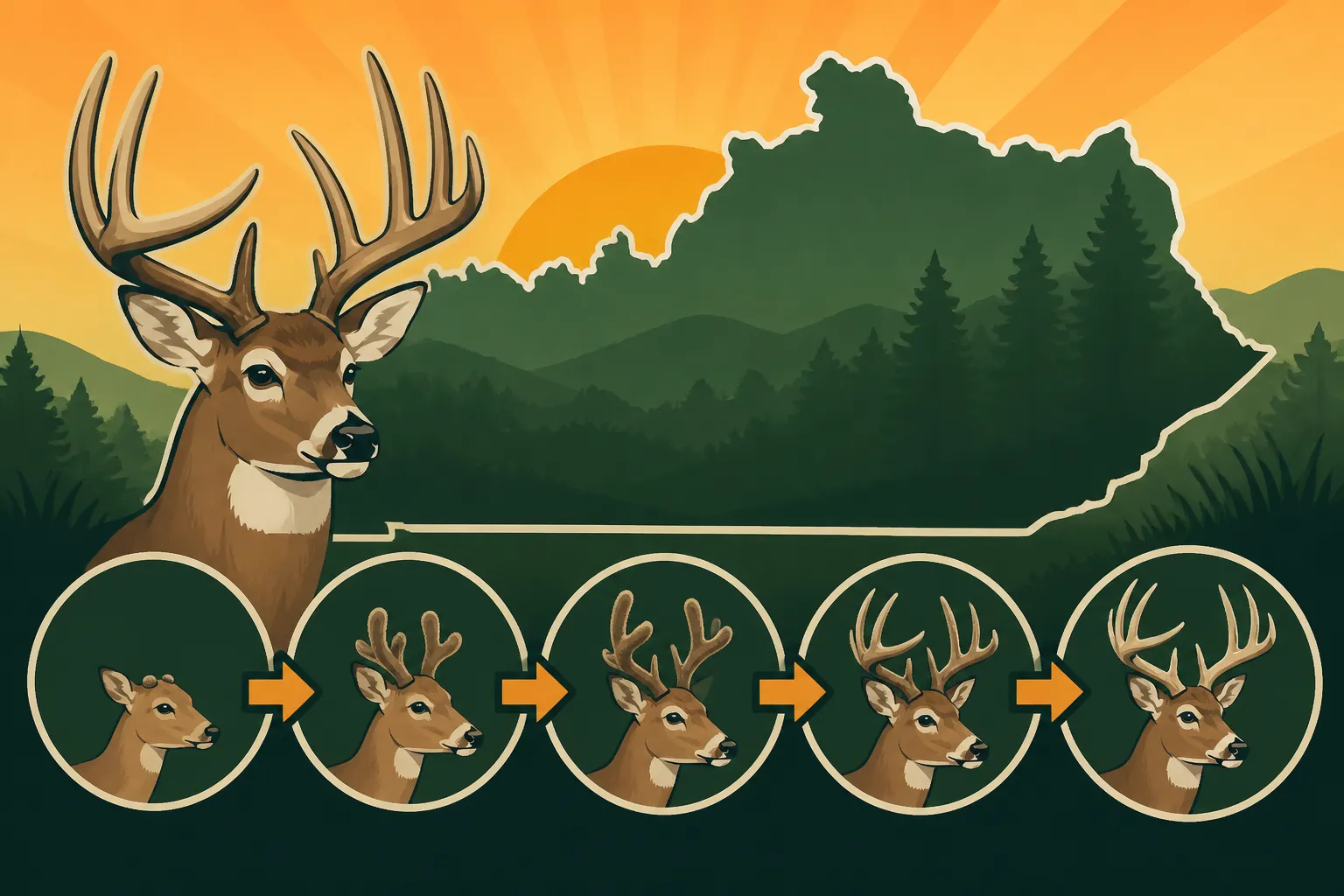
Kentucky Deer Antler Growth Timeline
For many Kentucky hunters, the annual cycle of deer antler growth is a source of endless fascination and a key indicator of the health and age structure of our whitetail herd. We all wonder when those bucks are putting on inches, when the velvet comes off, and when those impressive racks will finally hit the ground. Understanding this timeline isn't just for curiosity; it helps us predict buck behavior, scout effectively, and truly appreciate the incredible biology of these animals.
The Annual Cycle of Antler Development in Kentucky Bucks
The growth of a deer's antlers is one of nature's most remarkable processes, a rapid regeneration of bone unlike almost anything else in the animal kingdom. It's an intricate dance governed by hormones, daylight, and nutrition, and for Kentucky's whitetails, this cycle largely follows a predictable pattern, even with individual variations.
The Spring Surge: From Pedicles to Velvet Nubs
As the days begin to lengthen in late winter and early spring, typically around late February or early March here in Kentucky, the physiological process for antler regeneration kicks into high gear. This is when the old antlers have usually dropped (we'll talk about shedding later), and the pedicles—those bony protrusions on the buck's skull—are ready to sprout new growth.
Initially, you won't see much. It starts as tiny nubs, almost imperceptible beneath a layer of specialized skin known as velvet. This velvet is a marvel in itself, densely packed with blood vessels, nerves, and nutrients, all working together to nourish the rapidly developing bone beneath. It's a testament to how quickly these animals can rebuild such impressive structures. The initial growth is often slow, but as spring transitions into the lush, green abundance of a Kentucky May, the pace quickens dramatically. For those of us anxiously awaiting the next deer season, seeing those first signs of fuzz on a buck's head is a sure sign that the cycle is truly underway. This early growth is largely driven by increasing daylight hours which stimulate hormone production, signaling the buck's body to start investing massive amounts of energy into antler development.
Summer's Green Growth: Rapid Expansion and Velvet Protection
Summer in Kentucky is a time of explosive growth for deer antlers. From late May through August, a buck's antlers are literally growing inches per week. This isn't just about length; it's about mass, tine development, and the overall architecture of the rack. Imagine growing an entire skeleton on your head in just a few months! This incredible speed demands a huge amount of protein, calcium, phosphorus, and other minerals, which Kentucky's rich summer forage provides in abundance—think lush clover fields, succulent forbs, and burgeoning browse in the deep timber.
During this entire period, the antlers remain fully covered in velvet. This soft, fuzzy covering protects the growing bone, which is surprisingly delicate and sensitive. Any injury to the velvet during this phase can result in abnormal antler growth, leading to what hunters often call "nontypical" points or deformities. That's why bucks in velvet tend to be a bit more reclusive and cautious, especially when moving through thick brush or fighting. Their soft antlers are a precious commodity they're trying to protect. For those trying to get a jump on scouting, spotting a buck in velvet during late summer means you're seeing the potential of what he'll become. While most of us are thinking about Kentucky Fawn Survival Rates in spring, the bucks are busy building their headgear. Many hunters utilize trail cameras throughout the summer to monitor this growth, giving them a sneak peek at the local herd's potential before archery season opens.
Hardening Up: From Velvet to Polished Bone
The transition from soft, blood-filled velvet to hard, polished bone is one of the most anticipated phases for Kentucky deer hunters. It marks the shift from passive growth to active display and use, signaling the approach of the breeding season.
The Late Summer/Early Fall Transformation
As summer begins its slow fade into early fall, typically around late August and into September, the long days start to shorten, and this change in photoperiod once again triggers a hormonal shift in bucks. Testosterone levels begin to rise, and this surge signals the end of antler growth and the beginning of the hardening process. The blood flow to the velvet is cut off, and the once-vibrant tissue begins to dry out and die.
This is when you'll start seeing bucks actively rubbing their antlers on trees and brush, not just to mark territory, but to strip off that dead, itchy velvet. It’s an unmistakable sign of the approaching hunting season! You’ll often find fresh rubs appearing almost overnight in the woods, the bark shredded and sap oozing. This process usually takes a few days to a week for an individual buck, and it's a bit messy, with strips of velvet often hanging from their antlers. Once the velvet is completely removed, the antlers are exposed as the hard, bony structures we recognize. They'll have a beautiful, often darker, polished appearance from the dried blood and sap, ready for the rigors of the upcoming rut. The exact timing can vary by a week or two depending on the individual buck and local conditions, but by the time Kentucky Archery Season Opening Day rolls around, most mature Kentucky bucks will be hard-horned and ready to rumble.
Rubs, Scrapes, and the Rut: Antlers as Tools
Once their antlers are hard and clean, Kentucky bucks begin to utilize them for a variety of purposes, most notably in preparation for and during the rut. Antlers aren't just for show; they're vital tools in the social hierarchy of the deer woods. You’ll see them creating rubs on saplings and small trees, tearing them up with their antlers and foreheads. These rubs serve as visual and olfactory markers, communicating their presence and dominance to other deer. It's a clear sign that a buck is active in an area and asserting himself.
Alongside rubs, bucks will also paw out scrapes, usually under an overhanging branch, and then urinate over a tarsal gland on their leg into the pawed earth. They might chew on the licking branch above. While both sexes use scrapes, bucks definitely amp up their scrape activity as testosterone levels peak. These scrapes, often found along travel corridors or near bedding areas, are like community bulletin boards, allowing deer to exchange information through scent. And, of course, during the peak of Hunting the Rut in Early November, antlers become weapons. Bucks will spar, push, and sometimes engage in full-blown fights to establish dominance and secure breeding rights with does. The sound of antlers clashing in the crisp autumn air is a thrilling experience for any hunter. Effective calling techniques, like Rattling and Grunting in Kentucky, often try to mimic these sounds to draw in curious or aggressive bucks.
The Post-Rut Drop: When and Why Kentucky Bucks Shed
After the exhausting period of the rut, a buck’s body undergoes another significant change, leading to the shedding of its antlers. This transition marks the end of one cycle and the prelude to the next.
Winter's Wear and Tear: The Weakening Pedicle
Once the breeding season winds down, typically from late November into December, a buck’s testosterone levels begin to fall. This decline is a gradual process, but it's the primary physiological trigger for antler shedding. As testosterone levels drop, the bone and tissue that connect the antler to the pedicle on the skull begin to weaken and eventually dissolve. It's a bit like how a leaf detaches from a tree in the fall.
The exact timing of antler drop can be influenced by several factors. A particularly harsh winter, with deep snow and prolonged cold, can stress a buck's system, potentially causing him to shed earlier as his body prioritizes survival and energy conservation over carrying heavy bone. Similarly, a buck that sustained an injury during the rut, or one in poor overall health, might shed sooner. The older a buck is, the more consistently he might shed around the same time each year, assuming his health and environmental conditions are stable. For those of us still Hunting the Late-Season January Lull, seeing a buck with only one antler or even a completely bald head becomes more common as January progresses.
The Timing of the Drop and Why It Matters to Shed Hunters
In Kentucky, most bucks will shed their antlers sometime between late December and early March. The peak shedding period often falls in late January and February. You'll find some bucks dropping early, right after the rut, while others might hold onto their antlers well into March. It's not uncommon to see a buck with a full rack one day and then be sporting a single antler or no antlers at all the next. Shed hunting has become a hugely popular off-season activity, offering a chance to get back into the woods and scout for the upcoming season. Finding a shed antler from a buck you've been watching all year is like finding a treasure.
Knowing when bucks are likely to shed helps shed hunters immensely. They often focus their efforts on known bedding areas, feeding locations, and heavily used travel corridors. A buck will often drop his antlers while lying down, or even when jumping over a fence or log, causing the weakened connection to give way. Using tools like GoHunt, while primarily a hunting platform, can also aid in shed hunting by allowing you to review historical deer movement data and identify potential hot spots for activity throughout the winter months. This kind of data-driven approach, coupled with boots-on-the-ground scouting, can significantly increase your chances of finding those elusive treasures. If you're looking for more guidance on this, check out our piece on Shed Hunting on Kentucky Public Land.
Factors Influencing Antler Quality and Size in Kentucky
While the timeline for antler growth is relatively consistent, the quality and size of a buck’s antlers can vary wildly. Several critical factors converge to determine whether a Kentucky buck grows a modest rack or a true wall-hanger.
Age: The Number One Driver
Without a doubt, age is the single most important factor determining antler size in Kentucky whitetails. A buck simply needs time to reach his full genetic potential. Young bucks, say 1.5 years old, will typically sport spikes or a small fork-horn rack. While these antlers are fully formed, they represent a buck whose body is still primarily focused on growing, reaching sexual maturity, and building muscle and bone mass. Very little energy is left over for growing impressive headgear.
As a buck matures into the 2.5 and 3.5-year-old range, you'll start to see a significant increase in antler size, mass, and tine length. His body is no longer prioritizing basic growth as much, allowing more energy and nutrients to be diverted to antler production. Many Kentucky bucks reach their peak antler size between 4.5 and 6.5 years of age. Beyond that, some bucks may maintain impressive racks, while others might start to show a decline in overall size, a phenomenon often called "going downhill." This is why deer management strategies often focus on protecting younger bucks to allow them to reach older age classes. Understanding Kentucky Buck Age Structure is key to appreciating the potential within your hunting area.
Nutrition and Habitat: Fueling the Rack
Even an older buck with great genetics won't grow large antlers if he doesn't have access to a consistent, high-quality diet. Nutrition is the fuel that powers antler growth. Bucks need a diet rich in protein, calcium, phosphorus, and a host of other trace minerals throughout the spring and summer.
Kentucky offers a diverse range of habitats, from the rich agricultural lands of the Bluegrass and Western Coalfields to the more heavily forested, mineral-rich mountains of Eastern Kentucky. In areas with abundant agricultural crops like corn, soybeans, and alfalfa, or in forests with a reliable mast crop (acorns, hickory nuts) and high-quality browse, bucks typically have the nutritional resources to grow larger racks. Conversely, in areas with poor soil quality, overbrowsed forests, or limited food sources, even mature bucks may struggle to grow impressive antlers because their bodies simply can't spare the necessary resources. Drought conditions during the spring and summer can also severely impact antler growth by reducing forage quality and availability. This is why knowing Late-Season Food Sources for Kentucky Whitetails is so crucial, as it indicates where the deer are concentrating for survival, often reflecting summer conditions.
Genetics: The Blueprint
While age and nutrition are critical, genetics lay the blueprint for a buck’s antler potential. A buck's genes dictate the potential for tine length, mass, symmetry, and even the number of points. You've probably seen families of bucks in a particular area that consistently produce similar-looking racks, year after year, even if they're not giant. That's genetics at play.
It's important to understand that genetics are complex in wild populations. You can have a buck with excellent genetic potential, but if he lives in a nutritionally poor area, or is harvested as a young deer, you'll never see that potential realized. Conversely, a buck with average genetics in a prime habitat with plenty of age could still grow a very respectable rack. Kentucky has a rich history of producing impressive whitetails, including many entries into Boone and Crockett and Pope and Young record books. This speaks volumes about the combination of good genetics, strong management, and excellent habitat found across the state. Our article on Kentucky Boone and Crockett Whitetails delves deeper into the trophy potential of our state.
Health and Stress: The Hidden Costs
A buck's overall health and the level of stress he experiences can significantly impact his antler development. Any major health issue, such as a severe injury (a broken leg, for instance), a significant parasitic load, or disease (like EHD or CWD), can divert vital energy and nutrients away from antler growth, leading to smaller or malformed antlers. Bucks must expend a tremendous amount of energy to recover from injuries or fight off illnesses, and antler growth is often one of the first things to suffer as the body prioritizes survival.
Environmental stressors also play a role. Extreme heat or prolonged drought can cause significant stress, reducing a buck's ability to forage and stay hydrated, thus impacting growth. Even high hunting pressure or consistent disturbance can be a form of stress that subtly affects a buck's overall condition. For example, a buck constantly on the run or having to travel long distances for food might not allocate as much energy to antler growth as one in a more secure, low-stress environment. It’s a delicate balance, and anything that tips that balance away from optimal health can be seen on the buck's head.
| Antler Growth Phase | Approximate Kentucky Timeline | Key Characteristics | Influencing Factors |
|---|---|---|---|
| Shedding Old Antlers | Late Dec – Early Mar | Old antlers fall off pedicles | Declining testosterone, health, nutrition, weather |
| Pedicle Swelling | Late Feb – Early Mar | New growth visible as nubs | Increasing daylight, rising hormone levels |
| Velvet Growth | Mar – Aug | Rapid bone growth, covered in soft, vascular velvet | Daylight, testosterone, age, nutrition, genetics |
| Velvet Shedding | Late Aug – Mid Sep | Velvet dries, peels off; antlers harden | Rising testosterone, shortening daylight |
| Hard Antlers | Mid Sep – Late Dec | Antlers are hard, polished, used for rut activities | Testosterone levels high, age, nutrition, genetics |
Disclaimer
This article is for general informational purposes only and does not constitute professional advice. Laws, prices and regulations vary by location and change over time. Consult a qualified professional for guidance on your specific situation.