How Old a Cut Should Be for Grouse
Finding ruffed grouse in Kentucky can feel like searching for a phantom in the thick Appalachian timber, especially if you're not sure which type of cover is most likely to hold them. Many hunters spend frustrating hours pushing through mature forests, wondering why they aren't flushing any birds. The key often lies in understanding timber regeneration, specifically how old a cut should be to provide prime grouse habitat, and this guide will show you exactly what to look for on your next hunt.
The Elusive Ruffed Grouse and Their Habitat Needs in Kentucky
The ruffed grouse, sometimes called the "king of game birds," is a true woodland specialist. Unlike quail or pheasants that thrive in open fields and edges, grouse prefer the dense, regenerating forests found predominantly in Kentucky's eastern counties. Their needs are very specific, and understanding them is the first step to finding these wily birds. They need three main things: food, dense escape cover, and drumming sites. Without these, even a seemingly "wild" piece of woods won't hold grouse consistently.
Essential Food Sources for Grouse
Grouse are primarily herbivores, with their diet changing seasonally based on availability. In the spring and summer, they feast on tender green shoots, insects, and soft mast like berries. But as fall and winter set in, their diet shifts dramatically to hardier fare. Aspen buds, catkins from birch and hazel, and the buds of fruit-bearing shrubs become vital. Crucially for Kentucky hunters, acorns from various oak species, especially red oaks, are a significant food source. If a timber cut includes a good mix of these food-producing trees and shrubs, it instantly becomes more attractive to grouse. These birds are often found working through areas with a strong understory, browsing on what's available.
Dense Escape Cover is Non-Negotiable
This is perhaps the most critical factor for grouse survival. Ruffed grouse, despite their camouflage, are constantly vulnerable to aerial predators like hawks and owls, and ground predators such as coyotes and bobcats. They rely on extremely dense cover to evade these threats. Think thickets, briar patches, young saplings growing so close together you can barely walk through them, and evergreen stands like hemlock or pine. Mature, open timber with a clean understory is a death trap for grouse, offering no protection. A good grouse cover patch will make you work for every step, snagging your clothes and forcing you to duck and weave. This is where birds will roost, feed, and escape when pressured. For more general tactics on finding these birds, check out our comprehensive guide on Grouse and Small Game Hunting in Kentucky.
Drumming Logs and Breeding Habitat
While not directly related to hunting in the fall, understanding drumming habitat sheds light on why certain areas hold birds year-round. Male grouse use specific elevated spots—often fallen logs, large rocks, or root balls—to perform their distinctive drumming display to attract mates. These drumming logs are usually located within or very close to dense cover, allowing the bird to remain hidden while broadcasting its presence. If you find old drumming logs with clear signs of use, it’s a strong indicator that the area has been suitable grouse habitat for a long time and might still be. This also tells you a lot about the overall health of the local grouse population.
Understanding Timber Regeneration: From Clearcut to Canopy
Kentucky's forests, especially in the eastern part of the state, are dynamic ecosystems constantly undergoing change due, in part, to timber harvesting. These changes create the varied age classes of timber that grouse depend on. Knowing the stages of forest regeneration is vital for predicting where grouse might be. It’s not just about finding a cut; it’s about finding the right cut.
The Initial Clearcut and Early Regeneration
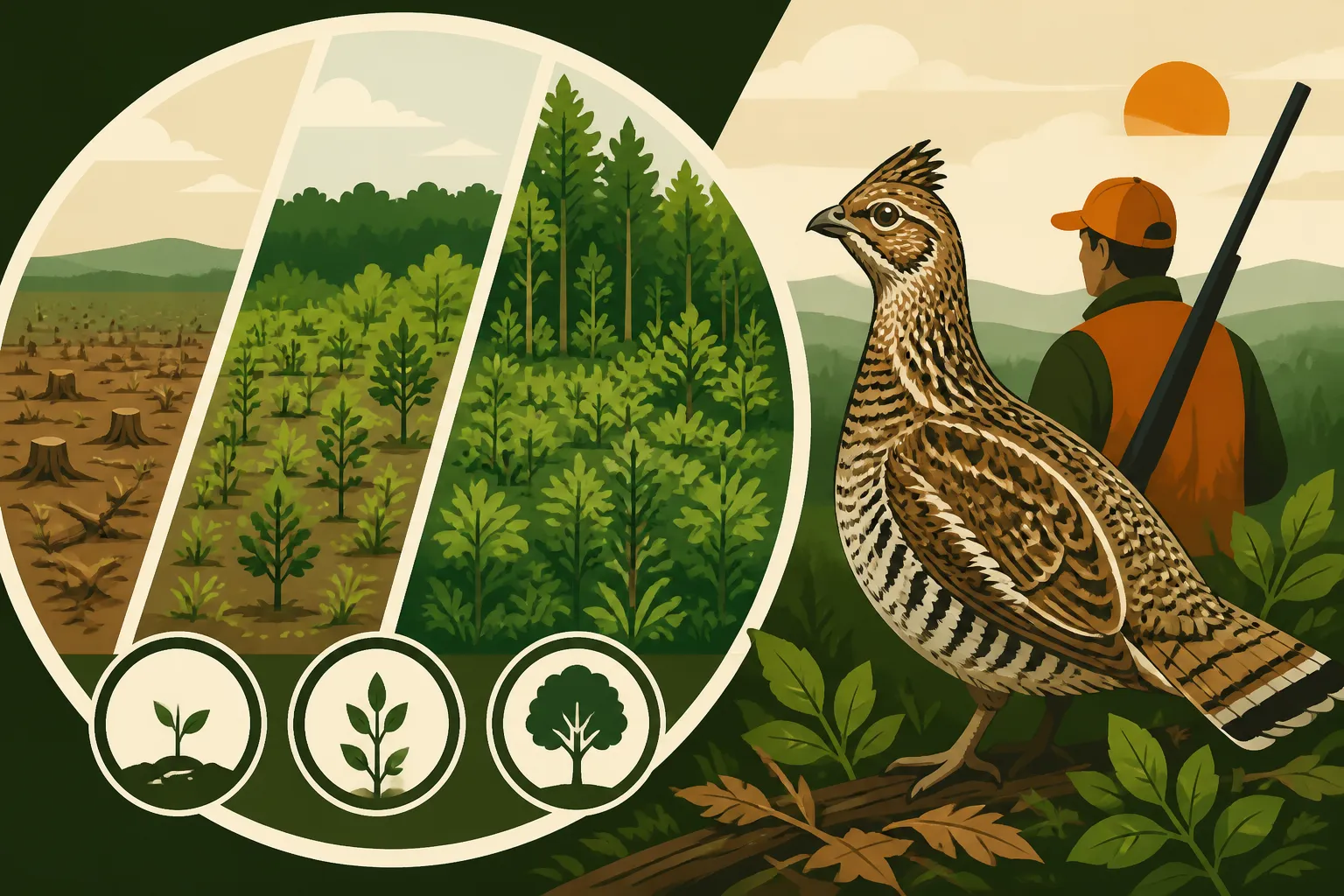
When an area is clearcut, it looks devastating at first glance—bare ground, stumps, and logging slash. However, this is the very beginning of a new forest, and it’s surprisingly important for grouse. Within the first 1-5 years, depending on sunlight and soil, the area explodes with herbaceous growth, briars, and rapidly growing tree sprouts. This early stage often provides critical food sources like berries and insects, and the sheer density of young plants can offer some limited cover. While not typically holding large numbers of adult grouse, it serves as a nursery for other small game and signals a healthy, regenerating habitat that will soon become prime grouse territory.
The Thicket Stage: Prime Grouse Country
This is the sweet spot. Usually, between 5 and 20 years after a timber cut, the area transforms into an incredibly dense thicket of young trees, saplings, and brush. Species like oak, maple, poplar, and birch rapidly grow, creating a nearly impenetrable canopy close to the ground. This stage provides exactly the kind of overhead and lateral cover that grouse crave for escape and roosting. The understory is often filled with fruit-bearing shrubs and young trees, offering consistent food. This is the habitat where you'll encounter the highest densities of grouse. When you're Scouting Kentucky Public Land Before Season, look for these vigorous, tangled areas on maps or from overlooks.
Pole Timber and Maturing Forest
As the trees continue to grow, typically from 20 to 40 years post-cut, the forest enters the pole timber stage. The canopy begins to close, shading out much of the understory growth. Individual trees become taller and thinner, and while still offering some cover, the dense, ground-level thickets that grouse prefer start to thin out. Food sources might shift to more mature hard mast, but the critical escape cover diminishes. Grouse numbers will typically start to decline in these areas, as the habitat becomes less ideal. They might still use the edges or pockets of persistent dense cover, but the expansive, bird-holding thickets are gone.
Mature Forest and Declining Grouse Numbers
Beyond 40-50 years, the forest fully matures. The trees are large, the canopy is high, and the understory is generally open and park-like. While beautiful and home to other wildlife like deer and squirrels, these areas offer very little for grouse. The lack of dense escape cover makes them highly vulnerable, and the food sources they prefer are often scarce. You might occasionally find a grouse in an isolated mature stand that borders a younger cut, but it’s rarely prime habitat. This explains why hunting for grouse in vast, unbroken mature timber is often a fruitless endeavor.
The Prime Age for Grouse-Holding Timber Cuts
So, getting right to the point: what's the magic number for a timber cut to hold ruffed grouse in Kentucky? While there's no single "perfect" age that applies universally due to variations in species, soil, and management, a clear range consistently produces results. The sweet spot generally falls within two distinct phases, offering different advantages. For a more localized look at where these cuts are common, check out our guide on Grouse Hunting the Cumberland Mountains.
The Young Thicket: 5 to 15 Years Post-Cut
This is often considered the absolute prime window for grouse. In this stage, the young trees and shrubs are aggressively growing, creating an incredibly dense tangle of cover from knee-high to eye-level. Walking through these areas is a chore, often requiring you to push through thick branches and briars, but that's precisely what a grouse needs for security. You'll find a mix of food sources here too: young buds, catkins, and residual berries from earlier successional plants. These areas are almost impossible for a hawk to penetrate and provide excellent camouflage against ground predators.
A hypothetical example: Imagine a 10-year-old clearcut on a national forest tract. The logging roads from a decade ago are barely visible, overgrown with sumac, blackberry, and young oak and maple saplings standing 10-15 feet tall. The entire area is a solid wall of green and brown, making it tough to even see 20 yards. This is precisely the kind of place where you’d expect to hear the explosive flush of a ruffed grouse. When using mapping tools like GoHunt, look for areas marked as "young regeneration" or "recent timber harvest" that fall within this age range. You can often see the distinct edges of these cuts on aerial photographs.
The Middle Ground: 15 to 25 Years Post-Cut
While the initial thicket phase is king, grouse will continue to utilize cuts that are a bit older, typically in the 15 to 25-year range. In these areas, the dominant trees are starting to thin themselves out, becoming what's often referred to as "pole timber." However, a healthy understory can persist, especially if the canopy hasn't fully closed, or if there's been some selective thinning or disturbance. You might find a more open main canopy, but with persistent pockets of dense cover at ground level, particularly along drainages, wetter areas, or where shade-tolerant evergreens like mountain laurel or rhododendron thrive.
These slightly older cuts might not hold the sheer density of birds as the younger thickets, but they can still be productive, especially if they offer specific food sources like mature serviceberry or apple trees, or excellent drumming logs surrounded by a good network of escape cover. Hunters often find grouse in these areas by targeting specific features, such as the transition zones between the pole timber and even younger growth, or areas where the terrain creates natural bottlenecks of cover. It's often where you'll find a greater mix of other small game as well, like rabbits or even squirrels. When scouting with GoHunt, pay attention to the texture of the forest canopy in high-resolution aerials; denser, lumpier texture can indicate these middle-aged cuts.
Here's a quick summary table of timber cut characteristics and their appeal to grouse:
| Cut Age Range | Habitat Characteristics | Grouse Appeal (Cover & Food) | Hunting Difficulty |
|---|---|---|---|
| 0-5 Years | Bare ground, logging slash, early herbaceous growth, sprouts | Limited early cover, some insect/berry food. Not ideal for adults. | Low (sparse cover) |
| 5-15 Years | Dense thicket, saplings 5-15 ft tall, briars, shrubs. | Prime: Excellent escape cover, abundant buds, berries, insects. | Very High (dense) |
| 15-25 Years | Pole timber, thinning canopy, persistent understory pockets. | Good cover in pockets, consistent hard/soft mast. Still productive. | High (thick pockets) |
| 25-40 Years | Closing canopy, declining understory, taller trees. | Reduced cover, food becomes less diverse. Grouse numbers decline. | Medium (more open) |
| 40+ Years | Mature forest, open understory, large trees. | Very poor for grouse: no escape cover, limited preferred food. | Low (open woods) |
Beyond Age: Other Key Factors for Finding Kentucky Grouse Success
While timber cut age is a crucial starting point, it's just one piece of the puzzle. Savvy Kentucky grouse hunters know that other environmental factors play a significant role in where these birds choose to live. Ignoring these can lead to overlooked hotspots, even in perfectly aged timber cuts. After all, a perfectly aged cut on a south-facing slope with no water might be less appealing than a slightly older cut on a north slope with a flowing creek nearby.
Topography and Aspect
The lay of the land, or topography, and its aspect (the direction a slope faces) heavily influence grouse distribution.
In Kentucky's mountainous eastern regions, north-facing slopes and hollows tend to retain more moisture, leading to a denser, more diverse understory and more persistent pockets of evergreen cover like hemlock or rhododendron. These areas often stay cooler in summer and offer better protection from severe winter winds. South-facing slopes, conversely, are typically drier and warmer, often resulting in more open timber and sparser undergrowth, which is less appealing to grouse. When you're using a mapping tool like GoHunt, paying close attention to these contour lines and shading on the map can help you identify potential grouse havens. These topographic features also influence things like Wind and Thermals on a Kentucky Ridge, which can impact how you approach your hunt.
Water Sources and Habitat Diversity
Like all wildlife, grouse need access to water, even if it's just from dew, precipitation, or the moisture content of their food. However, areas near small seeps, spring heads, or creek bottoms often support richer, more diverse vegetation, creating lusher thickets than drier uplands. These moist areas can act as magnets, concentrating grouse. Furthermore, habitat diversity within or adjacent to a cut is a huge bonus. A large, homogenous clearcut might initially hold birds, but one interspersed with different forest types, small mature pockets (for specific food trees), or diverse terrain features will usually hold more birds and sustain them longer. For example, a young cut bordering a mature pine stand offers both dense cover and thermal protection in winter.
Hunting Pressure and Undisturbed Cover
Finally, let's talk about the human element: hunting pressure. Ruffed grouse, like most game, quickly learn to avoid areas with heavy human activity. Even if a timber cut is perfectly aged and has all the right features, if it's easily accessible and gets hammered by hunters every weekend, the birds will either be pushed out or become incredibly wary and difficult to flush. Hunters often find that the best grouse spots are those that are harder to reach – requiring a long hike, navigating steep terrain, or being tucked away deep in a large public land tract. When looking at your hunting app, try to identify areas that are a good distance from major roads or popular trails. Sometimes, the key to success is simply finding ground that others walk past. This is a critical consideration for finding good hunting, whether you're targeting grouse or even when thinking about Hunting Pressure on Kentucky Public Land. If you plan on Flushing Grouse Without a Dog, minimizing pressure is even more important as you'll rely on surprising the birds.
Kentucky's grouse population has seen its ups and downs, as discussed in detail in our article on Kentucky Ruffed Grouse Decline. Finding good grouse habitat today means being more strategic than ever. By focusing on the precise age of timber cuts and combining that knowledge with an understanding of topography, water, and pressure, you can significantly increase your chances of a successful hunt. Remember, the challenge is part of the allure of chasing these incredible birds in the beautiful Kentucky wilderness. You can further hone your scouting skills by learning Reading Aerial Photos for Eastern Kentucky Deer, which will directly apply to identifying prime grouse cover. For those interested in other species that share similar early successional habitats, be sure to check out Kentucky Woodcock Season Dates. Understanding current population trends, such as Kentucky Ruffed Grouse Numbers Today, can also help set realistic expectations for your hunt.
Disclaimer
The information provided in this guide is for general informational purposes only and is not intended as legal advice. Hunting regulations and conditions in Kentucky can change. Always consult the most current Kentucky Department of Fish and Wildlife Resources regulations before planning any hunting trip. Stay safe and respect wildlife and private property.