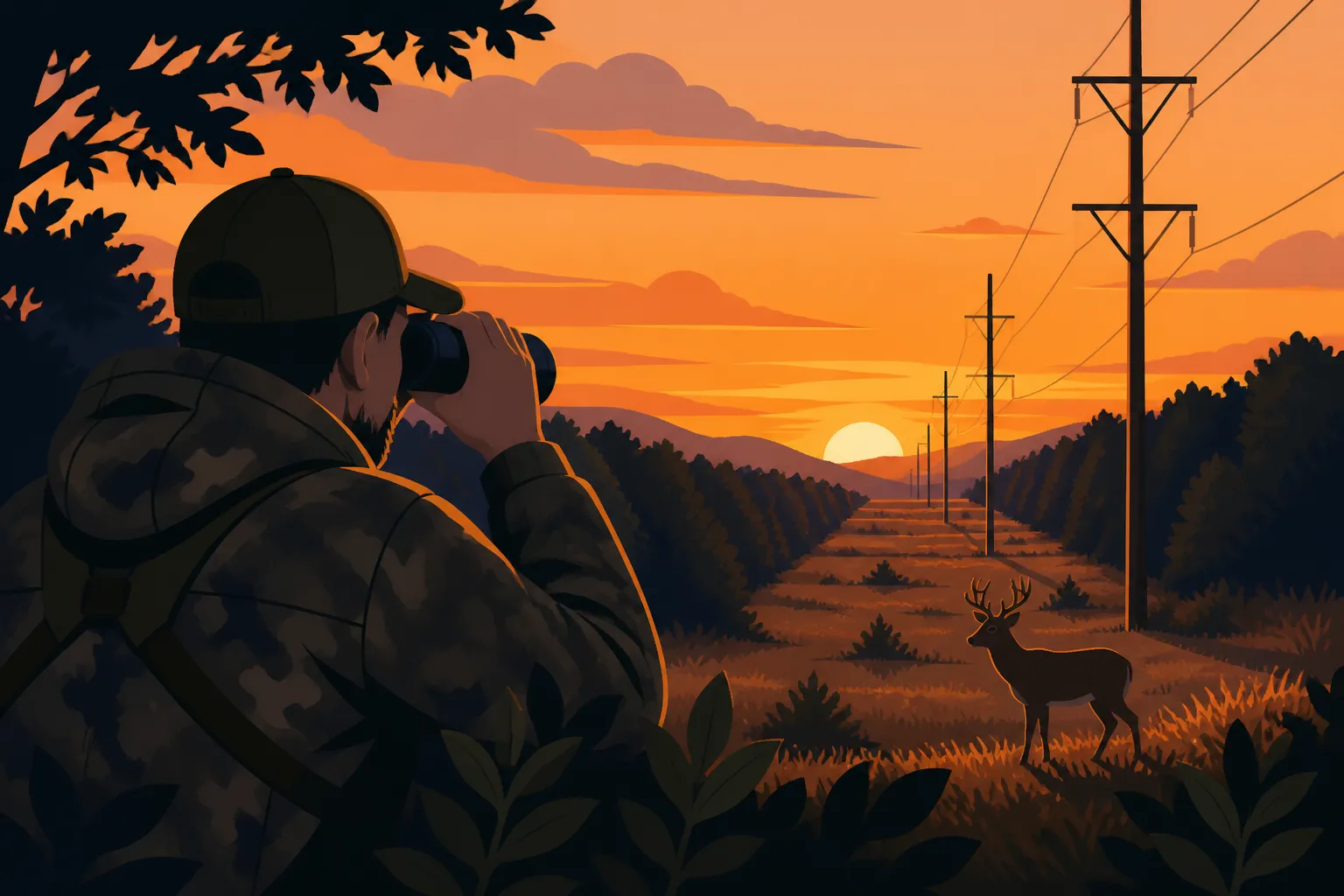
Glassing a Powerline Cut at Last Light
There’s nothing quite like the anticipation of that last hour of daylight in the Kentucky woods. You’ve sat patiently, maybe all day, and now the shadows are getting long, the air is cooling, and you can feel it in your bones: a deer is about to move. But often, those crucial moments are wasted staring into thick timber or a distant field edge, hoping to catch a glimpse. If you’ve ever found yourself frustrated, knowing deer must be there but unable to spot them, especially around those long, open powerline cuts, then this guide is for you. We're going to dive deep into how to effectively glass these promising corridors in Kentucky, revealing exactly how to spot those elusive whitetails as they emerge for their evening meal.
Understanding Powerline Cuts as Deer Magnets at Last Light
Powerline cuts might seem like scars on the landscape, but to a whitetail deer, they can be absolute havens and highways, particularly as evening approaches. These man-made clearings offer a unique set of advantages that deer are quick to exploit, making them prime real estate for hunters willing to put in the time to glass them effectively.
Why Deer Utilize Powerline Corridors
Think about it from a deer's perspective. These aren't just barren strips; they're often dynamic environments that blend security with sustenance, providing both cover and food sources right next to each other.
Deer are creatures of the edge. They thrive where different habitat types meet, and a powerline cut is essentially one long, continuous edge. You'll find thick woods on either side, providing crucial bedding cover, and then this open, often brushy strip in the middle. This transition zone is where deer feel secure enough to move, knowing that dense escape cover is just a few steps away. They're not going to stroll out into a wide-open pasture in broad daylight, but at last light, with the shadows playing tricks and their instincts kicking in, these edges become perfect travel lanes. They can creep along the treeline, just inside the timber, until they feel comfortable stepping out.
Beyond just being great travel corridors, many powerline cuts are also inadvertently fantastic food sources. Utility companies often clear these areas, preventing large trees from growing and interfering with the lines. This constant clearing promotes the growth of younger, browse-heavy vegetation. Think about all those tender shoots, briars, and forbs that spring up in disturbed soil—deer absolutely love them. In some areas, landowners or even the utility companies themselves might plant small food plots within these cuts, creating irresistible draws. Even if there are no cultivated plots, a good acorn crop year can see deer venturing into the cut to pick up what's fallen from oaks on the edge, or nibbling on available green shoots.
Finally, powerline cuts are often natural highways. They provide a clear, unobstructed path, connecting different blocks of timber or allowing deer to move between their bedding areas and larger agricultural fields. If you've been scouting and noticed deer using specific trails to cross from one woodlot to another, chances are a powerline cut might be part of that route. They can function similarly to how deer use Hunting a Funnel Between Two Hollows or even act as a subtle version of Entry Routes Through Standing Beans where deer have a clear path to follow. They’re less likely to get lost or disoriented, and the open nature allows them to scan for danger more easily than in thick timber.
The "Last Light" Advantage
The specific timing of "last light" isn't just a romantic notion for hunters; it’s a critical window that maximizes your chances of spotting deer in these open corridors. This is when deer feel the most confident to move, and when your strategic glassing can really pay off.
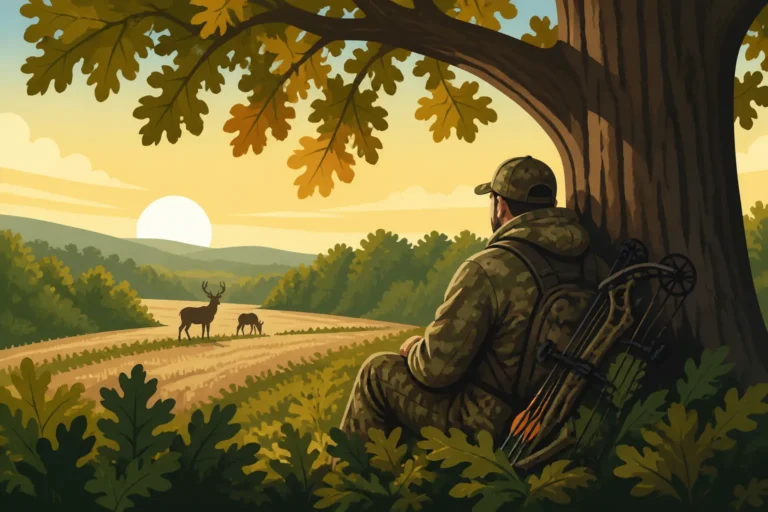
As the sun dips below the horizon, the entire deer herd seems to collectively take a deep breath and begin to stir. During the day, especially in heavily hunted areas of Kentucky, deer often remain bedded in thick cover, conserving energy and avoiding human disturbance. But as darkness approaches, their internal clocks tell them it's time to feed. This shift from daytime bedding to evening feeding is a predictable behavior, making last light a prime period for observation. They know they have a few precious minutes to fuel up before total darkness offers them full concealment for the night.
The lower light conditions, while challenging for human eyes, actually work in the deer's favor from a security standpoint. They rely heavily on their senses, and as visibility decreases, they feel less exposed. This encourages them to venture out into more open areas like powerline cuts where they might be hesitant during midday. However, this same low light also means you have to work harder to spot them. It's a delicate balance. What makes them feel safer also makes them harder to detect for us. Unlike trying to spot a deer within the dense cover of a Hunting a Standing Cornfield in Farm Country, where you might only see a flicker of an ear, in a powerline cut, you're looking for entire bodies, but they'll be camouflaged by the fading light and shadows.
This combination of deer becoming active and feeling secure in the fading light leads to fairly predictable movement patterns. They will often emerge from the densest cover along the edges of the powerline cut, often pausing and surveying the scene before committing to crossing or feeding within the open strip. By understanding where they're likely to emerge from (think thickets, saddles, or creek bottoms connecting to the cut), you can focus your glassing efforts and increase your odds exponentially. It’s not a random appearance; it’s a calculated, albeit instinctual, move.
Strategic Glassing Techniques for Powerline Cuts
Spotting a deer in a powerline cut at last light isn't about blind luck; it's about precision, patience, and a systematic approach. Just like any other hunting method, mastering glassing requires intentional technique.
Choosing the Optimal Vantage Point
Finding a powerline is one thing; finding the spot along that powerline to glass from is quite another. Your vantage point can make or break your success.
First, consider elevation and distance. The general rule of thumb for glassing is to get high for a better perspective. A slight rise, a subtle ridge, or even a small knoll overlooking the powerline cut can give you an invaluable advantage. From an elevated position, you can see over small rises, into dips, and scan a much wider area with ease. However, there's a sweet spot for distance. Too far, and even the best optics will struggle to resolve fine details in fading light, making it hard to distinguish a deer from a stump. Too close, and you risk bumping deer as they approach, or your silhouette might be too obvious. Experiment with distances—sometimes 200-300 yards is ideal, allowing you to cover ground while maintaining detail. You might find a spot on an Eastern Kentucky ridge that gives you a perfect view, much like when you're Reading a Ridge for Cumberland Deer.
Next, always factor in wind direction and the angle of the setting sun. Your scent is your biggest enemy. No matter how good your glassing technique, if the wind is carrying your scent directly into the powerline cut, deer will bust you long before you even know they're there. Always position yourself downwind or crosswind from where you expect deer to appear. The sun angle is equally important. At last light, the sun can be directly in your eyes or creating severe glare on the landscape. Try to position yourself so the sun is either at your back or off to the side, allowing you to glass without constantly squinting or being blinded.
Finally, the most effective vantage points are often discovered through diligent scouting beforehand. This isn't just about driving around and looking for powerlines. Use tools like the Kentucky Hunt Fish App or a mapping service like GoHunt, which can help you identify clearings, elevation changes, and potential bedding areas adjacent to the powerline. Look for bends in the cut, small side trails leading into it, or pinch points where the timber comes closer together. These are often natural travel corridors that deer will favor. Don't be afraid to walk the cuts during the offseason, looking for old tracks, droppings, and browse lines that indicate heavy deer use.
Effective Glassing Patterns and Patience
Once you're in position, it's not enough to just casually scan the area. To maximize your chances, you need a systematic approach and a healthy dose of patience.
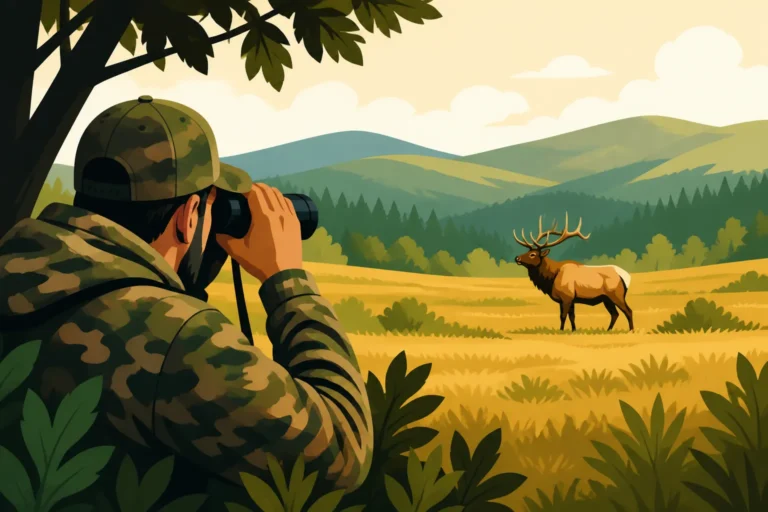
Start by implementing a grid search pattern. Instead of randomly sweeping your binoculars, break the powerline cut into smaller, manageable sections. Begin at one end, scan horizontally through a section, then drop your binoculars down slightly and scan back horizontally in the opposite direction. Repeat this until you've covered the entire area you intend to glass. This methodical approach ensures you don't miss anything, forcing your eyes to analyze every inch of the landscape. It takes discipline, but it's incredibly effective, especially as light fades and deer blend into their surroundings.
As you execute your grid search, pay extra close attention to the edges of the powerline cut and any areas of shadow. Deer, being wary animals, will almost always hug the thicker cover. They often step out from the treeline cautiously, sometimes only revealing a head, a shoulder, or an ear before committing. These edges are where you should spend most of your focused effort. Similarly, shadows are a deer's best friend. A small patch of dark timber, a shadowed dip in the terrain, or the long, raking shadows cast by the setting sun can perfectly conceal a deer. Learn to distinguish a deer's silhouette from the natural forms around it, even when obscured by diminishing light.
This brings us to the "blink test" and the power of repetitive scanning. Our brains are incredibly good at filtering out what they perceive as "unimportant" or static objects. What looks like a stump to a quick glance might, on closer inspection, be a deer. To combat this, slowly scan an area, then look away for a few seconds, then scan it again. Sometimes, seeing the same area with fresh eyes can reveal something you missed. Also, look for subtle movements: an ear twitch, a flick of a tail, the slight sway of a head as a deer browses. These tiny movements are often the first giveaways. Patience is truly key here; you might spend 20-30 minutes glassing a seemingly empty powerline cut only for a mature buck to materialize out of thin air. This is why having good Binocular Power for Ridge Hunting is crucial—you need to resolve those details.
Essential Gear for Low-Light Glassing Success
Effective glassing at last light demands more than just sharp eyes and patience; it requires the right tools. Investing in quality gear, particularly optics, will exponentially increase your chances of spotting those elusive deer.
Optics: The Heart of Last Light Glassing
When it comes to glassing, your binoculars are your most important piece of equipment. You need optics that excel in low light conditions, gathering as much available light as possible to present a bright, clear image.
For binocular selection, most experienced hunters will tell you that a 10×42 or 10×50 magnification is ideal for general hunting and especially for low-light glassing in Kentucky. The "10x" means it magnifies the image 10 times, and the "42" or "50" refers to the diameter of the objective lens in millimeters. A larger objective lens (like 50mm) gathers more light, which is crucial as the sun sets. While a compact 8×32 might be light, it simply won't perform as well in dim conditions. Quality glass, featuring coatings that reduce glare and maximize light transmission, will make a noticeable difference. Don't skimp here; this is where your money is best spent. When comparing 8×42 Versus 10×42 in the Woods, for example, the 10×42 often provides a great balance of magnification and light-gathering capability for open areas like powerline cuts.
To truly unlock the potential of your high-quality binoculars, especially during extended last-light sessions, a tripod and adapter are indispensable. Trying to hold binoculars steady for long periods, especially with higher magnification, leads to shaky images and eye fatigue. A lightweight tripod allows you to lock your optics onto a stable platform, eliminating shake and allowing you to discern subtle details that would be impossible handheld. You'll see things you never thought possible. Many reputable optics companies like Vortex, Leupold, and Maven offer excellent tripods and binocular adapters.
Finally, once you've spotted that deer, knowing its exact distance is paramount, especially as shooting light dwindles. This is where a reliable rangefinder comes in. Many modern rangefinders are designed with low-light performance in mind, offering illuminated reticles or red displays that are easier to see in dim conditions. You might have seen reviews on sites like GoHunt highlighting specific rangefinders that excel in these situations. Having that exact yardage allows you to make an ethical shot quickly and confidently, or decide if the shot is even feasible given the fading light.
Ancillary Gear for Comfort and Stealth
While optics are the star of the show, other pieces of gear contribute significantly to a successful last-light glassing effort, ensuring you remain comfortable, concealed, and ready for whatever the evening brings.
First and foremost, appropriate clothing is crucial. In the stillness of last light, sound travels far. Choose quiet fabrics that won't rustle or make noise as you shift or move your optics. Fleece, wool, or soft brushed synthetics are excellent choices. Layering is also important, as temperatures can drop significantly once the sun goes down, especially in Kentucky's fall and winter. Being cold and uncomfortable will inevitably lead to fidgeting and movement, which can spook deer. Having a system for Layering for a Kentucky Deer Stand will serve you well when glassing, allowing you to stay warm and still.
Next, consider a comfortable seating option. While a tree stand offers a great vantage point for glassing, if you're ground-based, a small, lightweight folding stool or a comfortable cushion can make hours of sitting and glassing much more tolerable. Discomfort leads to movement, and movement blows your cover. If your rear isn't numb, you're more likely to stay still and focused for those critical last minutes.
Finally, don't forget the small but mighty essentials: a wind checker and a headlamp. A small bottle of unscented powder or a puff bottle allows you to constantly monitor wind direction, ensuring your scent isn't inadvertently blowing towards the powerline. And as for the headlamp, well, walking out of the woods after dark without one is a recipe for disaster. Opt for a headlamp with a red-light setting, which preserves your night vision and is less likely to spook any remaining animals as you make your exit. A reliable Headlamps for Walking Out After Dark is a non-negotiable item for any serious hunter.
Interpreting Deer Behavior and Making Your Move
Spotting a deer is only half the battle. The real skill lies in interpreting its behavior, understanding its intentions, and knowing when and how to ethically engage, especially when the clock is ticking down to total darkness.
Identifying Key Deer Movements
Once you've got a deer in your sights, don't immediately reach for your bow or rifle. Take a moment to observe. Their initial movements can tell you a lot about their comfort level and what they're likely to do next.
The initial emergence of a deer into a powerline cut is almost always cautious. They’ll often pause right at the treeline, sometimes just their head or neck visible, ears swiveling, nose testing the wind, eyes scanning for danger. This is their moment of assessment. They want to be sure the coast is clear before fully committing to the open space. This is a critical time for you to remain absolutely still and continue glassing, as they might be looking directly in your direction. Don’t rush; let them make the decision to move forward.
Once they commit, observe their feeding patterns. Are they grazing quickly and nervously, constantly lifting their heads to scan, indicating they're on high alert? Or are they relaxed, taking their time, seemingly unconcerned? A relaxed deer might offer you more time to get into a shooting position or allow for a more precise shot. Pay attention to what they're eating; this can give you clues for future hunts on that specific powerline cut. For example, if they're hammering certain types of browse, you know what to look for next time.
Also, try to identify their likely travel routes within or across the powerline cut. Do they follow a specific faint trail, hugging one side more than the other? Are they heading towards a particular point where the cut narrows, or where there's another patch of woods on the other side? Understanding these routes can help you predict where they might emerge if you're unable to get a shot on the initial animal, or even inform future stand placements. Deer are creatures of habit, and their chosen pathways are often quite consistent.
Deciding When and How to Engage
The moment of truth in hunting a powerline cut at last light is deciding when and how to make your move. This requires a calm mind, an understanding of your capabilities, and a deep respect for the animal.
First, always prioritize waiting for the right opportunity. Don't let the fading light rush you into a bad shot. If the deer is still wary, or if its body position isn't ideal, patiently wait. Sometimes, a deer will move a few more steps, presenting a better broadside angle. Sometimes, another deer will emerge, distracting the first. If you have the luxury of time, let them get comfortable. If you're bowhunting, this might mean waiting for them to drop their head to feed, allowing you to draw undetected. If rifle hunting, it means waiting for that clear, confident shot. Never compromise ethical shot placement for a fleeting opportunity.
Second, be acutely aware of shot placement in low light conditions. As the ambient light decreases, contrast fades, and distances can become deceiving. Your aiming point might appear differently than it does in full daylight. Understand your own limits and the capabilities of your equipment. If it's truly too dark to confidently make a clean kill, then the most ethical decision is to pass on the shot. There will always be another opportunity. Remember that a clean kill is always the goal, and a marginal hit in near darkness is a recipe for a lost animal.
Finally, and perhaps most critically for a last-light shot, plan the recovery before you even take the shot. Mentally mark the exact spot where the deer was standing when you shot. Pick out a tree, a rock, or a unique feature directly in line with where it was. Then, pay attention to its reaction after the shot and listen for the sound of it crashing. If you hit it, resist the urge to immediately sprint after it, especially if it's getting dark. Give it time. An hour or two can make a huge difference in how far a wounded deer travels. Before you even head out, have a plan for Blood Trailing After Dark in Kentucky, including powerful flashlights, extra batteries, and possibly another person to help. Recovering an animal in the dark, particularly in challenging terrain like some of Kentucky’s eastern ridges, can be a daunting task, but it's an essential part of the hunt.
| Binocular Specification | Best for Low Light | Why it Matters |
|---|---|---|
| Objective Lens Diameter | 42mm – 50mm | Larger lenses gather more light, crucial in dim conditions. |
| Magnification | 8x – 10x | 10x provides good detail at distance without excessive shake; 8x is brighter and steadier handheld. |
| Exit Pupil | 4.2mm – 5mm | Calculated by (Objective Lens / Magnification). A larger exit pupil allows more light into your eye, making the image appear brighter. Your pupil dilates in low light, so you need a binocular that can deliver. |
| Glass Quality/Coatings | ED Glass, Fully Multi-Coated | High-quality glass and coatings reduce glare and maximize light transmission, giving you a clearer, brighter image with true color fidelity. |
| Field of View | Wider is Better | Easier to scan and locate deer quickly in a large area like a powerline cut. |
Disclaimer
The information provided in this article is for educational and entertainment purposes only. Hunting regulations and laws in Kentucky can change frequently. Always consult the official Kentucky Department of Fish and Wildlife Resources (KDFWR) regulations before planning any hunt. Ensure you have all required licenses and permits, and adhere strictly to all safety guidelines and ethical hunting practices. The author and publisher are not responsible for any accidents, injuries, or legal infractions that may occur.