Spot-and-Stalk Tactics for Pine Mountain Bears
Hunting bears, especially using spot-and-stalk tactics in Kentucky's rugged Pine Mountain region, can feel like trying to find a needle in a haystack while blindfolded and walking uphill. The dense cover, unpredictable thermals, and the sheer elusiveness of these incredible animals make it a challenge that often leaves even seasoned hunters scratching their heads. This guide is here to unravel the complexities, offering a deep dive into successful spot-and-stalk strategies tailored specifically for the unique environment of Pine Mountain, helping you understand their behavior, master your gear, and execute a successful hunt.
Understanding Pine Mountain's Bear Habitat
Pine Mountain isn't just any mountain; it's a unique geological feature in southeastern Kentucky, stretching for miles, presenting a formidable landscape for both bears and hunters. Its steep slopes, deep hollows, and dense vegetation create a perfect haven for black bears, but also present significant hurdles for anyone trying to pursue them. Knowing this terrain intimately is the first step in formulating an effective spot-and-stalk plan.
Topography and Cover for Bears
The topography of Pine Mountain is characterized by extremely steep grades and a mix of mature hardwood forests, interspersed with thick rhododendron and mountain laurel thickets. These rhododendron and laurel patches, often referred to as "rhodo hells" by locals, are incredibly dense and offer impenetrable cover for bears. They provide excellent bedding areas, escape routes, and nurseries for cubs, making them prime locations for bears to hide, especially when pressured. Hunters often find themselves staring at a solid wall of green, wondering how a bear could possibly move through it, let alone be spotted.
Beyond the dense undergrowth, massive rock outcroppings and crevices dot the landscape, offering natural dens and protection from the elements. Water sources, often in the form of small trickling streams and seeps within the hollows, are also crucial. Bears use these hollows as travel corridors, moving between bedding areas on the high ridges and feeding grounds. Understanding these natural highways and hideaways is paramount for identifying where a bear might be. The constant elevation changes also mean that wind and thermals behave uniquely, an aspect we'll delve into later. For hunters interested in broader opportunities, it’s worth noting that Pine Mountain State Forest Hunting offers excellent public access to this kind of rugged country.
Key Bear Food Sources by Season
Bears on Pine Mountain are highly opportunistic eaters, and their movements are largely dictated by the availability of food throughout the seasons. During the early fall, when bear seasons typically open in Kentucky, acorns are king. White oak acorns are particularly favored due to their lower tannin content, making them sweeter and more digestible. Bears will often focus their feeding efforts on ridge tops and benches where these oak stands are abundant. Observing where the white oak leaves are falling, or where signs of disturbance indicate heavy feeding, can pinpoint key areas.
As fall progresses into winter, if the season extends, bears will transition to other food sources. This might include persistent hard mast like red oak acorns (which drop later and are often saved for colder weather), or any remaining soft mast like wild grapes or blackgum berries, though these are typically exhausted earlier. When natural mast production is low, bears might move into lower elevations or areas bordering agricultural fields, if any exist near the mountain, to forage on corn or other crops. However, on Pine Mountain itself, the hunt truly revolves around the hard mast crops. Knowing what bears are currently feasting on is like having a secret map to their movements; for more on this, check out Hunting Bears Over Natural Mast in the Mountains.
Essential Gear for Spot-and-Stalk Bear Hunting
Spot-and-stalk bear hunting on Pine Mountain isn't a casual stroll. The terrain demands specific gear that will not only enhance your chances of success but also ensure your safety and comfort throughout the arduous process. Skimping on quality here can mean the difference between a successful stalk and a miserable, or even dangerous, outing.
Optics for Long-Range Scouting
When you're dealing with vast, steep mountain slopes and dense patches of timber, high-quality optics are your absolute best friend. You'll spend a significant amount of time perched on an overlook, glassing distant hillsides and hollows, meticulously searching for any sign of a black bear. A good pair of 10×42 binoculars is the minimum requirement, offering a solid balance of magnification and field of view. However, if you can swing it, a pair of 12x50s or even 15x56s will make a noticeable difference in resolving detail at extended ranges. Coupled with a sturdy tripod, you can spend hours scanning without fatigue, turning every rock and shadow into a potential bear.
Beyond binoculars, a quality spotting scope (20-60x magnification) becomes invaluable, especially for confirming what you think you're seeing at extreme distances. Is that dark blob a bear, a burned stump, or a patch of shadow? A spotting scope can often provide the clarity you need to make that call, saving you hours of wasted hiking. Look for optics with excellent low-light performance, as bears are often most active during dawn and dusk. Brands like Vortex, Leupold, and Swarovski are popular choices among serious mountain hunters for their clarity and durability. When you're planning your scouting trips, remember that resources like the Kentucky Department of Fish and Wildlife's (KDFWR) online maps can be enhanced by layering on private land boundaries, a feature often found in robust hunting apps like those from GoHunt, helping you identify public hunting areas and potential access points, which is crucial when planning your long-range glassing locations. For a deeper dive into choosing appropriate glass, consider reading Optics for Eastern Kentucky Ridges.
Footwear and Clothing for Rugged Terrain
Your feet will take a beating on Pine Mountain, so investing in proper footwear is non-negotiable. You need boots that provide exceptional ankle support, a stiff sole for navigating rocky terrain, and reliable waterproofing. Full-grain leather or durable synthetic mountaineering-style boots are ideal. Break them in well before your hunt to avoid blisters, which can quickly derail your efforts. Think about brands like Kenetrek, Schnee's, or Lowa, known for their rugged mountain performance.
Clothing must be layered, quiet, and capable of handling drastic temperature swings. The mornings can be crisp and cool, but a strenuous hike up a steep ridge can quickly have you sweating profusely. A wicking base layer, an insulating mid-layer (fleece or synthetic puffy), and a durable, breathable, and waterproof outer shell are essential. Avoid cotton entirely. Choose colors that blend with the natural environment – earth tones, greens, and browns. Quiet fabrics, like softshell or brushed fleece, are critical for the final stages of a stalk when stealth is paramount. Remember, Kentucky hunting regulations require blaze orange during certain firearms seasons, even for archery hunters, so check the specific dates for Kentucky Bear Archery Season Dates or Kentucky Bear Firearms Season Dates to ensure you're compliant. For more on what to wear, you can read Boots for Kentucky Hollows and Creek Bottoms.
Firearms and Ammunition Considerations
When selecting a firearm for bear hunting on Pine Mountain, reliability and knockdown power are paramount. While black bears are not typically aggressive, a wounded bear in dense cover can be a dangerous proposition. For rifle hunters, calibers like .30-06 Springfield, .300 Win Mag, .338 Win Mag, or even a robust .308 Winchester with appropriate bullet selection are excellent choices. The key is to use premium, heavy-for-caliber bullets designed for deep penetration and controlled expansion, such as Barnes TSX, Nosler Partition, or Swift A-Frame. Avoid light, frangible bullets that might break up on heavy bone.
Archery hunters pursuing bears will need to ensure their setup generates sufficient kinetic energy and momentum for deep penetration. A minimum draw weight of 50-60 pounds, coupled with heavy arrows (450+ grains) and sharp, fixed-blade broadheads, is generally recommended. Mechanical broadheads can be effective, but many bear hunters prefer fixed blades for their reliability in punching through thick hide and bone. Regardless of your weapon choice, practice extensively from various positions, including awkward angles that mimic real hunting scenarios on steep slopes. Your shot needs to be accurate and decisive. You can get more details about Rifle Calibers for Kentucky Bear.
Developing Your Spot-and-Stalk Strategy
Executing a successful spot-and-stalk hunt on Pine Mountain requires more than just good gear; it demands meticulous planning, an understanding of bear behavior, and an intimate knowledge of the terrain. This isn't a "wander and hope" kind of hunt; it's a chess match played across vast, rugged landscapes.
Pre-Season Scouting and Identifying Bear Sign
The work for a successful spot-and-stalk hunt often begins long before the season opens. Pre-season scouting is absolutely critical on Pine Mountain. You need to identify potential glassing points – high ridges or knobs that offer expansive views of hollows, benches, and opposite slopes. Use mapping tools, like the KDFWR's online maps or advanced platforms like GoHunt, to identify promising areas. Look for south-facing slopes, which tend to warm up earlier in the day, attracting bears looking to sun themselves, especially in cooler weather. Pay attention to natural travel corridors, such as saddles between ridges, old logging roads, or creek bottoms.
Once on the ground, search for fresh bear sign. This includes scat (its contents will tell you what they're eating), tracks in soft earth or mud, claw marks on trees (especially on beech trees where they climb for nuts), and disturbed ground under oak trees from foraging. You might also find rubbed trees where bears scratch their backs. Pay close attention to the freshness of the sign. Faded tracks or old scat mean the bear moved through some time ago, while glistening scat or fresh claw marks indicate recent activity. The more recent and concentrated the sign, the higher the probability of finding a bear in that vicinity. This diligent scouting will help you narrow down your search area when the season actually begins, making your spot-and-stalk efforts much more efficient.
Utilizing Wind and Thermals
The wind is always your enemy in spot-and-stalk hunting, but on Pine Mountain, thermals add an extra layer of complexity. Thermals are air currents created by temperature changes – air rising as it warms and falling as it cools. In mountainous terrain, cold air sinks into hollows at night and early morning, then rises up the slopes as the sun heats the ground during the day. This means your scent can be carried downhill in the morning and uphill in the afternoon, regardless of the prevailing wind direction.
To effectively spot-and-stalk, you must constantly monitor both the wind and the thermals. Use a wind checker (a small squeeze bottle with powder) frequently. Plan your approach routes carefully, ensuring that your scent is carried away from the bear's likely location. If you spot a bear feeding in a hollow in the morning, you'll need to approach from above, letting your scent drift down and away. Conversely, if you spot a bear on a ridge in the afternoon, you'll want to approach from below, utilizing the rising thermals. This constant chess game with the air currents is paramount, as a bear's nose is its primary defense. Ignoring wind and thermals will almost guarantee a busted stalk.
Patient Glassing and Movement
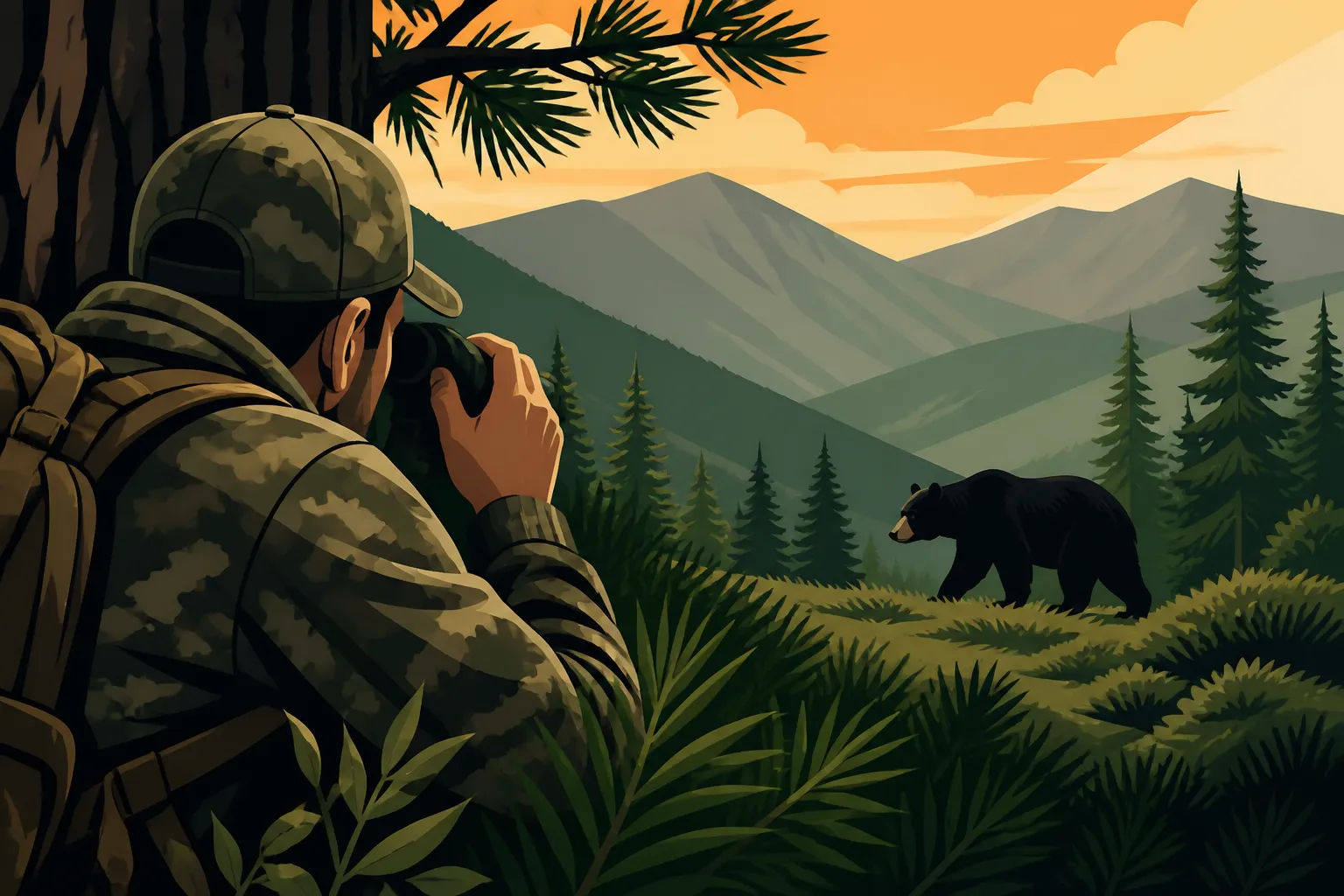
Spot-and-stalk hunting for bears on Pine Mountain is often 90% glassing and 10% stalking. Patience is absolutely vital. Find a good glassing point, set up your tripod and optics, and systematically pick apart the landscape. Don't just glance; scrutinize every dark patch, every shadow, every movement. Use a grid pattern to ensure you don't miss anything. Bears can appear surprisingly small and blend in incredibly well, even a large black bear can look like a stump or a dark rock. Look for subtle cues: a flicker of an ear, the shine of a wet nose, the distinct gait of a moving animal, or the tell-tale black shape against a lighter background.
Once you spot a bear, resist the urge to immediately move. Observe its behavior. Is it feeding, bedding, or traveling? What direction is it heading? How fast is it moving? Assess the terrain between you and the bear. Are there any natural features you can use for cover – a rise, a cluster of rhododendrons, a thicket of pines? Plan your route meticulously, always considering the wind and thermals. Your movement needs to be slow, deliberate, and quiet. Take one step at a time, checking for loose rocks, snapping twigs, or anything that could give away your position. Sometimes, waiting for the bear to move into a more favorable position or closer to a cover strip is the best strategy. Remember, the mountain is the bear's home turf; you are the intruder. Packing light but effectively is key for these long days, and a good resource for this is Packs for a Daniel Boone Forest Day Hunt.
Closing the Distance and Shot Placement
The final approach is often the most nerve-wracking and critical part of the stalk. As you get closer, every rustle, every breath feels amplified. Maintain a low profile, using all available cover. If the bear is feeding, try to time your movements with its head down. If it's walking, try to intercept it, or parallel its movement, slowly closing the gap. Keep checking the wind, as even a subtle shift can be disastrous. Once you are within your effective range, find a solid rest for your shot. This might be leaning against a tree, kneeling, or lying prone if the terrain allows.
Shot placement on a bear is crucial, more so than on a deer, due to their robust bone structure and thick fat and muscle layers. The primary target is the lung/heart area, which sits slightly further forward and lower than on a deer, directly behind the shoulder. Avoid shoulder shots unless you're confident in your firearm's power and bullet's penetration, as bears have dense bone and muscle there. A quartering-away shot can be excellent, aiming for the opposite shoulder. Take your time, control your breathing, and make a clean, ethical shot. If the bear moves before you can shoot, be patient. Another opportunity will likely present itself if you remain calm and still. For more specific information, consult Shot Placement on a Kentucky Black Bear.
Safety and Post-Harvest Considerations
Bear hunting, particularly in challenging terrain like Pine Mountain, comes with inherent risks. Being prepared for potential bear encounters and understanding how to properly handle a harvested bear in such an environment are just as important as the hunt itself.
Bear Encounter Preparedness
While black bears are generally not aggressive, understanding how to react during an encounter is vital for your safety. Most black bear "charges" are bluffs, designed to intimidate you into leaving. If a bear approaches or appears aggressive, make yourself look as large as possible, make loud noises, and slowly back away. Do not run, as this can trigger a chase instinct. Carry bear spray and know how to use it. It's a non-lethal deterrent that can stop an aggressive bear at close range and is highly effective. Keep it accessible, not buried in your pack.
If a bear makes contact or is truly attacking you, fight back aggressively. Target its face and eyes. This is different from a grizzly encounter, where playing dead is often recommended. In Kentucky, aggressive black bear behavior is rare, but being prepared mentally and with the right tools, like bear spray, is part of being a responsible hunter. Always hunt with a buddy if possible, especially in remote, rugged areas. Communication is key, and having someone to assist in an emergency or with tracking can be invaluable. Considering the remote nature of Pine Mountain, a robust first aid kit and knowledge of basic wilderness first aid are also prudent; for more on this, check out First Aid Kits for Remote Daniel Boone Forest Ground.
Field Dressing and Recovery in Steep Terrain
Harvesting a bear on Pine Mountain is a tremendous accomplishment, but the work is far from over. Field dressing a bear in steep, rugged terrain presents unique challenges. First, ensure the area is safe. Take a moment to recover from the adrenaline. Begin field dressing immediately to cool the carcass and preserve the meat. Bears have thick fat layers that retain heat, and rapid cooling is essential to prevent spoilage. If you're using the gutless method, it can be particularly effective in steep country, as it allows you to quarter the animal and pack it out without having to move the entire carcass. This method involves skinning and deboning the bear in sections.
Packing out a bear from a steep hollow can be an exhausting, multi-person job. Consider what gear you have to assist: a heavy-duty game bag to protect the meat, sturdy frame pack to carry heavy loads, and potentially a game cart for flatter sections if you can get one to the recovery site. If you're alone, you might have to make multiple trips. Mark your path with flagging tape or use your GPS to track your route. Remember to secure the hide and skull if you intend to have them processed. Knowing how to efficiently break down the animal will significantly lighten your load and reduce the number of trips required. For more specific tips on dealing with your harvest, consider Handling a Bear After the Shot. Kentucky's black bear population has shown impressive growth, and responsible harvesting and recovery contribute to healthy management practices, so remember to properly Kentucky Bear Checking Requirements as well.
Pine Mountain Bear Hunting Overview
| Aspect | Description | Key Challenge | Recommended Approach |
|---|---|---|---|
| Terrain | Steep slopes, deep hollows, dense rhododendron/laurel thickets, rock outcroppings. | Extreme physical exertion, limited visibility, unpredictable footing. | Prioritize physical fitness, sturdy boots, careful foot placement. Focus glassing on edges and open patches. |
| Bear Movement | Driven by seasonal food sources (primarily acorns in fall). Utilizes hollows as travel corridors, thickets for bedding. | Bears are elusive and blend well. Their movements can be hard to predict. | Extensive pre-season scouting for sign (scat, tracks, rubs) and food sources. |
| Optics Use | Essential for glassing vast distances, identifying bears, and confirming details in dense cover. | Fatigue from long glassing sessions, difficulty resolving small details. | High-quality binoculars (10x-15x) on a tripod, spotting scope. Use systematic grid patterns. |
| Wind & Thermals | Complex interaction of prevailing wind and daily thermal shifts (up/down slopes). Crucial for scent control. | Scent can be carried in unexpected directions, busting stalks. | Constant wind checking, understanding daily thermal patterns, planning approach routes accordingly. |
| Stalk Execution | Slow, deliberate, quiet movement using available cover. Patience to wait for opportune moments. | Dense cover, steep ground, and noise can give away position. | Take one step at a time, check footing, utilize natural cover, time movements with bear activity. |
| Post-Harvest | Field dressing and packing out a heavy animal from remote, steep locations. | Physical demands, risk of spoilage, navigation challenges. | Carry game bags, plan for multiple trips or help, use gutless method, know your egress route. Ensure proper cooling. |
Disclaimer
This guide is intended for informational purposes only and does not constitute official hunting regulations or legal advice. Hunting laws and regulations in Kentucky, particularly concerning bear hunting and specific areas like Pine Mountain, can change. Always consult the most current Kentucky Department of Fish and Wildlife Resources (KDFWR) regulations before planning and executing any hunt. It is the hunter's responsibility to know and follow all applicable laws. Be safe, hunt ethically, and respect the wildlife and the land.