Rifle Calibers for Kentucky Bear
Choosing the right rifle caliber for Kentucky black bear can feel like a daunting task, especially when you consider the sometimes-dense forests of the eastern part of our state and the sheer power these animals possess. You want to be confident that your chosen setup delivers an ethical, clean kill, and that means looking beyond just "big enough" to what truly performs in real-world hunting situations. This guide aims to clear up some of the confusion, helping you understand the factors that go into selecting an effective and responsible caliber for bear hunting here in Kentucky.
Understanding Kentucky Black Bear Biology and Shot Placement
Before we even talk about specific cartridges, it's absolutely vital to understand what you're hunting. Kentucky black bears are robust, powerful animals, and while they might not reach the sheer size of their Western cousins, a 300-pound bear is a formidable creature. They have thick hide, dense muscle, and often carry a substantial layer of fat, all of which can impede bullet penetration. This isn't like deer hunting where a marginal hit might still result in recovery; a poorly placed shot on a bear often means a long, arduous, and potentially dangerous tracking job, or worse, a lost animal.
The vitals on a bear – heart and lungs – are tucked relatively forward and low in the chest cavity, often protected by the shoulder bone. Unlike a deer where you might aim for the "crease" behind the shoulder, a bear's anatomy dictates a slightly different approach. Many seasoned bear hunters advocate aiming for the shoulder itself to break it down and anchor the animal, ensuring the bullet then drives into the vitals. This requires a bullet with good construction and enough energy to punch through bone and still penetrate deeply. Quartering-away shots can be effective, aiming to exit through the opposite shoulder, but broadside is generally preferred for a high-percentage shot. Recovering a bear from the steep, rugged terrain common in places like Pine Mountain or the Big South Fork region can be a monumental task, so dropping them close to the shot is always the goal. Understanding Shot Placement on a Kentucky Black Bear is paramount.
Bear Resilience and Tracking Challenges
One of the biggest differences between hunting bear and deer is their incredible resilience. A bear can take a significant hit and still travel a considerable distance, especially if adrenaline is pumping. Their thick fat layer can quickly plug up a wound channel, limiting blood trails, which are already notoriously difficult to follow in the leaf litter and undergrowth of Kentucky's bear country. You might find a spot of blood here and there, but don't expect the bright, consistent trails you sometimes get with a deer. This is why bullet performance, which we'll discuss, is so critical. You need a bullet that creates ample internal damage and ideally, a good exit wound for maximum blood trail potential, even if that trail is sparse.
Think about a scenario where you make a great shot, but the bear still runs 50 yards into a thick stand of rhododendron. If your bullet didn't expand properly or had insufficient energy, that 50 yards could become 500, or even turn into a recovery effort that spans days. That's a frustrating situation no hunter wants to face, both for the animal's sake and for the sheer physical effort involved. Utilizing tools like the GoHunt platform for pre-scouting and identifying potential escape routes or dense cover can really help you anticipate these challenges.
Typical Shot Distances and Environment
While some bear hunting might occur in more open areas, like reclaimed mine lands or clear-cuts, much of Kentucky's bear habitat is within dense hardwood forests or mountainous terrain. This means shots are often taken at relatively close ranges, perhaps 50-150 yards. However, an opportunity could present itself across a hollow or on a powerline right-of-way, pushing distances to 200-300 yards. Your chosen caliber needs to perform effectively across this range of distances. A bullet designed for deep penetration at close range might over-expand or shed too much weight at higher velocities, while a bullet built for long-range might not expand enough at lower velocities if the shot is close. This highlights the importance of matching your bullet to your chosen caliber and anticipated hunting conditions.
Minimum and Recommended Calibers for Kentucky Bears
Kentucky does not specify a minimum caliber for bear hunting, which means it falls under the general rules for legal firearms for big game. However, that doesn't mean every deer caliber is suitable for bear. Ethically, you want a cartridge with sufficient energy and bullet weight to ensure a humane kill. We're talking about putting down an animal that can weigh several hundred pounds and has a much tougher build than a whitetail.
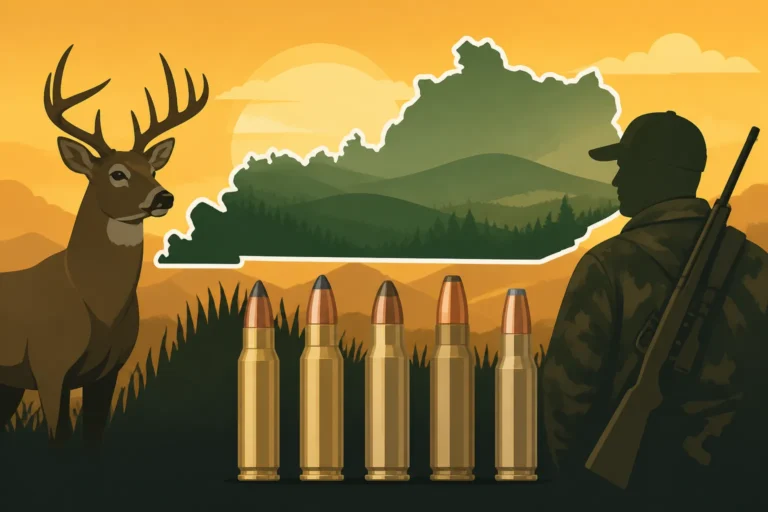
Generally, most reputable sources and experienced bear hunters recommend calibers that start around the .270 Winchester, but a bit more power is always a good idea. The real sweet spot tends to be calibers that start with .30 (like .30-06, .300 Win Mag) and move up from there. These calibers offer a good balance of energy, bullet weight, and availability of suitable projectiles.
Popular and Effective Calibers
- .30-06 Springfield: The venerable .30-06 is arguably the most versatile cartridge ever developed, and it's a solid choice for black bear. Loaded with 180-grain or 200-grain premium bullets, it delivers plenty of energy and penetration for Kentucky bears. It's widely available, recoil is manageable for most shooters, and it’s a proven performer in dense timber and across clearings. Many hunters already own a .30-06 for deer, making it an accessible option for their first bear hunt.
- .308 Winchester: Similar to the .30-06 but in a shorter action, the .308 Win with 180-grain quality bullets is also very capable. It's known for its accuracy and lighter recoil than many magnum calibers. For typical Kentucky bear hunting ranges, it's more than sufficient, especially when paired with a stout, controlled-expansion bullet.
- .300 Winchester Magnum: If you want more power and flatter trajectory for potentially longer shots, the .300 Win Mag is an excellent choice. It hits hard and drives bullets deep, making it a favorite for many bear hunters, especially those who might encounter larger bears or desire a bit more knockdown power. The trade-off is increased recoil and often higher ammunition cost, but it's undoubtedly effective. This caliber also crosses over nicely if you ever consider Rifle Calibers for Kentucky Elk.
- .35 Whelen: This is a fantastic, underrated caliber for bear. Essentially a .30-06 case necked up to accept .358 diameter bullets, it pushes heavy, large-diameter projectiles that hit like a hammer. It's excellent in thicker cover where shots are closer, providing deep penetration and a large wound channel. It's not as common, but if you have one, don't hesitate.
- 7mm Remington Magnum: The 7mm Rem Mag offers excellent ballistic performance, delivering good energy and a flat trajectory. With 160-grain or 175-grain bonded or monolithic bullets, it's more than capable of taking down a black bear cleanly. Like the .300 Win Mag, it does come with more recoil.
Calibers to Approach with Caution (or Avoid)
While smaller calibers like the .243 Winchester or 6.5 Creedmoor are fantastic for deer, they generally lack the bullet weight and kinetic energy needed for reliable bear hunting, especially with typical deer hunting bullets. They can kill a bear, of course, but the margin for error is significantly smaller, and the risk of a non-lethal wound or a very difficult recovery increases. We're aiming for ethical hunting, and that means choosing a caliber that gives you the highest chance of a quick, clean kill under varying circumstances. Remember, bears are not deer, and their biology demands more power.
| Caliber | Recommended Bullet Weight (Grains) | Pros | Cons |
|---|---|---|---|
| .30-06 Springfield | 180-200 | Versatile, widely available, proven performance, manageable recoil. | Not a "magnum," so slightly less energy than larger options. |
| .308 Winchester | 180 | Accurate, shorter action, good energy for typical ranges, moderate recoil. | Slightly less energy than .30-06, especially at longer distances. |
| .300 Winchester Magnum | 180-200+ | High energy, flat trajectory, deep penetration, great for larger bears. | Significant recoil, higher ammo cost. |
| .35 Whelen | 200-250 | Heavy-hitting, large wound channel, excellent for close/medium range. | Less common caliber, limited factory ammo choices. |
| 7mm Remington Magnum | 160-175 | Flat shooting, good energy, versatile for open terrain. | Increased recoil, may not offer the largest wound channel diameter. |
Bullet Construction and Performance
Choosing the right caliber is only half the battle; the bullet you load into that cartridge is just as, if not more, important for bear hunting. A bear's thick hide, dense muscle, heavy bone structure, and potential fat layer demand a bullet that can hold together, penetrate deeply, and still expand reliably to create a significant wound channel. Standard cup-and-core bullets designed for deer might fragment or shed too much weight upon impact with a bear's shoulder, leading to insufficient penetration.
This is where premium bullet construction truly shines.
Key Bullet Characteristics for Bear Hunting
- Controlled Expansion: You want a bullet that expands to about 1.5 to 2 times its original diameter but doesn't fragment excessively. Controlled expansion ensures a wide wound channel while retaining enough mass to penetrate deeply through tough tissue and bone. Look for bullets designed for "deep penetration" or "heavy game."
- Weight Retention: A bullet that retains most of its original weight after impact is critical for deep penetration. Bullets that shed a lot of weight lose momentum quickly and may not reach the vitals or create an exit wound.
- Bonded Cores or Monolithic Construction:
- Bonded bullets (like Federal Fusion, Remington Core-Lokt Ultra Bonded, Nosler AccuBond, Swift Scirocco II) have their lead core chemically bonded to the copper jacket. This virtually eliminates core-jacket separation, ensuring high weight retention and controlled expansion.
- Monolithic bullets (like Barnes TSX/TTSX, Hornady GMX, Federal Trophy Copper) are constructed from a single piece of copper. They expand by peeling back petals but retain virtually 100% of their original weight. They are known for exceptional penetration.
- Heavy for Caliber: Within your chosen caliber, opt for the heavier end of the bullet weight spectrum. For example, if you're shooting a .30-06, a 180-grain or 200-grain bullet will be a better choice for bear than a 150-grain. The heavier bullet will have more momentum for penetration and be less susceptible to deflection.
Think about it: you've spent countless hours scouting, preparing, and then finally drawn that coveted bear tag through the GoHunt application service. You certainly don't want to skimp on ammunition quality when the moment of truth arrives. A premium box of bullets might cost a bit more, but it's a small price to pay for a clean, ethical harvest. Whether you're hunting in the more accessible regions or venturing into the deep wilderness to find Kentucky's Black Bear Population, confidence in your ammunition is key.
Practical Considerations for Kentucky Bear Hunting
Beyond the ballistics and bullet choices, there are several practical aspects unique to hunting black bear in Kentucky that should influence your rifle and caliber decision. The terrain, typical shot opportunities, and the need for reliable performance under adverse conditions all play a role.
Terrain and Shot Distances
Kentucky's bear habitat, primarily in the eastern coalfields and Cumberland Mountains, is rugged. This means steep climbs, dense underbrush, and often limited visibility. As mentioned, shots can range from brush-busting close quarters to longer pokes across hollows or clear-cuts. Your rifle caliber needs to be effective at these varied distances. A heavier, slower bullet might be excellent up close, but drop off significantly over 200 yards, requiring precise range estimation. A fast, flat-shooting magnum might offer less drop, but its higher velocity can sometimes lead to excessive bullet fragmentation if it hits a shoulder bone at very close range, unless using premium monolithic or bonded bullets.
Consider the weight of your rifle setup as well. Trekking up and down mountains all day with a heavy magnum rifle and a substantial pack can wear you out quickly. While you need power, you also need a rifle you can comfortably carry and shoot accurately when fatigued. If you're physically fit and accustomed to a powerful cartridge, then a magnum might be a great choice. But if you struggle with recoil, a well-placed shot with a .30-06 or .308 will always be better than a flinch-induced miss with a .300 Win Mag. Planning your hunt, perhaps using the GoHunt mapping features to analyze topography and access, can help you visualize these scenarios.
Recoil Management and Follow-up Shots
Recoil is a factor that many hunters overlook, especially when caught up in the excitement of caliber selection. While black bears typically aren't going to charge unless provoked or wounded, having the ability to quickly get back on target for a follow-up shot is crucial. A bear hit hard might still bolt, and a second shot can make the difference between an immediate recovery and a lost animal. If you are flinching from excessive recoil, your accuracy will suffer, making both the first and subsequent shots less effective.
Choosing a caliber with manageable recoil for you is incredibly important. If a .300 Win Mag makes you anticipate the shot and flinch, you'll be far more effective with a .30-06 or .308 that you can shoot accurately and confidently. Practice with your chosen rifle and caliber is non-negotiable. Spend time at the range, not just punching paper, but practicing quick target acquisition and follow-up shots. Simulating real hunting scenarios will build your confidence and proficiency. This is especially true if you plan to hunt the rugged terrain covered in posts like Spot-and-Stalk Tactics for Pine Mountain Bears.
Ammunition Availability and Cost
While not directly impacting ethical killing power, practical considerations like ammunition availability and cost are worth mentioning. Common calibers like .30-06 and .308 Winchester are almost always available, and usually in various bullet configurations suitable for bear. More esoteric calibers, like the .35 Whelen, might require a special order or reloading. When you're planning a trip, especially to more remote areas within the bear zones like Kentucky Bear Zone One and Two Rules, you don't want to be scrambling for ammunition at the last minute. Stock up on your preferred premium loads and practice with them well in advance.
In the end, the "best" rifle caliber for Kentucky bear is the one you shoot most accurately and confidently, loaded with a premium, heavy-for-caliber bullet designed for deep penetration and controlled expansion. It's about combining sufficient power with precise shot placement to ensure a swift, humane harvest.
Disclaimer
This article is for general informational purposes only and does not constitute professional advice. Laws, prices and regulations vary by location and change over time. Consult a qualified professional for guidance on your specific situation.