Kentucky Record Book Bull Elk
Let's be honest: for many of us, the dream of hunting a record book bull elk in Kentucky feels a bit like chasing a unicorn. The odds are stacked against you, the applications are competitive, and the sheer size of the herd can be overwhelming. But that doesn't mean it's impossible. This guide is here to walk you through what it really means to pursue a true trophy bull in the Bluegrass State, from understanding the scoring systems to the grit and determination it takes to make that dream a reality.
The Allure of Kentucky Elk: East of the Mississippi Giants
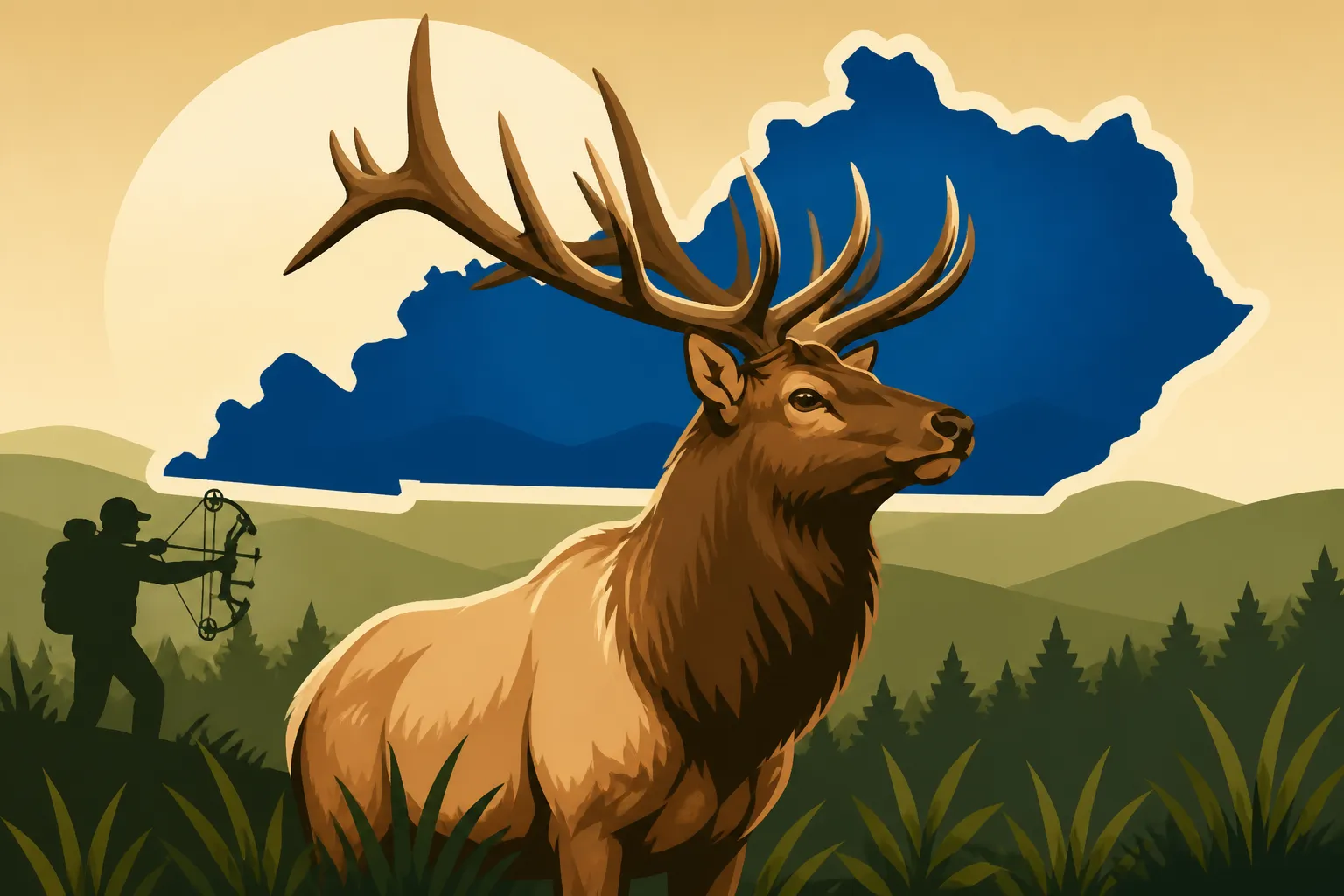
There's something truly majestic about a mature bull elk, a creature that embodies the wild spirit of the mountains. And in Kentucky, we have a herd that can stand toe-to-toe with some of the best in the West. It's a testament to incredible conservation efforts, and it draws hunters from all over, hoping to etch their name in the record books.
Why Kentucky Produces Such Impressive Bulls
Kentucky's elk story is nothing short of miraculous. Once extirpated from the state, our current population has rebounded from a reintroduction program to become the largest herd east of the Mississippi River. This isn't just a numbers game; it's about quality. The habitat in our southeastern coalfields, a mix of reclaimed mine lands, forested ridges, and fertile valleys, provides an ideal environment for elk to thrive. They have abundant food sources, from lush grasses to hard mast, which contributes to excellent body condition and, crucially, impressive antler growth.
The Kentucky's Record Elk Herd is carefully managed, focusing on herd health and providing opportunities for mature bulls to develop their full potential. It's a long-term strategy that has paid off, yielding some truly massive racks that make hunters' jaws drop. When you combine strong genetics with rich forage and strategic management, you get the perfect recipe for growing record-class animals. This success story is a point of immense pride for Kentucky hunters and conservationists alike.
The Realities of a Record Book Hunt: Beyond the Hype
Now, let's talk turkey – or rather, elk. While the dream of a record book bull is powerful, the reality is that these animals are exceptionally rare, and the opportunity to hunt them is even more so. The Kentucky Elk Quota Hunt Rules mean that a limited number of permits are issued each year through a lottery system. Thousands of hopeful hunters apply, vying for those precious few tags.
It's easy to get caught up in images of monstrous racks, but it's important to understand the sheer scale of the challenge. Drawing an elk tag in Kentucky, especially a bull tag, is a monumental feat in itself, with draw odds often being incredibly slim. Even if you're lucky enough to draw, finding a bull that meets record book criteria requires intense scouting, skillful hunting, and a good dose of luck. Don't let the low odds discourage you, but do approach it with realistic expectations. The true reward is often the journey, the time spent in the woods, and the pursuit of such a magnificent animal, regardless of its score. The frustration of applying year after year without success is a shared experience among many dedicated hunters.
Understanding Record Book Organizations and Scoring
Before you can chase a "record book" elk, you need to understand what that term actually means. There are specific organizations that keep these records, each with their own set of rules and minimum scores. These systems ensure that trophies are measured consistently and fairly.
Boone and Crockett Club: The Benchmark
When most hunters talk about a "record book" animal, they're usually referring to the Boone and Crockett Club. Founded in 1887 by Theodore Roosevelt, it's the oldest wildlife conservation organization in North America and sets the standard for fair chase hunting and big game trophy records. For elk, B&C differentiates between typical and non-typical antlers.
- Typical Elk: These are bulls with symmetrical antler growth, meaning that points and mass measurements on one side are very similar to the other. The scoring system rewards this symmetry. To qualify for the Awards minimum, a typical American elk needs a net score of 375 inches. For the All-time minimum, it's 360 inches.
- Non-Typical Elk: These bulls have abnormal points or significant differences between their left and right antlers. While some asymmetry is common, "non-typical" specifically refers to points that don't match or grow in unusual directions. The scoring system accounts for these abnormal points. A non-typical American elk needs a net score of 385 inches for the Awards minimum and 375 inches for the All-time minimum.
The scoring process is meticulous, involving numerous measurements of main beam length, circumference (mass), and individual point lengths. It's a net score, meaning deductions are made for any lack of symmetry on typical racks or for certain non-typical characteristics.
Pope and Young Club: Archery Excellence
For those dedicated archery hunters, the Pope and Young Club is the equivalent of Boone and Crockett. This organization maintains records exclusively for animals taken with a bow and arrow under fair chase conditions. Their scoring system mirrors that of Boone and Crockett, using the same measurements and distinctions between typical and non-typical.
The minimum scores for Pope and Young are slightly lower than B&C, acknowledging the unique challenges of harvesting an animal with archery equipment. For a typical American elk, the minimum score is 260 inches, while a non-typical needs 300 inches. Achieving these scores with a bow is a monumental accomplishment, requiring incredible skill, patience, and close-range precision. If you're serious about Bowhunting Kentucky's Long Archery Season and hoping for a record book elk, understanding these numbers is crucial.
Kentucky's Own Record Keeping: KDFWR Records
While Boone and Crockett and Pope and Young are national and international benchmarks, the Kentucky Department of Fish and Wildlife Resources (KDFWR) also keeps track of impressive harvests within the state. These state records often provide a more accessible view of top trophies taken by Kentucky hunters, and they can be a great resource for understanding the caliber of animals being harvested here.
KDFWR's records might include categories for various weapon types or other distinctions, offering a broader recognition for hunters who might not hit the national club minimums but still harvest an exceptional animal for the state. They typically maintain lists of top animals by county or year, which can be fascinating to explore and offer insights into where some of the biggest bulls have been taken. Always check the official KDFWR website or publications for the most current information on state-level records and recognition programs.
The Path to a Kentucky Record Bull: From Application to Harvest
So, you're ready to commit to the quest for a Kentucky record book bull. This isn't just about showing up with a rifle; it's a multi-year commitment that begins long before you ever step foot in the elk zone.
Navigating the Kentucky Elk Quota Hunt Application
The very first hurdle, and often the biggest, is simply drawing a tag. Applying for a Kentucky Elk Quota Hunt is an annual ritual for many hopeful hunters. You'll need to purchase an elk quota hunt application, and you'll choose the type of permit you're applying for (bull firearm, bull archery/crossbow, cow firearm, cow archery/crossbow).
The competition for bull tags is intense. We're talking thousands of applicants for only a few hundred permits. The system typically involves a preference point system, meaning each year you apply and aren't drawn, you accrue a point that theoretically increases your odds in future drawings. However, there's no guarantee, and many dedicated hunters apply for years, even decades, before getting a chance. This can be incredibly frustrating, especially when you feel like you're putting in the time and effort without seeing a return.
Resources like GoHunt can be invaluable for understanding draw odds, application strategies, and analyzing past results. They compile data that can help you make informed decisions about which hunt options to prioritize, though it's still ultimately a lottery. Be sure to mark your calendar for the Kentucky Elk Application Window Dates each year!
Scouting and Strategy for Trophy Elk
Once you beat the astronomical odds and actually draw a bull tag, the real work begins. Hunting the Hunting Kentucky's Elk Restoration Zone requires a deep understanding of elk behavior and the specific terrain of eastern Kentucky. This isn't flat farmland; it's rugged, steep, and can be physically demanding.
- Pre-Season Reconnaissance: Spend as much time as possible in your assigned unit before the season opens. Use mapping tools to identify potential bedding areas, feeding grounds, water sources, and travel corridors. Look for fresh sign: tracks, droppings, rubs, and wallows. Early scouting, especially through the summer and early fall, can reveal patterns of movement and where mature bulls might be hanging out.
- Understanding Elk Movement: Elk in Kentucky, like anywhere, are creatures of habit but can be easily pressured. They often feed in reclaimed mine lands or open clear-cuts during the early morning and late evening, retreating to dense timber on the steep north-facing slopes during the day. Learning to read the terrain for optimal ambush points or still-hunting routes is key. Glassing an Elk Restoration Zone Meadow from a distance at first and last light can give you critical intel without pressuring animals.
- Utilizing Technology: Modern mapping applications with satellite imagery and topographic overlays are essential. They can help you identify remote pockets of public land, understand elevation changes, and plan your entry and exit routes. Consider how features like powerline cuts, old logging roads, and changes in timber type might funnel elk.
In-Season Tactics for Challenging a Bull
When opening day finally arrives, having a solid strategy is paramount. Many hunters focus on the September archery season, hoping to catch bulls in the full swing of the rut when they are most vocal and susceptible to calling. The Kentucky Archery-Crossbow Elk Season Dates offer an incredible opportunity to experience bugling bulls up close.
- Calling Strategies: During the rut, calling can be highly effective. Understanding how to use bugle tubes, cow calls, and even rake sounds to mimic a rival bull or a receptive cow can draw a curious or aggressive bull into range. Be patient and listen intently. A solo hunter might focus on subtle cow calls and soft bugles, while a team of two can execute a "shooter/caller" strategy, with one person calling to pull the bull past the other. You can learn a lot from guides and experienced hunters about Calling a Southeastern Kentucky Bull Elk.
- Patience and Persistence: Elk hunting is rarely a quick affair. You might spend days covering ground, calling, and glassing without seeing a legal bull. Persistence is key. Don't be afraid to adjust your strategy if what you're doing isn't working. If you're drawn for the Kentucky Bull Firearm Elk Season Dates, remember that rifle hunting for elk often involves more long-range glassing and ambush tactics, as the rut behavior might be winding down.
- Ethical Shot Placement: When the moment of truth arrives, proper shot placement is critical, especially on an animal as large and tough as an elk. Know your weapon, practice regularly, and only take shots you are confident in. A wounded elk can travel a long distance through rugged terrain, making recovery extremely difficult. Carrying appropriate Elk Hunting Gear for Southeastern Kentucky, including a reliable rifle, is crucial. For firearms, consider Rifles Built for a Southeastern Elk Hunt that offer power and accuracy for varying distances.
After the Shot: Preserving Your Trophy and Reporting
Taking down a record book bull is an experience you'll never forget, but the work isn't over when the animal hits the ground. Proper field care is essential to preserve your trophy for scoring and to ensure the meat is handled well.
Field Care and Initial Preservation
An elk is a massive animal, and preparing it for transport and scoring requires considerable effort.
- Cooling the Meat: First and foremost, get the meat cooled as quickly as possible. Field dress the animal promptly. If you're deep in the backcountry, you might need to quarter the animal and pack it out using a frame pack. Even in cooler weather, elk meat can spoil if not properly cared for.
- Caping for a Mount: If you plan to get a shoulder mount (which is highly recommended for a record book animal), learn how to cape the animal properly beforehand. This involves making precise cuts to ensure the cape is large enough for the taxidermist. Keep the hide clean and cool. You'll want to take good care of that magnificent rack, too!
- Antler Preservation: Protect the antlers from damage during transport. Wrap them if necessary to prevent scrapes or breaks. A record book score depends on accurate, undamaged measurements.
Official Scoring and Documentation
After you've recovered your bull, there's a specific process for getting it officially measured for record books.
- Drying Period: Before an official score can be taken, the antlers must undergo a mandatory drying period, typically 60 days. This allows the antlers to stabilize, as they can shrink slightly after harvest due to moisture loss.
- Finding an Official Measurer: Both Boone and Crockett and Pope and Young have a network of official measurers. You'll need to locate one in your area. They are trained to perform the precise measurements required by the scoring systems. The measurer will fill out a score sheet, document all measurements, and take photos.
- Submitting for Review: The score sheet and accompanying photos are then submitted to the respective club for review. They will verify the score and determine if the animal meets the minimum criteria for inclusion in their record book. This final step confirms whether your hard-earned trophy is indeed a "record book" bull.
Celebrating and Sharing Your Achievement
Harvesting a record book bull in Kentucky is a truly remarkable achievement. It's the culmination of years of applying, dedicated scouting, physical exertion, and skillful hunting. Take the time to celebrate this incredible accomplishment.
Share your story with fellow hunters, friends, and family. It’s a moment of immense pride and a testament to your commitment to ethical hunting and conservation. Whether your bull makes it into the national record books or stands as a personal best, the memories forged in the rugged beauty of Kentucky's elk country will last a lifetime. This kind of success also highlights the incredible triumph of conservation efforts that have allowed How Many Elk Live in Kentucky Today to thrive once again.
Elk Record Book Minimums Comparison
To give you a clear picture of what "record book" truly means for American Elk, here's a comparison of the minimum scores required by the two primary record-keeping organizations:
| Category | Boone and Crockett (All-time) | Boone and Crockett (Awards) | Pope and Young (Archery) |
|---|---|---|---|
| Typical Elk | 360 inches | 375 inches | 260 inches |
| Non-Typical Elk | 375 inches | 385 inches | 300 inches |
Note: These are net scores, meaning deductions for asymmetry or certain non-typical characteristics are applied.
Disclaimer
This article is for general informational purposes only and does not constitute professional advice. Laws, prices and regulations vary by location and change over time. Consult a qualified professional for guidance on your specific situation.