Wind and Thermals on a Kentucky Ridge
There’s nothing quite as frustrating as feeling like you’ve done everything right—scouted your spot, found fresh sign, made a quiet approach—only to have a subtle shift in the wind or an unexpected thermal betray your presence and send a mature buck crashing through the timber. Hunting Kentucky’s rugged ridges means constantly battling unseen forces of nature, but understanding how wind and thermals behave can turn a challenging hunt into a successful one. This guide is all about demystifying those fickle air currents, giving you the knowledge to put yourself in the best position for success.
Understanding the Basics of Wind and Thermals in Kentucky
Kentucky's landscape, particularly the eastern and central regions with their undulating hills and steep ridges, creates a complex environment for air movement. It's not just about the weather app's wind direction; it's about how that larger atmospheric flow interacts with the very terrain you're hunting, combined with the often-overlooked power of thermals.
How Atmospheric Wind Works on a Ridge
When we talk about "wind," we're usually referring to the larger atmospheric flow driven by weather systems. On a flat plain, this might be fairly predictable. But introduce a Kentucky ridge line, and things get complicated fast. A steady west wind can hit the side of a ridge and get deflected, creating eddies, swirls, and even localized reversals in hollows and draws. Imagine a river flowing around a boulder—the water immediately behind and to the sides of the boulder will behave differently than the main current. The same principle applies to wind interacting with topography.
Ridge tops tend to experience the most consistent prevailing wind, but as you drop down into saddles or steep hollows, that wind can be broken up, accelerated, or even channeled. This is especially true in areas like the Daniel Boone National Forest, where dense timber can further disrupt air currents close to the ground. A stiff breeze predicted at 10 mph can feel like a gentle swirl just 50 yards down into a protected ravine, only to pick back up as you near the opposing ridge. This is why paying attention to localized indicators like swirling leaves, swaying small branches, or even carrying a puff bottle is absolutely critical, rather than relying solely on your weather app.
The Dynamics of Thermal Air Movement
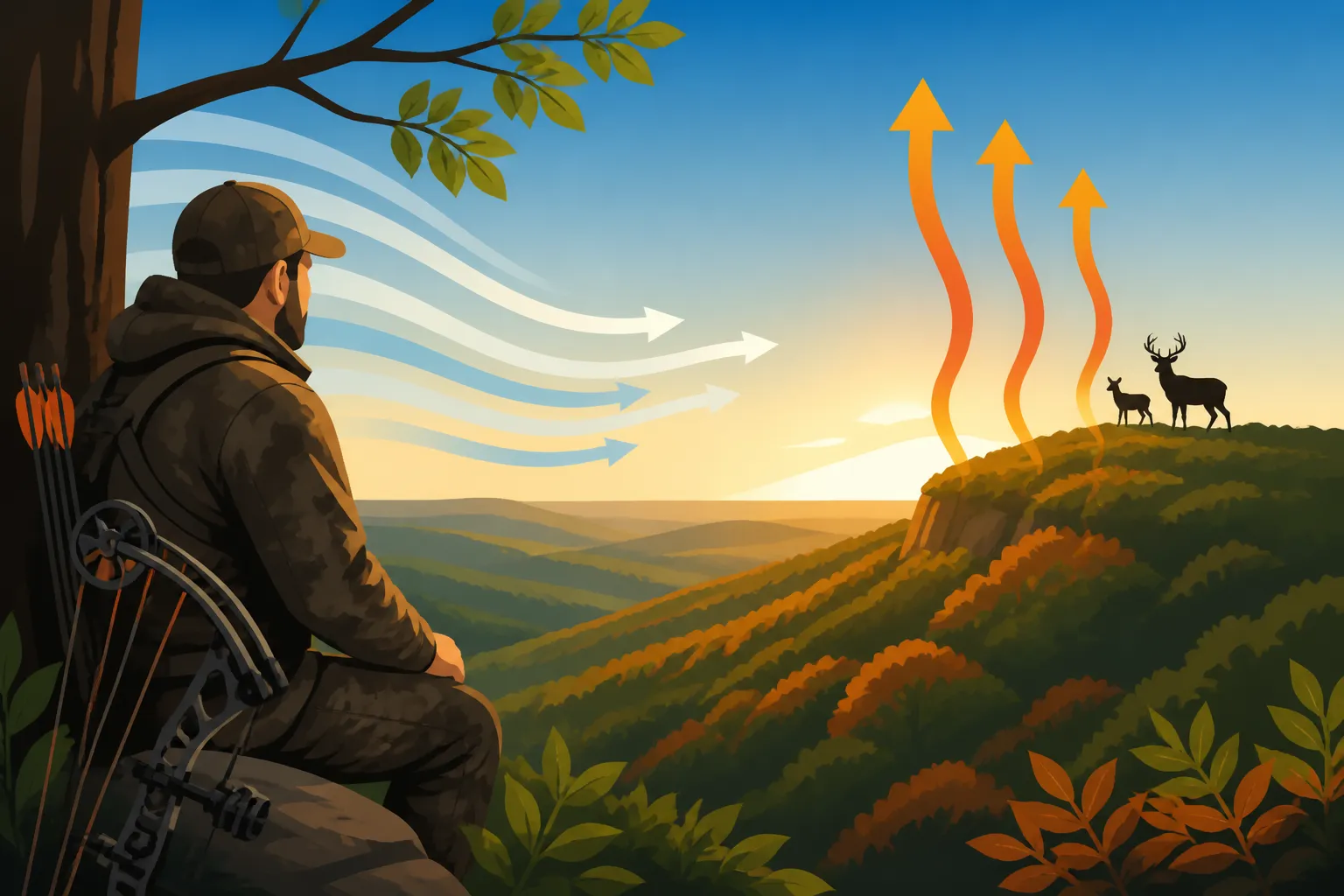
Beyond the broad atmospheric wind, there are thermals, which are entirely driven by temperature changes. Think of thermals as miniature, localized weather systems happening on the landscape. As the sun rises and heats the ground, the air near the surface warms up, becomes lighter, and begins to rise. This is an "up-draft" or "ascending thermal." Conversely, as the sun sets and the air cools, the denser, heavier air sinks, creating a "down-draft" or "descending thermal." These thermal flows are incredibly powerful on a ridge, often overriding the prevailing wind, especially during the early morning and late evening hours.
In Kentucky, where temperature swings between night and day can be significant, especially during the fall Bowhunting Kentucky's Long Archery Season, thermals are a dominant force. In the early morning, as the valley warms before the ridge tops, air will naturally climb the slopes. By evening, as the ridge tops and upper slopes cool faster than the hollows, that cool air will begin to drain downhill. Understanding this fundamental principle is key to knowing not just where a deer might be, but how your scent will travel to or away from it. Ignoring thermals is like hunting with half the information; it’s a gamble you usually lose.
Reading the Ridge: Predicting Air Movement
Successfully hunting a Kentucky ridge involves becoming a master observer of these invisible air currents. It’s about anticipating how the sun, temperature, and topography will conspire to move your scent. You can't control the wind or thermals, but you can learn to read them and use them to your advantage.
Morning Ascending Thermals and Your Approach
As dawn breaks and the sun begins to warm the eastern slopes of a Kentucky ridge, the air starts to get lighter and gently lift upwards. This ascending thermal can carry your scent straight up the hillside, even if the prevailing wind is blowing across the ridge. This is a critical factor when deer are often bedding high on the ridges or just below the crest, seeking security and a vantage point. If you’re trying to sneak into a morning stand that’s positioned too low on the ridge, an early ascending thermal will undoubtedly carry your scent directly to any deer above you.
To counteract this, your morning approach needs to be carefully planned. Ideally, you want to approach from below the deer, with the rising thermal carrying your scent away from their bedding areas, or at least parallel to them. Many seasoned hunters will try to get above their intended stand location before light, allowing the rising air to carry their scent away as they descend to their setup. If you're Hanging a Stand on an Eastern Kentucky Ridge, consider how the morning sun will hit it and how that will affect the initial thermal draw. This might mean taking a longer, roundabout route to get to a specific point, but the extra effort is almost always worth it to avoid spooking game right off the bat. Tools like GoHunt can help visualize topography and predict sun angles, aiding in these intricate approach strategies.
Evening Descending Thermals and Your Exit
Just as the sun warms the earth in the morning, its disappearance in the evening brings a rapid cooling, especially in shaded hollows and on north-facing slopes. As the air cools, it becomes denser and heavier, causing it to sink and flow downhill—a descending thermal. This downward flow is your best friend when hunting evening food sources located in valley bottoms or lower slopes. Deer will often work their way down to these areas to feed before returning to higher ground to bed.
When setting up for an evening hunt, aim for a stand that allows the falling thermal to carry your scent down and away from the likely deer travel routes and feeding areas below you. This often means positioning yourself higher on the ridge. However, you also need to consider your exit. Once you climb down from your stand, the descending thermal will continue to carry your scent downhill. If deer are moving up from feeding areas towards bedding, you risk busting them on your way out. A smart strategy is to exit along a ridge top or a side spur that keeps your downwind scent away from any remaining deer in the feeding area, or to wait until full dark when deer are more established in bedding areas, or to know that your path will carry your scent into an empty hollow. This is especially vital when Hunting a Ridge-Top Saddle for Rutting Bucks, where deer movement can be constant.
Navigating Mid-Day Swirls and Gusts
Mid-day on a Kentucky ridge is often the most challenging time for predictable air movement. The sun is high, and thermals might still be trying to rise, but the prevailing atmospheric wind usually takes over as the dominant force. However, even then, the wind rarely blows in a clean, consistent direction in broken terrain. Instead, you'll encounter a maddening array of swirls, gusts, and crosscurrents as the wind interacts with every fold, draw, and timber stand.
During these hours, a deer might bed in a location where the shifting winds provide a 360-degree scent cone, making them incredibly difficult to approach. This is where patience, acute observation, and sometimes, a more mobile strategy come into play. If you're committed to a mid-day sit, choose a stand location that has multiple wind advantages, or one that’s fairly exposed on a consistent ridge point where the prevailing wind might be less disturbed. Alternatively, this is a prime time for Still-Hunting Eastern Kentucky Ridges, carefully moving into the wind, constantly checking your puff bottle, and being ready to freeze or back out if the wind turns against you. Monitoring real-time wind conditions via a robust app like GoHunt can provide crucial updates, though always verify with your own observations on the ground.
Tactical Approaches for Hunting Kentucky Ridges
Armed with an understanding of how wind and thermals behave, you can start to develop more effective strategies for your hunts. It's not just about avoiding detection; it's about positioning yourself for the shot.
Stand Placement and Wind Advantage
Choosing the right treestand location isn't just about finding good sign or a clear shooting lane; it's fundamentally about exploiting the wind and thermals. On a ridge, ideal stand placement will usually involve being either above or to the side of expected deer travel, utilizing the thermals to your advantage. For morning hunts, consider stands higher up the ridge where rising thermals will carry your scent over bedding deer, or along a side ridge where your scent won't blow directly into a primary bedding area. For evenings, stands overlooking feeding areas from a higher elevation can leverage falling thermals.
Saddles, which are low points in a ridge line, are classic deer travel corridors and excellent places to hang a stand. However, they are also notorious for swirling winds because they channel air currents from both sides. When Hunting a Funnel Between Two Hollows or a saddle, you need to be acutely aware of thermals and prevailing winds. A general rule is to place your stand slightly off to the side of the direct saddle, preferably downwind of how you expect deer to approach it, so that your scent blows across the saddle rather than directly into it. Remember to always have multiple stand options or be willing to move quickly if conditions change. Using modern mapping applications can help you identify these key topographic features and plan your setup before you even step foot in the woods.
Scent Control and Adaptability
Even with the best wind and thermal strategy, maintaining meticulous scent control is absolutely paramount when hunting Kentucky deer. Deer have an incredible sense of smell, and any slight shift in air currents can bring your odor right to them. This means showering with scent-free soap, washing your hunting clothes in scent-free detergent, and storing them in airtight containers. Avoid filling your gas tank or grabbing a coffee in your hunting clothes. While no scent control regimen is 100% foolproof, it significantly reduces your footprint and gives you a fighting chance when conditions aren’t perfect.
Beyond scent control, adaptability is your greatest asset on a Kentucky ridge. Never be so committed to a single stand location that you ignore changing conditions. If the wind shifts unexpectedly, or you observe thermals doing something different than anticipated, be prepared to adjust. This might mean carefully moving to another stand, switching to a ground blind, or even taking up a still-hunting approach to slowly cover ground with the wind in your favor. Carrying a small, lightweight climbing stand or saddle setup can give you the flexibility to adapt on the fly. Regularly Scouting Kentucky Public Land Before Season with an eye for multiple setup options under different wind conditions will prepare you for these inevitable shifts. And remember, finding good Finding Sign in Big Daniel Boone Timber is only half the battle; knowing how to hunt it based on the wind is the other.
| Time of Day | Temperature Change | Thermal Movement | Best Hunting Strategy | Potential Risk |
|---|---|---|---|---|
| Pre-Dawn | Cooling | Descending | Approach low to mid-ridge | Scent carried down to valley deer |
| Morning | Warming | Ascending | Climb high, or approach from above stand | Scent carried up to bedding deer |
| Mid-Day | Peak Warmth | Swirling / Prevailing Wind Dominant | Still-hunting, adapt to localized swirls | Unpredictable scent zones |
| Evening | Cooling | Descending | Hunt high, overlooking low feeding areas | Scent carried down to feeding deer |
| Post-Sunset | Rapid Cooling | Descending | Exit along high ground or wait until full dark | Scent carried down to deer moving to bed |
Ultimately, successful hunting on Kentucky's diverse topography, whether you're focused on Treestand Setups in Daniel Boone National Forest or simply trying to get a deer to walk by your setup on a small private tract, hinges on your ability to work with, not against, the invisible currents of wind and thermals. Combining your knowledge of these forces with diligent scouting and sharp Optics for Eastern Kentucky Ridges will significantly elevate your chances of success.
Disclaimer
The information provided in this guide is for general educational and informational purposes only and does not constitute professional hunting advice. Hunting regulations and conditions can change rapidly. Always consult the most current Kentucky Department of Fish and Wildlife Resources regulations before planning any hunt. Safety should always be your top priority in the field.