Hanging a Stand on an Eastern Kentucky Ridge
The rugged, breathtaking landscape of Eastern Kentucky, with its steep ridges, dense timber, and winding hollows, presents a unique challenge for deer hunters looking to set up a treestand. It’s easy to feel overwhelmed, trying to figure out where to even begin in such vast, often unforgiving terrain. Many hunters spend countless hours in the woods, only to realize their stand placement is off, leading to missed opportunities and frustrating, deer-less hunts. This comprehensive guide is designed to empower you with the knowledge and practical strategies needed to confidently and effectively hang a stand on an Eastern Kentucky ridge, maximizing your chances for success.
Scouting for the Perfect Ridge Position
Before you ever carry a stand into the woods, the most critical step is diligent scouting. Eastern Kentucky deer are masters of their environment, and understanding their travel patterns is paramount. Your boots-on-the-ground efforts, combined with modern technology, will be your greatest allies in pinpointing that sweet spot.
Reading Topography for Deer Movement
Eastern Kentucky ridges are rarely uniform; they undulate, pinch, and fan out, creating natural pathways and obstacles for deer. Learning to "read" these topographical features is like understanding the language of the landscape. Deer, like us, prefer the path of least resistance, especially when navigating steep inclines and declines.
Look for natural funnels, which are narrow points where terrain features force deer movement into a concentrated area. A saddle, for instance, is a dip in a ridge that connects two higher points. Deer frequently use these saddles as travel corridors, especially during the rut when bucks are cruising for does. Imagine a buck moving from one ridge system to another; a saddle offers the easiest crossing point. Similarly, benches—flat, shelf-like areas that break up a steep hillside—are often used by deer to rest, feed, or travel horizontally without losing or gaining much elevation. These benches can act like highways for deer, providing excellent opportunities for stand placement. Creek bottoms, while not technically part of the ridge itself, can also serve as key travel routes, often funneling deer from lower elevations up onto the ridges. Identifying where these converge or run parallel to a ridge can be a game-changer. For a deeper dive into these nuances, you might find insight in articles discussing how to effectively read a ridge for Cumberland deer.
Identifying Key Sign and Travel Corridors
Once you've identified promising topographical features, it’s time to get down and dirty, looking for tangible evidence of deer activity. What you’re seeking isn’t just old tracks, but fresh, consistent sign that indicates current and regular deer movement.
Fresh rub lines, where bucks have scraped their antlers against trees, are clear indicators of recent activity, particularly in the pre-rut and rut phases. Pay attention to the size of the rubs and the direction they point; this can tell you a lot about the buck's travel route. Scrape lines, where bucks paw the ground, urinate, and sometimes rub overhead branches, are also invaluable. These serve as communication hubs for deer. Look for fresh dirt and a strong odor. Beyond rubs and scrapes, always be on the lookout for fresh tracks, especially along the edges of benches, saddles, and creek crossings. The freshest tracks, with crisp edges, indicate recent passage. Browsed vegetation, like nipped honeysuckle or young shoots, can point to current feeding areas. Remember, deer patterns can shift with food sources, so understanding how a poor acorn year might impact deer movement is also crucial. Finding consistent, fresh sign near a topographical funnel is often the perfect recipe for successful stand placement. Delving into finding sign in big Daniel Boone timber can further refine your scouting techniques.
Using Technology for Remote Scouting
In today’s hunting world, technology is an indispensable tool for efficient scouting, especially when tackling vast Eastern Kentucky terrain. Apps like onX Hunt and mapping services like Google Earth allow you to do significant pre-season work from the comfort of your home.
These platforms offer detailed topographical maps, satellite imagery, and public/private land boundaries, helping you identify potential stand locations before you ever step foot in the woods. You can mark waypoints for saddles, benches, creek crossings, and even potential bedding areas, creating a virtual game plan. The ability to overlay different map layers, such as timber cuts or historical aerial photos, can reveal changes in habitat that might influence deer movement. For instance, a clear-cut from a few years ago might now be dense young growth offering prime bedding cover, or it might have created new travel corridors along its edges. GoHunt is another excellent resource for planning, allowing you to visualize terrain and plan your approach routes, which is invaluable when dealing with the ruggedness of Eastern Kentucky. It helps you anticipate where deer might move based on the lay of the land, saving you precious time and effort once you’re in the field. Using the Kentucky Hunt Fish App can also provide valuable insights into specific WMA boundaries and regulations, further aiding your remote scouting efforts.
Choosing the Right Tree and Stand Type
Once you’ve identified a prime location, the next step is selecting the perfect tree and the right stand for the job. This decision depends heavily on the specific characteristics of the tree and your personal hunting style.
Evaluating Tree Health and Suitability
The tree you choose for your stand isn’t just a perch; it’s an integral part of your hunting setup and, more importantly, your safety. Always prioritize a healthy, living tree. Avoid dead trees, trees with obvious signs of disease, or those with significant dead branches that could break off, especially in high winds. The trunk should be sturdy and straight, particularly if you’re using a climbing stand. For hang-on stands and climbing sticks for Kentucky hardwoods, a reasonably straight trunk with minimal taper is ideal, allowing for a secure and level setup.
Consider the tree species as well. Smooth-barked trees like beech or some maples can be slippery, making climbing more challenging, especially in wet conditions. Trees with rougher bark, like oaks or hickories, often provide better grip for climbing sticks. The natural growth pattern of the tree itself can also offer crucial concealment. Does it have branches that will help break up your silhouette, or will you be exposed like a sore thumb against the sky? Look for a tree that blends in naturally with its surroundings and provides sufficient cover from approaching deer. Remember, the healthier and more suitable the tree, the safer and more effective your stand will be.
Pros and Cons of Different Stand Styles
Eastern Kentucky’s diverse terrain often calls for different stand strategies. There’s no one-size-fits-all answer, so understanding the strengths and weaknesses of each type is key.
Hang-on stands are incredibly versatile. They are generally lightweight, packable, and can be hung in almost any tree with enough girth and stability, making them perfect for irregular or limby trees where a climber wouldn't work. This versatility is a huge advantage when you're trying to set up in a very specific, high-traffic tree you've identified through scouting. However, they require separate climbing sticks or steps, adding to the gear you need to pack in and set up. They’re great for pre-set stands or for mobile hunters willing to invest the time in hanging sticks quietly.
Climbing stands offer unparalleled mobility and speed if you have the right tree. They are self-contained units, meaning you don't need separate climbing aids, which can be a huge time-saver. The downside is their strict requirement for a straight, limbless tree, which can be hard to find in some parts of Eastern Kentucky's dense timber. If you're hunting areas with mature, uniform trees, a climber can be incredibly efficient.
Saddle hunting has gained immense popularity for its ultra-lightweight and highly mobile nature. A saddle is essentially a harness that you wear, allowing you to lean into the tree rather than sit on a platform. This offers 360-degree shooting opportunities and makes you incredibly adaptable to various trees and hunting angles. Many hunters are discovering the benefits of saddle hunting in Kentucky hardwoods, finding it ideal for the steep, broken terrain where traditional stands might be too cumbersome. However, there's a definite learning curve to mastering a saddle, and it requires specific accessories like an aider, ropes, and a small platform or steps. Each stand type has its place, and the best choice often depends on the specific spot and your preferred hunting style. If you’re exploring various options, learning about different treestand setups in Daniel Boone National Forest can offer valuable perspectives.
Considering Accessibility and Packability
When you’re hiking into remote ridge country in Eastern Kentucky, every ounce of gear matters. The walk to your stand can often be long, steep, and grueling, making accessibility and packability crucial considerations.
A heavy, bulky stand might seem comfortable once you're in it, but the struggle of getting it there can quickly sap your energy and potentially compromise your hunt before it even begins. This is why many experienced ridge hunters opt for lighter, more modular systems. For example, a lightweight hang-on stand paired with compact climbing sticks or screw-in steps is often preferred over a heavy climber for long hauls. The noise factor during transport is another significant concern. Clanking metal or rattling parts can alert game long before you reach your desired location. Consider stands and climbing aids that are designed for quiet transport, perhaps with padded straps or sections that nest together securely. Think about your entire system: your stand, your climbing aids, your pack (like those durable packs for a Daniel Boone Forest day hunt), and even your boots for walking Kentucky ridges. The easier it is to carry, the quieter it is to deploy, the more enjoyable and successful your hunt will be.
Safety First: Ascent, Setup, and Beyond
No deer is worth a serious injury. Tree stand hunting, especially on steep Eastern Kentucky ridges, inherently carries risks. Prioritizing safety is not just good practice; it's non-negotiable.
Essential Safety Gear and Practices
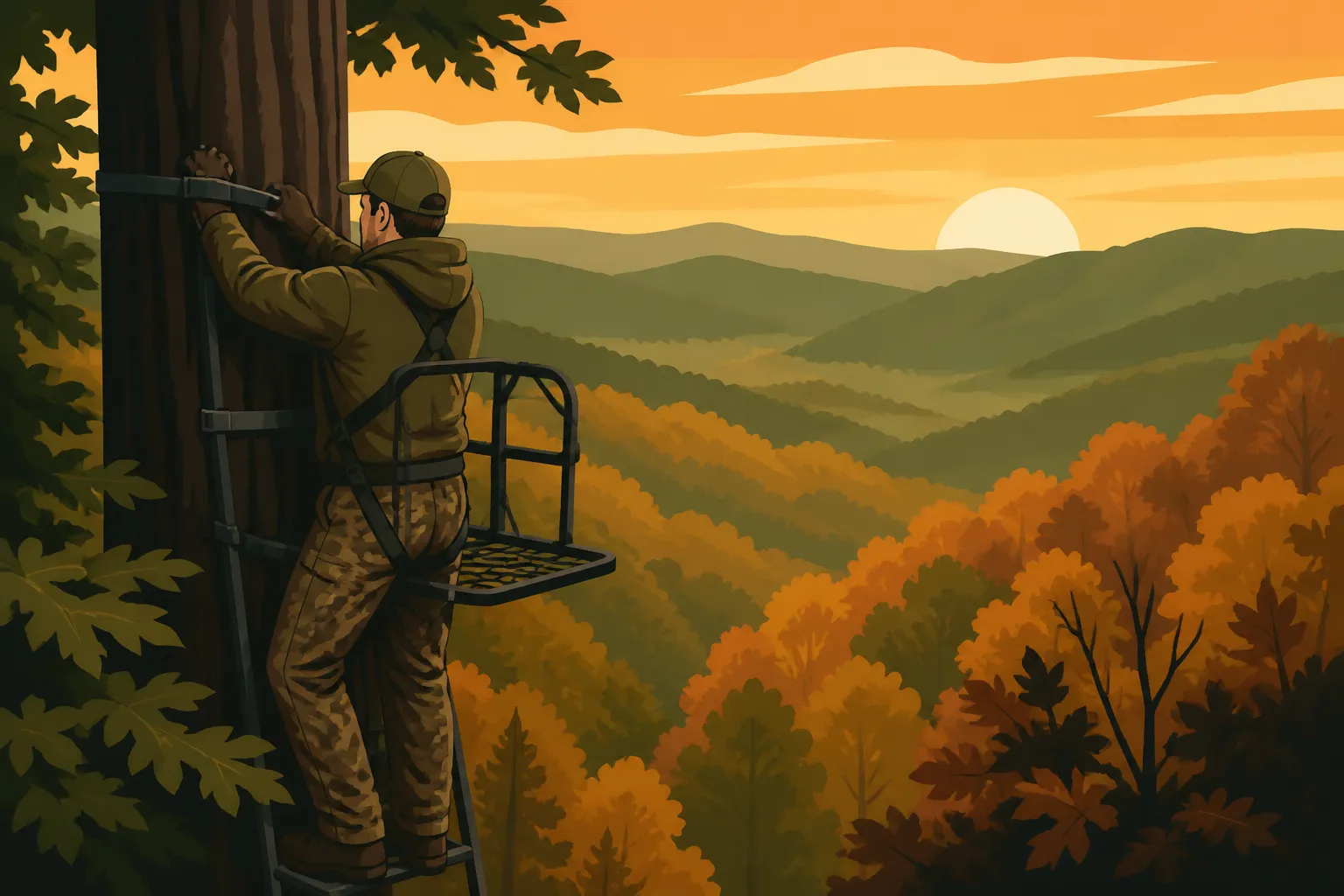
Before you ever leave the ground, ensure you are wearing a full-body harness that is properly fitted and inspected for wear and tear. This is your life support system, and it must be worn from the moment your feet leave the ground until they are safely back on it. Always use a lifeline or a safety rope system that tethers you to the tree during ascent, descent, and while you're in the stand. This continuous connection is paramount. A haul rope is also essential for raising and lowering your bow, firearm, and backpack once you are safely secured in your stand. Never climb with gear strapped to your back or in your hands.
Beyond the harness, carry a sharp knife, a small first-aid kit, and a reliable communication device (fully charged phone, satellite messenger, or two-way radio). Let someone know where you are hunting and when you expect to return. Before each use, thoroughly inspect your stand, climbing sticks, and all ropes and straps for any signs of damage or wear. Cracks, frayed ropes, or loose bolts are all red flags. Investing in quality treestand safety gear for steep ground is a small price to pay for peace of mind and, potentially, your life.
Pre-Season Setup Checklist
Many hunters make the mistake of trying to hang a stand for the first time on opening morning. This is a recipe for disaster. Pre-season preparation is key to a safe and effective setup.
First, practice using your stand and climbing method in a safe, low-to-the-ground environment. Get comfortable with the feel of your harness, the mechanics of your climbing sticks, and the process of securing your stand. This practice builds muscle memory and confidence. Second, use your remote scouting and on-the-ground reconnaissance to identify your precise stand location and your entry/exit routes. Walk these routes in daylight, noting any obstacles or noise-makers. Third, and perhaps most importantly, trim any necessary shooting lanes well before the season opens. Doing this quietly in the off-season prevents you from making noise and disturbing deer closer to your hunting days. Don't over-trim; only remove branches that directly impede a shot. Finally, double-check all your stand components, straps, and bolts. Ensure everything is tight, secure, and ready for deployment. This pre-season checklist minimizes risk and maximizes your hunting efficiency once the season arrives.
Dealing with Steep Terrain Challenges
Eastern Kentucky ridges are beautiful but can be brutally steep, posing unique challenges for stand placement and safety. The ground beneath your climbing sticks might be severely angled, making it difficult to get a stable footing.
When placing climbing sticks, prioritize secure attachment points and ensure each step is level and firmly in place before you put your weight on it. You might need to use adjustable length sticks or strategically angle them to compensate for the terrain. Be mindful of fatigue, especially on long climbs. Pushing yourself too hard can lead to mistakes. Take breaks, stay hydrated, and know your limits. Recovering a deer from a steep hollow can be a monumental task, let alone a fall from a treestand in such terrain. If you feel uncomfortable or unsafe at any point, descend and reassess. There’s no shame in moving to a safer, albeit less ideal, tree. Sometimes, the safest stand might be a ground blind brushed in strategically, especially if the terrain truly prohibits a secure treestand setup. Always evaluate the risks carefully and choose safety over a perceived "perfect" spot.
Optimizing Your Stand for Success
Once your stand is safely and securely hung, it's time to refine your setup to ensure it maximizes your chances of encountering and harvesting a deer.
Concealment and Shooting Lanes
Even a perfectly placed stand on a high-traffic ridge won't do you much good if you're silhouetted against the sky or can't get a shot off. Effective concealment is about more than just wearing camouflage; it's about blending into your environment.
Choose a tree that provides natural cover from branches and foliage. Aim to break up your outline against the backdrop of the woods, rather than being starkly visible against an open sky. You might need to climb a little higher or position your stand slightly off the main ridge crest to achieve this. When it comes to shooting lanes, the goal is clear lines of sight to where you expect deer to travel, without removing so much cover that you become exposed. Trim only what is absolutely necessary – a few key branches can make all the difference. Think about your primary shooting lanes, typically along the most likely travel routes, but also consider secondary angles in case a deer approaches unexpectedly. Remember that leaves will fall as the season progresses, so what offers great cover in September might leave you exposed in November. Be prepared to adapt, or choose a spot with natural evergreen cover if available.
Wind Direction and Thermals
In Eastern Kentucky's hilly terrain, understanding wind direction and thermals isn't just important; it's absolutely critical. Unlike flat land where wind might be more predictable, ridges create complex air currents.
Thermals are localized air currents caused by temperature differences. As the sun rises and warms the land, air on the ridge tops begins to rise, carrying your scent upwards. This is called an "updraft." In the evening, as the sun sets and the air cools, the air begins to fall down the hollows, creating a "downdraft" that carries your scent downwards. Ignoring these forces is a surefire way to get busted by keen-nosed whitetails. You must position your stand so that your scent is carried away from known or suspected deer travel routes and bedding areas. A stand that's perfect for a morning hunt with an updraft might be completely wrong for an evening hunt with a downdraft. Apps like GoHunt often include weather overlays that can help you anticipate wind direction and thermal movement throughout the day. Always factor in these complex air currents when deciding your precise stand location and when to hunt it. For a more detailed understanding of these phenomena, consider reading about wind and thermals on a Kentucky ridge.
Entry and Exit Strategies
Your hunt begins and ends long before and after you step into and out of your stand. A poorly planned entry or exit can spoil an otherwise perfect stand location.
The goal is to approach and leave your stand as quietly and stealthily as possible, without alerting deer. This means planning a route that avoids known bedding areas, high-traffic corridors, or areas where deer are likely to be feeding. Often, following creek bottoms or hidden folds in the terrain can provide a concealed path. Think about using natural barriers or thick cover to mask your movement and sound. During your entry, if you're hiking in before dawn, move slowly and deliberately, keeping noise to an absolute minimum. Similarly, your exit should be just as quiet, especially if you’ve had a successful hunt and are trying to avoid disturbing other deer in the area. Always consider how your chosen entry and exit routes align with the prevailing wind and thermals. Your ability to get in and out undetected is just as important as the quality of your stand location itself. This often involves scouting Kentucky public land before season to identify the quietest and most concealed routes.
| Stand Type | Pros | Cons | Ideal Eastern KY Terrain/Scenario |
|---|---|---|---|
| Hang-on | Versatile, lightweight, quiet to set up | Requires climbing sticks/steps, more complex setup | Irregular, limby trees; specific hot spots; mobile hunting |
| Climbing | Self-contained, fast setup, simple to use | Limited to straight, limbless trees; bulkier | Mature, uniform timber; quick setup on the fly |
| Saddle | Ultra-light, 360-degree shooting, mobile | Learning curve, requires accessories, not for sitting | Steep, varied terrain; ultimate mobility and adaptability |
| Ground Blind | Very versatile, weather protection, conceal | Limited sight lines, deer can spot easily, bulky to move | Flat benches, field edges, thick cover; less physical setup |
Disclaimer
Hunting carries inherent risks, and it is the responsibility of each individual hunter to understand and follow all applicable laws, regulations, and safety guidelines. The information provided in this guide is for informational purposes only and should not be considered a substitute for professional instruction or personal judgment. Always prioritize safety and consult with local wildlife agencies for the most current rules and regulations.