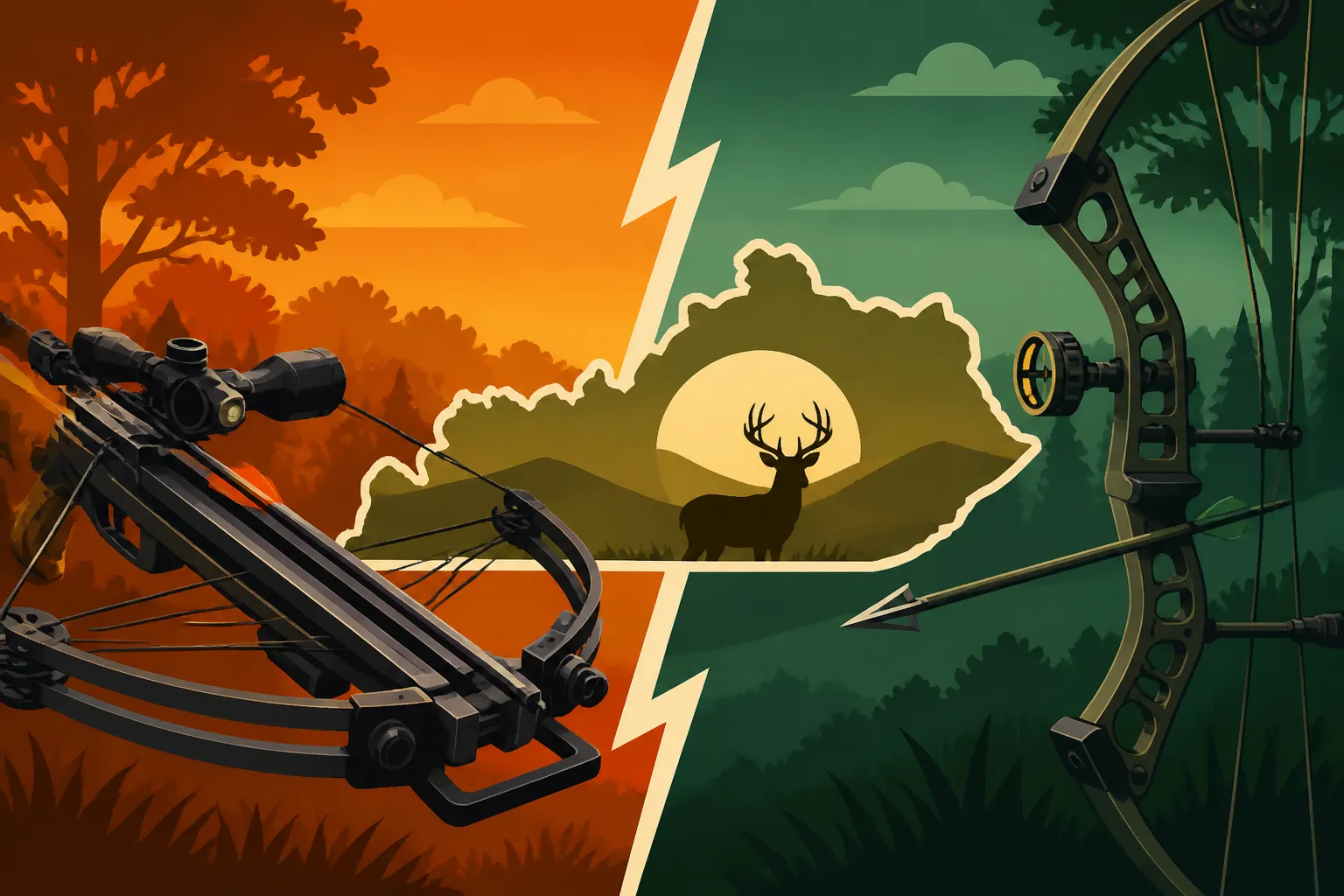
Crossbow Versus Vertical Bow in Kentucky
Choosing the right archery equipment for deer hunting in Kentucky can feel like a really personal decision, and honestly, a bit of a debate among hunters. Whether you're a seasoned veteran or just getting started, deciding between a vertical bow and a crossbow involves weighing personal preference, physical ability, and hunting style. This comprehensive guide aims to cut through the noise, helping you understand the regulations, the pros and cons of each, and ultimately, which might be the best fit for your next hunt in the Bluegrass State.
Understanding Kentucky's Regulations for Bows and Crossbows
One of the biggest questions new hunters, or those transitioning from firearms, often have is about the legality of their archery choice. Kentucky's Fish and Wildlife Resources (KDFWR) makes things fairly straightforward, but it's always good to understand the specifics so you're never caught off guard in the field.
Legal Definitions and Season Structure
In Kentucky, the KDFWR defines an "archery equipment" as a longbow, recurve bow, or compound bow capable of shooting a legal hunting arrow. A "crossbow" is defined separately, but crucially, both are generally legal to use during the statewide archery deer season. This is fantastic news because it means you have flexibility in your choice of weapon without being restricted to different season dates.
The statewide archery season for deer in Kentucky is famously long, often opening in early September and running all the way through the third Monday in January. This expansive window means you can literally chase whitetails from the scorching heat of early fall right into the frigid depths of winter. What's particularly welcoming is that you don't need a special permit to use a crossbow; if you have your standard Kentucky deer permit, you're good to go, whether you prefer a compound bow or a crossbow. This really simplifies things, allowing hunters to focus more on strategy and less on complex permit acquisition. If you're wondering about the exact start, you can check when Kentucky's Archery Season Opens.
Specific Requirements and Restrictions
While Kentucky is quite permissive regarding the use of both vertical bows and crossbows, there are still some fundamental requirements that hunters must adhere to. For all archery equipment, including both vertical bows and crossbows, the arrow or bolt must be at least 20 inches long. This rule is in place to ensure ethical hunting practices and effective energy transfer. Furthermore, the broadhead must be a fixed-blade or mechanical broadhead with at least two sharp cutting edges and a minimum cutting diameter of 7/8 inch. These specifications are designed to promote quick, humane harvests, which is paramount in ethical hunting.
Another critical regulation to remember, especially if you're on public land, is the requirement for hunter orange. During modern gun seasons or any firearms deer season, all hunters, even those using archery equipment, must wear hunter orange. However, during the standalone archery seasons when no firearms deer seasons are open, hunter orange is not required for bow or crossbow hunters. Always double-check the current year's regulations because these details can change. Many experienced hunters rely on mapping apps like GoHunt to quickly reference regulations and check land boundaries before heading out, ensuring they stay compliant with all state rules. This kind of preparation is crucial for a smooth and legal hunt. For more specific information, you might want to review Kentucky Crossbow Rules During Archery Season.
The Vertical Bow: Pros, Cons, and Hunting Scenarios
The vertical bow, encompassing traditional longbows, recurves, and modern compound bows, holds a special place in the hearts of many hunters. It represents a deep connection to the hunt, emphasizing skill, patience, and close-range engagement.
Advantages of Vertical Bowhunting
There's an undeniable satisfaction that comes with successfully harvesting an animal with a vertical bow. It's often seen as a more challenging pursuit, demanding a higher degree of physical and mental discipline. The journey from practice range to a successful hunt with a vertical bow builds a unique set of skills. You learn about shot placement, judging distance instinctively, and controlling your nerves when a deer steps into range. The physical act of drawing and holding a compound bow, or the fluid motion of a recurve, creates a profound link to the animal and the environment.
Another significant advantage is the generally lighter weight and more compact nature of most vertical bows compared to crossbows. This makes them incredibly portable, especially when you're still-hunting Eastern Kentucky Ridges or navigating dense thickets. You can maneuver through brush more easily, reducing the chance of snagging your equipment. Plus, the minimal mechanical noise of a vertical bow, especially a well-tuned compound, often gives you a slight edge in close-quarters encounters, allowing for a quieter draw and release that might not spook a wary buck.
Challenges and Considerations for Vertical Bows
Let's be real, vertical bowhunting isn't for everyone, and it comes with its own set of hurdles. The most prominent is the steep learning curve and the significant commitment to practice. Achieving proficiency with a vertical bow requires consistent practice, often year-round, to develop muscle memory, form, and accuracy under pressure. This isn't just about hitting a target; it's about doing it consistently, quietly, and accurately from various positions in the field. If you don't have the time or dedication for this kind of rigorous practice, frustration can quickly set in.
Physical demands are also a key factor. Drawing and holding a compound bow at full draw, even with let-off, requires a certain level of strength and endurance. This can become particularly challenging in cold weather when muscles are stiff, or after sitting for hours in a treestand. Illness, injury, or simply the natural aging process can make vertical bowhunting physically taxing, leading some hunters to explore other options. Furthermore, the effective range of a vertical bow is generally much shorter than that of a crossbow or firearm. Most ethical bowhunters limit their shots to within 40-50 yards, which demands greater stealth and patience to get deer into tight windows. If you're interested in the power required, you can read about the Minimum Draw Weight for Kentucky Deer.
Ideal Kentucky Hunting Scenarios for Vertical Bows
Vertical bows truly shine in situations where close-range encounters and stealth are paramount. If you love the challenge of getting within spitting distance of a whitetail, a vertical bow is probably your preferred tool. They are excellent for hunting dense timber, thick creek bottoms, or areas with heavy cover where shot distances are naturally short.
Imagine setting up a well-brushed ground blind on a pinch point where deer funnel through a dense woods. Or perhaps you’re using a quiet treestand setup in Daniel Boone National Forest, perched above a scrape line along a logging road. In these scenarios, the quiet operation and compact nature of a vertical bow give you the advantage. They are also fantastic for still-hunting, slowly moving through the woods, picking apart cover, and drawing on a deer before it knows you're there. The thrill of a close-range shot, especially during the peak of the rut in early November, is what keeps many vertical bowhunters coming back year after year.
The Crossbow: Pros, Cons, and Hunting Scenarios
Crossbows have exploded in popularity over the last decade, and for good reason. They offer a blend of rifle-like accuracy with the challenge of archery, making them a fantastic option for a wide range of hunters.
Benefits of Crossbow Hunting
One of the most compelling advantages of a crossbow is its accessibility. For hunters who may have physical limitations that prevent them from drawing a vertical bow, or for those new to archery, a crossbow offers an easier entry point. It requires less upper body strength to operate, as the bow is cocked mechanically, and the string is held at full draw by a trigger mechanism. This means you can be ready for a shot for an extended period without fatiguing, a huge benefit when waiting for that perfect moment.
Crossbows are also renowned for their inherent accuracy. With a scope, often similar to those found on rifles, and a stable shooting platform, many hunters find it easier to achieve consistent accuracy at longer ranges than with a vertical bow. This can extend your ethical shooting range, potentially offering more shot opportunities, especially in open country or from an elevated stand. The ability to hold at full draw indefinitely, without muscle strain, significantly reduces "buck fever" jitters at the moment of truth. GoHunt's detailed maps often show areas with longer sightlines, which might be perfect for maximizing a crossbow's effective range. For specific insights into aiming, check out Crossbow Scopes for Kentucky Timber Ranges.
Drawbacks and Practicalities of Crossbows
While crossbows offer many advantages, they aren't without their own set of considerations. They are generally heavier and bulkier than vertical bows, making them less agile to carry through dense woods. This added weight can be a real factor when you're traversing rugged terrain or trying to maneuver in a tight treestand. Cocking a crossbow, while mechanically assisted, can still require significant effort and often involves specialized tools or rope cockers, which can be cumbersome in the field.
Another practical consideration is the single-shot nature of a crossbow. Unlike a vertical bow, where you might quickly nock another arrow if the first shot goes awry (though highly discouraged in most hunting scenarios), recocking a crossbow takes time and significant movement, making a follow-up shot virtually impossible on a moving animal. The mechanical noise of a crossbow, the "thwack" of the string and bolt, is also generally louder than a vertical bow's release, potentially alerting nearby deer more readily. This means paying extra attention to shot timing and deer body language.
Optimal Kentucky Hunting Scenarios for Crossbows
Crossbows excel in situations where stability, accuracy, and reduced physical exertion are beneficial. They are an excellent choice for hunting from fixed positions like treestands or ground blinds, especially during colder weather when layers of clothing might restrict a vertical bow's draw cycle. Their rifle-like characteristics make them well-suited for targeting deer across slightly longer distances than typical vertical bow range, such as across a small field edge or through a more open timber stand.
Imagine sitting in a comfortable ground blind on a crisp November morning, overlooking a food plot in Western Kentucky Bottomland. A crossbow allows you to sit patiently, hold steady, and take a precise shot when a deer offers itself. For hunters who find themselves spending long hours in a stand, particularly during the late season when temperatures drop, the ability to cock and wait without physical strain is a huge advantage. This makes crossbows a favorite for many hunters looking for comfort without sacrificing the archery experience. Utilizing a ground blind on Kentucky Public Land can make crossbow hunting very effective due to the stable shooting rest they provide.
Making Your Choice: Factors to Consider
Ultimately, the best bow for you isn't about what's "better" universally, but what's better for you and your hunting style. It's a deeply personal decision, and there's no shame in choosing the equipment that makes you feel most confident and capable in the woods.
Physicality and Accessibility
Your physical condition is perhaps the most significant factor. If you have shoulder issues, back problems, or simply aren't as strong as you once were, a crossbow might open up bowhunting opportunities that a vertical bow would otherwise close off. This accessibility aspect is huge; it allows more people to participate in and enjoy the archery season. Similarly, for youth or new hunters who might struggle with the draw weight and form requirements of a vertical bow, a crossbow offers an easier, safer introduction to archery hunting. Kentucky even has specific programs like the Kentucky Apprentice Hunter License Rules that encourage new hunters to get afield with experienced mentors, where equipment like crossbows can be a great starting point.
Conversely, if you're in peak physical condition and enjoy the rigorous training and challenge, a vertical bow can be an incredibly rewarding tool. It truly depends on your personal capabilities and comfort level. Don't feel pressured to choose one over the other based on what others do; choose what allows you to hunt safely and effectively.
Hunting Style and Preferred Terrain
Consider how you typically hunt in Kentucky. Are you primarily a treestand hunter, spending hours perched above a trail? Or do you prefer to actively stalk and still-hunt through thick cover? Your hunting style heavily influences which bow might be a better fit.
For static hunting from a stand or blind, the bulk and weight of a crossbow are less of an issue, and its stability and extended hold time can be a huge asset. If your focus is on getting deer within a specific, close range, such as hunting a funnel between two hollows, then a vertical bow’s compact size and quiet operation can be advantageous. If you mostly hunt open hardwoods or field edges, where shots might occasionally be slightly longer, a crossbow's accuracy at those ranges could be a game-changer. Thinking about how you intend to hunt – whether it’s primarily still-hunting, ambushing from a blind, or sitting a ridge – will guide your decision. Many hunters even own both, choosing their weapon based on the specific hunt and conditions of the day.
Commitment to Practice and Skill Development
Let's be honest about the commitment required. A vertical bow demands a substantial investment of time and effort into practice. You need to develop muscle memory, consistency, and confidence, not just in good weather, but in simulated hunting conditions. If you're someone who loves to shoot frequently, fine-tune your equipment, and continually refine your form, a vertical bow will likely be a deeply satisfying choice.
However, if your schedule or desire for intense practice is limited, a crossbow allows you to be an ethical and effective hunter with less upfront time investment in developing fundamental archery skills. While practice is always recommended with any weapon, a crossbow's mechanics can often lead to quicker proficiency. You can spend more time scouting Kentucky Public Land Before Season, learning deer patterns, and less time worried about your draw cycle. This pragmatic approach doesn't diminish the hunt; it simply optimizes your time and effort for your personal circumstances.
Comparative Overview: Vertical Bow vs. Crossbow
To help you visualize the differences, here's a quick comparison of key factors:
| Feature | Vertical Bow (Compound/Recurve) | Crossbow |
|---|---|---|
| Learning Curve | Steep; requires significant practice to master form and accuracy | Moderate; easier to achieve proficiency due to rifle-like mechanics |
| Physical Demands | Moderate to High; requires strength and stamina to draw and hold | Low; minimal physical exertion to operate after cocking |
| Accuracy | Excellent, but highly dependent on shooter skill and practice | Excellent; generally easier to achieve consistent accuracy due to stability |
| Effective Range | Shorter (typically 20-50 yards for ethical hunting) | Longer (can extend to 60-80+ yards for some skilled hunters) |
| Portability | Generally lighter and more compact; easier to maneuver in dense cover | Heavier and bulkier; can be cumbersome in thick brush or small stands |
| Noise Level | Very quiet upon release, minimal mechanical sound | Louder mechanical "thwack" upon firing |
| Readiness to Fire | Requires drawing and holding at full draw; limited hold time | Can be cocked and ready for extended periods without fatigue |
| Follow-up Shot | Possible with quick nocking (though rarely practical) | Extremely difficult/impossible in hunting scenarios due to cocking time |
Final Thoughts on Bow Selection for Kentucky
The choice between a vertical bow and a crossbow for hunting Kentucky's diverse landscape is a deeply personal one, driven by your unique circumstances, aspirations, and physical capabilities. Both are incredibly effective tools for harvesting deer, and both offer their own distinct challenges and rewards. The most important thing is that you choose the equipment that allows you to hunt ethically, safely, and with confidence.
Whether you prefer the traditional feel and skill demanded by a compound bow, or the accessible accuracy offered by a crossbow, Kentucky's generous archery seasons welcome you. Focus on becoming proficient with your chosen weapon, understand the regulations, and spend time scouting and learning deer behavior. That preparation, more than any specific piece of gear, is what truly makes a successful hunter.
Disclaimer
The information provided in this guide is for general informational purposes only and does not constitute legal advice. Hunting regulations can change annually, and it is the hunter's responsibility to consult the most current Kentucky Department of Fish and Wildlife Resources (KDFWR) regulations pamphlet or website before engaging in any hunting activities. Always prioritize safety and ethical hunting practices.