Coyote Calling in Kentucky Farm Country
If you're a landowner or hunter in Kentucky's sprawling farm country, you've likely seen firsthand the ever-increasing presence of coyotes. These adaptable predators can be a real nuisance, impacting livestock, small game populations, and even local deer herds, leaving many folks frustrated and searching for effective control methods. This comprehensive guide will walk you through the most effective coyote calling strategies tailored specifically for Kentucky's diverse agricultural landscapes, empowering you to manage their numbers and protect your property.
Understanding Kentucky Coyotes in Agricultural Settings
Coyotes are incredibly intelligent and resilient creatures, and they thrive in diverse habitats, especially where food sources are abundant. Kentucky's farm country, with its mix of open fields, woodlots, creek bottoms, and livestock operations, provides an ideal environment for them to flourish. Understanding their behavior and ecological role is the first step to successfully calling them in.
Their Role in the Ecosystem and Impact on Farmers
While coyotes play a natural role in controlling rodent populations, their unchecked growth can lead to significant problems, particularly for farmers and those trying to improve game populations. They are opportunistic predators, meaning they'll readily predate on easy targets. This often includes newborn calves, lambs, and even poultry, leading to substantial economic losses for agricultural producers. Beyond livestock, coyotes can put immense pressure on deer fawns, wild turkeys, and other small game, impacting hunter success and wildlife management efforts. It's a tough balance because you appreciate the natural world, but when it starts directly affecting your livelihood or the health of local game, intervention becomes necessary. Many farmers feel like they're in a constant battle, and it's completely understandable why you'd want to gain an edge.
Typical Coyote Behavior in Farm Country
Coyotes in farm country often operate on the fringes. They'll use dense fencerows, creek drainages, and woodlot edges as travel corridors, offering them cover as they move between bedding areas and hunting grounds. They are highly territorial, and you'll often hear their distinctive howls, especially at dawn and dusk, which serves as a communication tool to announce their presence to other coyotes in the area. These animals are often quite nocturnal, especially in areas with human activity, though you'll certainly encounter them during daylight hours as well. Their keen senses of smell and hearing are incredible; they're constantly processing information about their surroundings. They learn quickly, too, so a bad calling experience can make them "call-shy" – a real headache for any hunter. When you're scouting, look for tracks in soft soil near water sources, scat on elevated spots, and especially den sites in thickets or under fallen trees. Knowing their movement patterns and preferred cover is crucial before you even think about setting up a stand.
Essential Calling Techniques for Farm Country Coyotes
Calling coyotes is less about raw volume and more about convincing them that there's an easy meal or a territorial intrusion at your location. It’s an art form that requires patience, observation, and adaptability.
Deciphering Stand Locations and Wind
Setting up your stand is perhaps the most critical part of successful coyote calling, especially in open farm country where your visibility can be a double-edged sword. You need to pick a spot that offers concealment, breaks up your silhouette, and, most importantly, keeps the wind in your favor. Coyotes will almost always circle downwind to scent-check an area before committing, so a bad wind direction will almost guarantee you get busted. I've been there, had the perfect setup, made all the right calls, only to have a coyote ghost me because the wind shifted unexpectedly. It's truly deflating.
Look for elevated positions that give you a good view of the surrounding terrain, but also consider natural funnels like narrow creek bottoms, draws, or the edges of dense timber that connect two open fields. These are natural travel routes for coyotes. Think about where a coyote would naturally approach from given the wind and terrain, and then set yourself up to have a clear shot at that approach. Using a quality app like GoHunt with its robust mapping features can be a game-changer for identifying optimal stand locations, predicting wind direction, and marking potential coyote travel corridors on aerial photos before you even step foot in the field. Remember, concealment isn't just about what you wear; it's about blending into your surroundings. A good ground blind or even just a thick cedar tree can make all the difference.
The Art of the Call: Sounds and Sequences
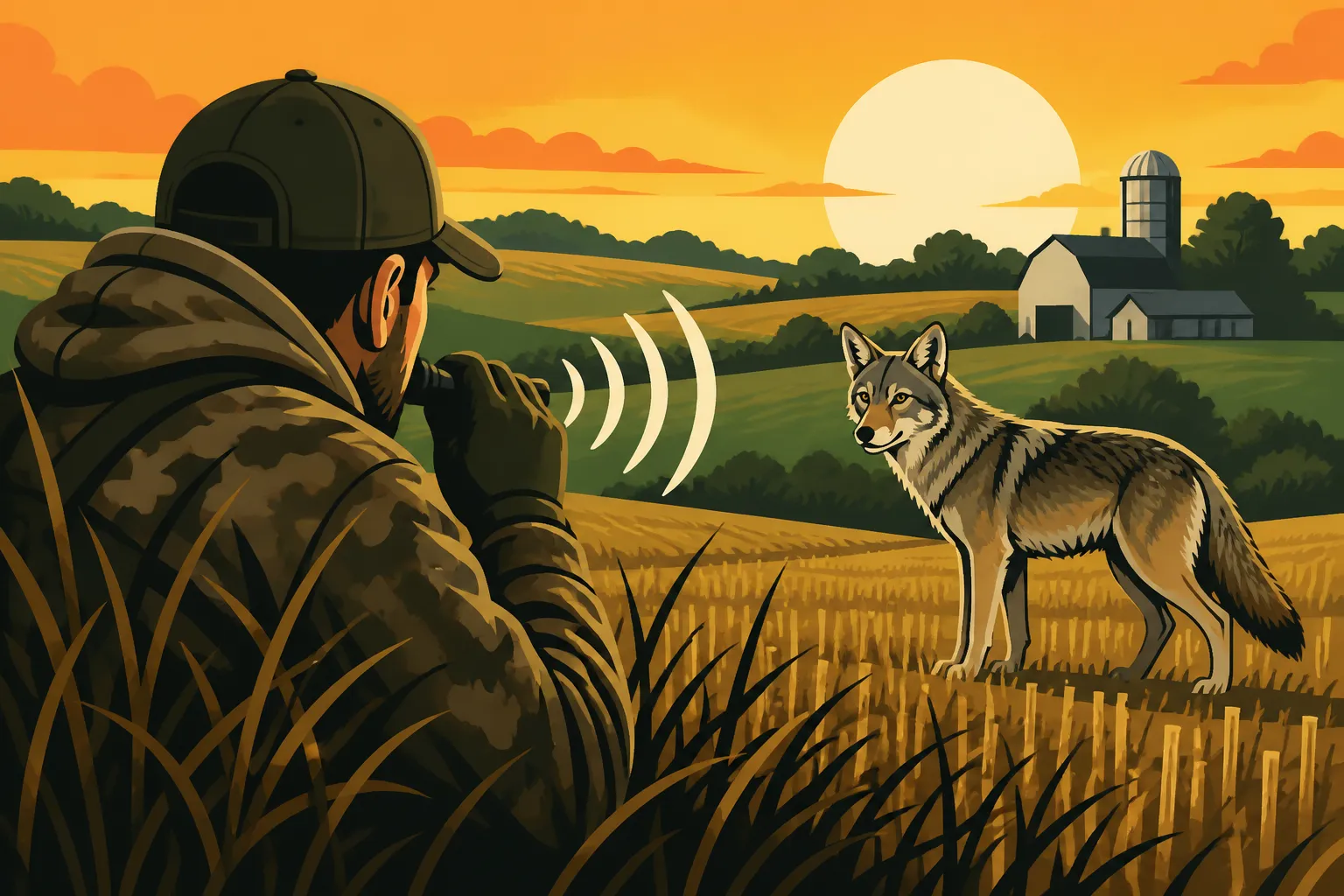
The vast array of coyote calls available can be overwhelming, but they generally fall into two categories: distress calls and territorial calls. Distress calls, mimicking an injured rabbit, fawn, or bird, are often the most effective in bringing coyotes in, especially in farm country where these prey animals are common. A rabbit distress call is a classic for a reason – it works. But don't be afraid to mix it up. Sometimes a bird distress call can be just the ticket when coyotes have become wary of rabbit sounds.
Here's a basic sequence to get started:
- Initial Burst: Start with a loud, attention-grabbing series of distress calls for about 30-60 seconds. This is your "smoke alarm" to let any coyotes in the vicinity know something is happening.
- Silence and Observation: Remain silent and scan the landscape intently for several minutes (5-10 minutes minimum). Coyotes can come in fast and silently, often from unexpected angles. This is where your patience is really tested.
- Intermittent Calling: If nothing shows, resume with shorter, less intense bursts of distress calls, perhaps 15-30 seconds every few minutes. Vary the pitch and intensity slightly to sound more natural.
- Consider Howls or Barks: If distress calls aren't working, or if you suspect coyotes are in the area but not committing, try a few soft howls or barks. A lone howl can pique curiosity, and a challenge howl might draw in a territorial male.
Remember, less is often more. Over-calling can spook wary coyotes. Always be ready with your firearm, as they can appear quickly. When it comes to Coyote Calling in Kentucky Farm Country, varying your sounds and being patient are absolute necessities.
Using Decoys Effectively
Decoys can be a powerful addition to your calling arsenal, especially in more open agricultural settings where visual confirmation helps draw a coyote in that final distance. The visual stimulus can override some of their natural wariness, making them commit more readily.
- Type of Decoys: The most popular decoys mimic small prey animals like rabbits or fawns. Motion decoys, which flutter or spin to simulate movement, are particularly effective. A spinning tail or a bobbing head can really catch a coyote's eye from a distance. Some hunters even use feather dusters on a stick with a string to simulate a bird in distress.
- Placement: Place your decoy upwind or crosswind from your position, far enough away to draw the coyote's attention away from you, but close enough for a clean shot. About 20-50 yards in front of your setup is a good starting point. The idea is to have the coyote focus on the decoy, buying you precious seconds for a shot as it approaches. If a coyote circles downwind, it should still be focused on the decoy, not you, when it hits your scent cone.
- When to Use: Decoys are excellent during daylight hunts when visibility is good. They can be less effective or even unnecessary during night hunts when coyotes are primarily relying on sound and smell. I've seen coyotes charge right into a spinning rabbit decoy, completely ignoring my well-hidden presence, simply because the visual appeal was so strong. It's a fantastic tool to have.
Gear Up for Success: What You'll Need
Having the right gear won't guarantee success, but it certainly increases your odds and makes the experience more comfortable and efficient. You wouldn't go deer hunting without your trusty rifle, and coyote hunting deserves similar preparation.
Calls: Electronic vs. Hand Calls
Choosing between electronic calls and hand calls often comes down to personal preference, budget, and the specific hunting situation. Many experienced callers carry both.
- Electronic Calls: These are highly versatile and incredibly effective. Brands like Foxpro or Icotec offer a huge library of realistic sounds, from various distress calls to howls, barks, and pup whines. The ability to control volume and switch sounds remotely from a distance means you can operate the call without moving, which is crucial for wary coyotes. They also allow you to place the sound source away from your actual position, drawing attention away from you. This is invaluable, especially when you're Hunting Western Kentucky Bottomland Deer or coyotes in open fields. The downside? They can be a significant investment, and batteries can die at the worst possible moment.
- Hand Calls: These are traditional, require skill to master, but are incredibly reliable and require no batteries. They come in open-reed and closed-reed designs. Open-reed calls offer more versatility in sound, while closed-reed calls are easier for beginners to produce consistent sounds. They are excellent for quick, impromptu stands, or for adding subtle variations that an electronic call might miss. Every seasoned coyote hunter I know has a few trusty hand calls on their lanyard, perfect for that quick lip squeak when a coyote hangs up at a distance. Practicing with hand calls is essential to sound natural, so don't just pick one up the day before the hunt!
| Call Type | Pros | Cons | Best Use Case |
|---|---|---|---|
| Electronic Call | Versatile sounds, remote control, high realism | Expensive, battery-dependent, requires learning remote | Open areas, multiple stand locations, wary coyotes |
| Hand Call | Affordable, reliable, subtle variations, no batteries | Requires skill, less sound variety, movement for calling | Close quarters, quick setups, backup for e-caller |
| Distress Calls | Highly effective, mimics injured prey | Can make coyotes call-shy if overused | Primary tactic for most situations |
| Howls/Barks | Territorial challenge, locate coyotes, curiosity | Can spook coyotes if overdone | Locating, challenging dominant animals, late in stand |
Optics, Camouflage, and Safety
Just like any other hunting pursuit, good optics, appropriate camouflage, and a strong emphasis on safety are paramount when pursuing coyotes in Kentucky farm country.
- Optics: A good set of binoculars (8x or 10x magnification) is essential for spotting coyotes coming in from a distance, especially in fields or across ridges. They often appear as just a flicker of movement or a subtle color change against the landscape. A rangefinder is also incredibly useful for accurately determining shooting distances in open terrain. When you're dealing with flat ground or subtle undulations common in farm country, judging distance can be tricky, and a rangefinder takes out all the guesswork.
- Camouflage: Blend in with your surroundings. While a full camo pattern isn't always strictly necessary, wearing muted earth tones or a pattern that matches the local vegetation (like Realtree or Mossy Oak patterns with farm-country specific elements) will help you disappear. The key is to break up your human outline. Even just wearing a good camo facemask and gloves can make a huge difference in obscuring your distinct shape.
- Safety: Always assume you're hunting with a loaded firearm and follow all firearm safety rules. Be absolutely certain of your target and what's beyond it. In farm country, stray bullets can travel long distances, so be aware of farmhouses, roads, and livestock. Also, be mindful of Night Hunting Rules for Kentucky Coyotes, as regulations can differ from daylight hours. It’s also important to wear blaze orange during any open firearms deer or elk season, even if you’re only targeting coyotes. Many farmers are happy to have you hunt coyotes on their land, but it's always critical to get permission beforehand, which might involve Knocking on Doors in Western Kentucky Farm Country to build those relationships. If you're using an electronic call, be aware that other hunters might be attracted to the sound. Safety is non-negotiable.
Advanced Strategies and Troubleshooting
Even with the best gear and techniques, coyotes can be challenging. They are survivors, and they learn. If you're consistently striking out, or dealing with particularly wily coyotes, it's time to refine your approach.
Dealing with Call-Shy Coyotes
Kentucky coyotes, especially those near populated areas or heavily hunted farms, can become "call-shy." This means they've likely heard common distress calls before, maybe even had a negative encounter, and now associate those sounds with danger. It's a common frustration, and many hunters simply give up. But don't despair! There are ways to outsmart them.
- Vary Your Calls: If rabbit distress isn't working, try something completely different. A fawn distress call (especially during spring and early summer), a bird distress, or even an aggressive challenge howl can sometimes trigger a response from a call-shy coyote. The key is to offer a sound they haven't associated with danger yet.
- Use Subtlety: Instead of blasting loud calls, try softer, more intermittent calling. Sometimes a low volume pup whimper or a quiet, inquisitive howl is enough to pique a call-shy coyote's curiosity without immediately putting them on high alert.
- Change Locations Often: Don't hammer the same stand location repeatedly. Move to different parts of the property, or even different properties, to target different coyote populations. Scout new areas, perhaps using mapping tools from GoHunt to identify overlooked corners or draws that might hold unpressured animals. A coyote that's heard you before will be twice as cautious the next time.
- Longer Wait Times: Increase your silent periods between calling sequences. A patient hunter often bags the most wary coyotes. They might be circling far downwind, taking their sweet time, and if you pack up too early, you'll miss them. I've personally waited 45 minutes on a stand after my last call only to have a coyote finally appear, checking everything out.
- Combine Tactics: Use decoys more aggressively, or try stalking into position more quietly. Some coyotes might be more visually oriented than audibly, or vice-versa. You might also consider setting up a Ground Blind on Kentucky Public Land even if it's on private land, as the permanent structure can help break up your outline in a familiar spot.
Night Hunting Considerations in Farm Country
Night hunting for coyotes is a thrilling, effective, and legal method in Kentucky, but it comes with its own unique set of challenges and safety considerations. Always double-check current Kentucky Coyote Hunting Season Rules and Night Hunting Rules for Kentucky Coyotes to ensure compliance.
- Lighting: You'll need a good quality, powerful light source, typically a red or green hunting light, which coyotes often don't associate with danger as readily as white light. Headlamps are great for walking in and out, but a weapon-mounted light or a handheld spotlight is essential for scanning and shooting. Focus on scanning slowly, looking for eye reflections. Their eyes glow like little embers in the dark.
- Optics for Night: While thermal and night vision optics are legal in Kentucky, they represent a significant investment. However, if you're serious about night hunting, they are incredibly effective for spotting coyotes from long distances and observing their behavior without them ever knowing you're there.
- Stand Selection: Your stand locations at night should be even more carefully chosen. Prioritize clear shooting lanes and backdrops that can safely stop a bullet. In open farm fields, this can be challenging, so always have a mental map of what lies beyond your target.
- Calling at Night: Coyotes are often more active and responsive to calls at night. Use distress calls, but also incorporate howls and barks, as they are often more vocal after dark. Again, discretion with volume is key.
- Safety First: Hunting at night inherently carries greater risks. Always hunt with at least one partner. Communicate clearly, maintain situational awareness, and be absolutely certain of your target before taking a shot. Remember, in the dark, everything looks different, and distances can be deceiving.
By understanding their behavior, refining your calling techniques, gearing up appropriately, and adapting to their wariness, you can effectively manage coyote populations in Kentucky's farm country and contribute to healthier game populations and livestock protection.
Disclaimer
Please be aware that hunting regulations, seasons, and licensing requirements can change. Always consult the official Kentucky Department of Fish and Wildlife Resources (KDFWR) website or their current hunting guide for the most up-to-date and accurate information before planning any hunting trip. Hunter safety is paramount; always follow all firearm safety rules and hunt ethically and responsibly.