Jump-Shooting a Kentucky Creek
Few hunting methods offer the same thrill and immediate gratification as jump-shooting a Kentucky creek. While sitting in a blind, bundled up and waiting for a flight, certainly has its charm, there are days when the ducks just aren't flying big water, or maybe you don't have a prime spot on a major lake. This guide is all about embracing the intimate, dynamic challenge of stalking Kentucky's smaller waterways, bringing you face-to-face with wary ducks, and experiencing an adrenaline rush unlike any other.
Why Kentucky Creeks Offer Prime Jump-Shooting Opportunities
Kentucky's landscape is crisscrossed with countless creeks, streams, and meandering waterways. These aren't just scenic features; they are vital arteries for migratory waterfowl, offering refuge and sustenance, especially when larger bodies of water are crowded or frozen. Understanding why these smaller channels are so attractive to ducks is key to unlocking successful jump-shooting adventures.
Understanding Creek Ecology and Duck Behavior
Imagine a busy interstate highway compared to a quiet country road. Large lakes and rivers are the interstates—high traffic, lots of commotion, but also abundant resources. Creeks, on the other hand, are the country roads. They offer secluded, low-pressure environments where ducks can loaf, feed, and rest away from the hubbub. Wood ducks, with their affinity for timbered waterways, are often the primary target, but you’ll frequently jump mallards, green-winged teal, and even occasional gadwall or black ducks, especially during colder weather when they're seeking sheltered water.
These creeks provide a smorgasbord of natural food sources. Think about the acorns dropping from overhanging oaks, the abundant aquatic invertebrates, and the submerged vegetation that thrive in these quieter environments. Ducks will settle into bends, logjams, and stretches of slow-moving water, feeling secure with the dense bankside cover. They'll use these spots to digest, preen, and just generally unwind. Knowing this behavior allows you to anticipate where birds might be holding. They're looking for that perfect combination of cover, food, and low disturbance. Often, if you can find a section of creek with mature timber dropping mast directly into the water, you've found a honey hole.
Navigating Different Creek Types and Water Levels
Kentucky’s creeks are not all created equal. You have everything from small, trickling streams that might only hold a pair of wood ducks, to larger, slower-moving creeks that can resemble mini-rivers. Each type presents its own challenges and opportunities. A narrow, brush-choked creek demands a different approach than a wider, more open one. The key is reading the water and its surroundings. Look for eddies behind fallen trees, slow pools on the inside of bends, or brushy overhangs—these are classic spots where ducks will be tucked away.
Water levels also play a huge role. After a significant rain, creeks can swell, making navigation tougher and potentially scattering ducks across a wider area, but also opening up new areas of flooded timber or fields. Conversely, during droughts, water levels can drop drastically, concentrating ducks in fewer, deeper pools. This can be a boon for jump-shooting, but it also means birds are warier and have fewer places to hide. Using advanced mapping tools like GoHunt can be invaluable here. You can study satellite imagery to identify creek bends, dense cover, and potential logjams before you even set foot on the bank. This helps you visualize the terrain and potential duck hideouts, allowing for more strategic planning and efficient scouting. Understanding the flow, the depth, and the natural structure of the creek is paramount, just as knowing how to read a ridge for Cumberland deer is for whitetail hunters.
Essential Gear and Strategic Preparation
Jump-shooting is a minimalist pursuit compared to setting up a full spread of decoys, but having the right gear and making smart preparations can make all the difference between a successful hunt and a frustrating, wet slog. You need to be mobile, silent, and prepared for quick action.
Shotgun, Ammunition, and Non-Toxic Requirements
Your shotgun choice is crucial. Most jump-shooters favor a 12-gauge or 20-gauge pump or semi-automatic shotgun for quick follow-up shots. You’ll be taking close-range shots, often 15-30 yards, so an improved cylinder (IC) or modified (Mod) choke is usually ideal. Anything tighter, and you risk blowing birds apart at close range or missing entirely on a quick-flushing bird. The ability to swing quickly and shoulder your gun smoothly is more important than having a tight pattern.
When it comes to ammunition, always remember the federal requirement for non-toxic shot when hunting waterfowl. Steel shot is the most common and economical choice. For ducks on a creek, steel #3 or #4 shot usually does the trick. You want enough pellets to create a dense pattern for quick kills, but also enough energy to anchor birds. For more detailed information on what's required, understanding Where Nontoxic Shot Is Required in Kentucky is essential. It’s also worth carrying a few heavier loads, perhaps steel #2, if there’s a chance you might jump a few Canada geese, though ducks are the primary target here. Make sure you've patterned your chosen load and choke combination. A few minutes at the range can save you a lot of heartache in the field.
Stealth, Safety, and Dressing for the Hunt
Staying hidden and dry is paramount. When it comes to camouflage, simple natural tones that blend with the bankside vegetation are usually sufficient. Earth tones, greens, and browns are your friends. Avoid anything too bright or contrasting. Layering is key, as you'll be exerting yourself while walking but then standing still. Start with a moisture-wicking base layer, add an insulating layer, and top it with a waterproof, breathable outer shell. You will get wet or muddy, so good rain gear is non-negotiable.
Waders are an absolute must. Chest waders are often preferred over hip boots, as they offer more protection if you slip or need to cross deeper sections of the creek. They also keep you warmer if you end up spending time in chilly water. For advice on choosing the right kind, check out a resource on Chest Waders Versus Hip Boots for Flooded Timber. Your boots should be comfortable for walking, provide good traction on slippery banks and submerged rocks, and be well-insulated if you’re hunting in cold weather. While not always required, wearing a personal flotation device (PFD) is a smart safety measure, especially if you're alone, unfamiliar with the creek, or if the current is strong.
Safety should always be your top priority. Keep your gun's muzzle pointed in a safe direction and the safety on until you're ready to shoot. Always be aware of your surroundings, especially if hunting near private property. Tools like GoHunt can show property lines, helping you avoid accidental trespassing. Also, know what’s beyond your target. You’re often shooting low over the water, but stray pellets can travel. Be sure of your backstop and your shooting lanes before you even think about pulling the trigger.
Scouting Your Chosen Waterways
Before you ever load a shell, you need to scout. This isn't just a leisurely walk; it's a critical information-gathering mission. Start with aerial maps. The Kentucky Department of Fish and Wildlife Resources (KDFWR) website has excellent map tools, and platforms like GoHunt offer detailed satellite imagery that can help you identify promising sections of creek: sharp bends, areas of dense cover, sections with woody debris, and potential access points. Look for pinch points where the creek narrows or areas where cover is particularly thick—these are prime spots for ducks to hold.
Access is a big deal. Can you legally access the creek from public land? Or do you need to secure permission from a landowner? Identify safe and discreet entry and exit points. When you're on the ground, look for fresh duck sign: feathers, droppings along the banks, or distinct "slides" where ducks enter and exit the water. Pay attention to the types of trees near the water—oaks and other mast-producing trees are a good sign. Consider scouting different sections of a creek on different days, as duck patterns can change based on weather, pressure, and food availability. This detailed scouting is akin to Scouting Kentucky Public Land Before Season for deer, just focused on different game and habitat. Seasonal changes will greatly impact the cover, so observe the creek in different times of the year if possible to understand its full potential.
Executing the Jump-Shoot: Tactics and Technique
Once you've done your homework and geared up, it's time to put boots on the ground (or in the water). The actual act of jump-shooting is a dynamic blend of stealth, observation, and quick reflexes. It's about outsmarting birds on their home turf.
The Art of the Silent Stalk
This is where the "jump" in jump-shooting comes from. You're trying to surprise the ducks. Walk slowly, deliberately, and silently along the bank. Hug the bank tightly, using any available cover—trees, brush, high banks—to break up your outline. Your goal is to see the ducks before they see you. Move like a predator, not a parade. Often, the best approach is to stay slightly back from the immediate edge, peeking around bends or through gaps in the foliage.
Pay attention to the wind direction. Walking into the wind will carry your scent away from the ducks and can also help muffle your sounds. The sun's position is also important; try to keep it at your back or side so it's not shining in your eyes or silhouetting you. Listen for subtle sounds: a faint quack, the splash of a duck dabbling, or the quiet murmur of feeding. Look for ripples on the water surface, telltale movement in the reflections, or the telltale flash of color. Move slowly enough that you can stop instantly if you see movement. Think of it as a methodical sweep, checking every potential hidey-hole as you advance. Being patient and methodical is often the key to success when you’re Still-Hunting Eastern Kentucky Ridges, and the same principle applies here.
The Moment of Truth: Flushing and Shooting
As you approach a likely spot, like a tight bend or a logjam, slow down even further. Peek around the corner cautiously. If you spot ducks, try to get a clear shooting lane before they flush. Sometimes, they'll simply sit tight, allowing you to get into a prime position. More often, they'll erupt from the water with surprising speed and noise.
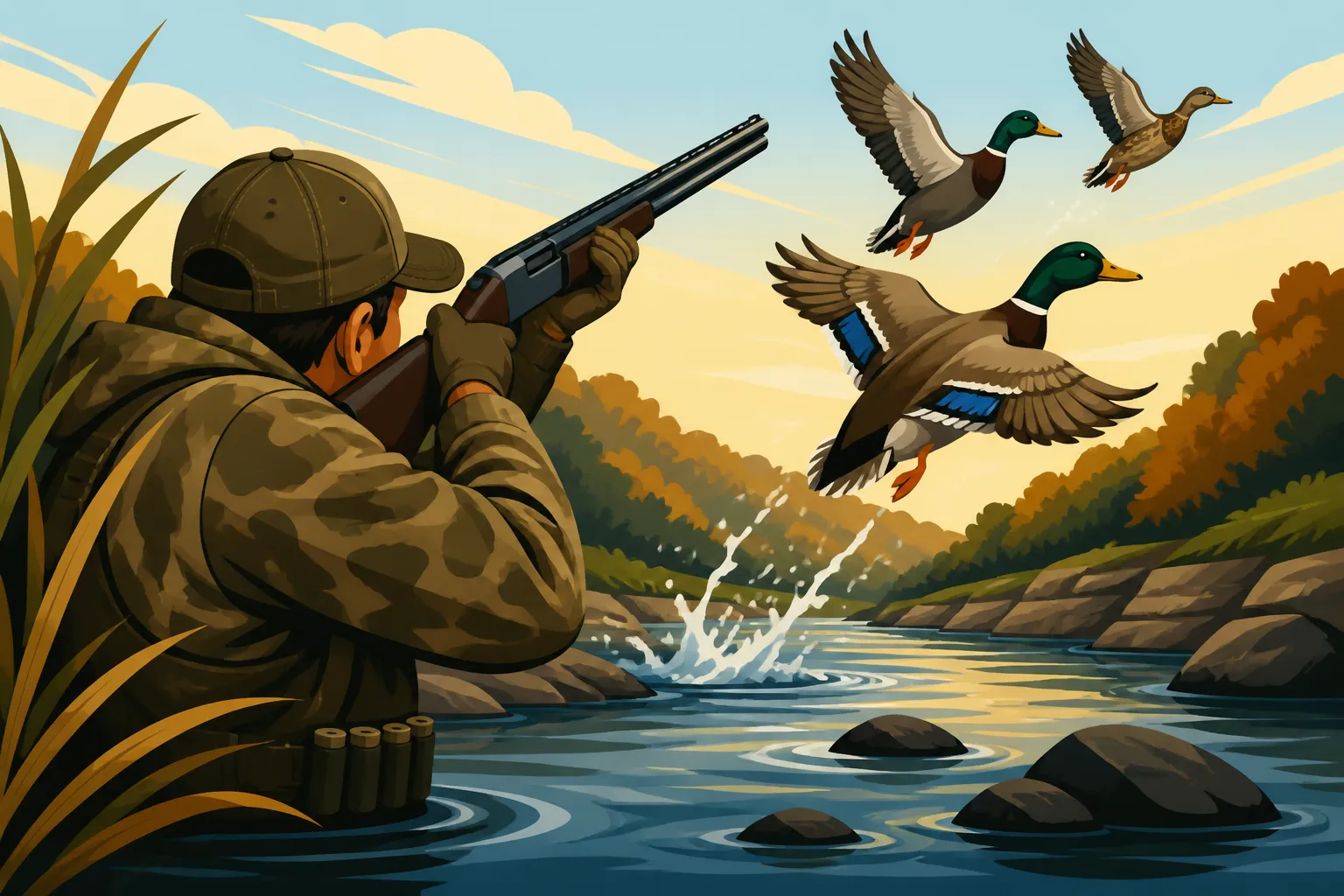
When the ducks flush, your training kicks in. Shoulder your shotgun smoothly, pick a target, and swing through the bird, pulling the trigger just as your barrel passes it. Since these shots are close, you need to be quick. Don't dally. A smooth, fluid motion is better than a jerky, precise aim. Often, a "double-tap" strategy – quickly getting two shots off – can be effective, especially if multiple birds flush. Always be ready for a follow-up shot on any wounded birds. Ethical hunters strive for clean kills and quick retrieves. Safety rules are paramount in this moment: identify your target, be sure of what's beyond it, and never swing past your partners.
Hunting Solo vs. With a Partner
Jump-shooting can absolutely be done solo. It offers a particular kind of quiet solitude and challenge. However, it can also make retrieval difficult, especially if a bird falls into strong current or thick brush. Hunting with a partner, or even a small group, can be incredibly effective.
With a partner, you can use tactical approaches. One hunter can stalk upstream while the other positions themselves downstream, ready for birds that flush and fly past. Or, one hunter can walk the creek bed while the other walks the bank, providing different angles. Communication is key here, often through hand signals or low whispers. A well-trained retriever dog is an unparalleled asset for jump-shooting. A good dog can retrieve birds from thick cover or strong currents that would be impossible or dangerous for a human. If you hunt with a dog, ensure it’s wearing appropriate protective gear and is well-behaved and under control at all times. This shared experience makes for lasting memories, much like Bringing a First-Timer on a December Hunt for deer.
Respecting the Harvest and the Habitat
Successfully jump-shooting a creek isn't just about bagging birds; it's about being a responsible steward of the land and a respectful hunter. This includes everything from how you retrieve your game to how you leave the creek.
Effective Bird Retrieval and Ethical Considerations
Once you've made a shot, your immediate priority is to retrieve your bird. Ducks can be surprisingly resilient, and a wounded bird can swim or fly a considerable distance, especially in a current. Mark the spot where the bird fell, paying attention to landmarks on the bank. If you're hunting with a partner, both of you should mark the spot.
Get to the downed bird as quickly and safely as possible. Waders are invaluable here, allowing you to enter the water without getting soaked. If the current is strong, be extremely cautious. Sometimes, a long stick or a throwing rope can help. Preventing lost birds is a critical part of ethical hunting. A lost bird is a wasted resource, and it reflects poorly on all hunters. If a bird is still alive when you reach it, dispatch it quickly and humanely. This commitment to the animal is foundational to being a responsible hunter and ensuring that game, like venison, is handled properly from Field Dressing a Deer in Cold Weather to the table.
Leaving No Trace and Local Regulations
Beyond the immediate hunt, it's crucial to leave the creek exactly as you found it, if not better. This means packing out all your trash, including spent shell casings. Avoid unnecessary damage to bankside vegetation. Don't leave any signs of your presence. This "leave no trace" ethic ensures that these beautiful waterways remain pristine for wildlife and for other recreational users, whether they be fellow hunters, anglers, or hikers.
Always be aware of and abide by all local and state regulations. This includes understanding the specific rules for Kentucky Waterfowl Zones and Seasons and Kentucky Duck Zone Boundaries. Make sure your Kentucky Migratory Bird Certification is current and that you have all necessary licenses and stamps, including your federal duck stamp. Also, be mindful of property lines. Even if you have permission to hunt one section of a creek, an adjacent property owner might not be as welcoming. Tools like GoHunt can show property lines right on your phone, preventing accidental trespass. Always telecheck your harvested birds according to KDFWR guidelines.
Jump-shooting a Kentucky creek is an incredibly rewarding and challenging way to hunt waterfowl. It fosters a deep connection to the land and a keen understanding of duck behavior. It might not be for everyone, but for those who embrace the challenge, it offers an unforgettable experience.
| Feature | Jump-Shooting Creeks | Traditional Blind Hunting (Lakes/Rivers) |
|---|---|---|
| Approach | Active, mobile, stealthy stalk | Passive, stationary, waiting |
| Target Species | Often Wood Ducks, Mallards, Green-winged Teal (local) | Diverse range, including larger puddle ducks, diver ducks |
| Gear Intensity | Minimalist (shotgun, waders, camo, small pack) | More gear (decoys, blinds, boat, calls) |
| Hunting Pressure | Generally lower, seeking secluded spots | Can be high, especially on popular public water |
| Shot Range | Close-range (15-30 yards) | Variable, from close to longer-range (30-50+ yards) |
| Physical Exertion | High (walking, wading, navigating obstacles) | Low to moderate (setting up blind/decoys, then sitting) |
| Best Conditions | Cold fronts, cloudy days, after rain (higher water) | Wind, cold fronts (migratory pushes) |
| Stealth Required | Extremely high | High (for setup), then camouflage for sitting |
| Retrieval | Can be challenging in current/cover, dog highly useful | Often easier with boat/dog, but can be tough on big water |
Disclaimer
Hunting is an inherently dangerous activity. Always prioritize safety, adhere to all Kentucky hunting regulations, and consider taking a hunter education course. This guide provides general information and should not replace official KDFWR guidelines or professional instruction.