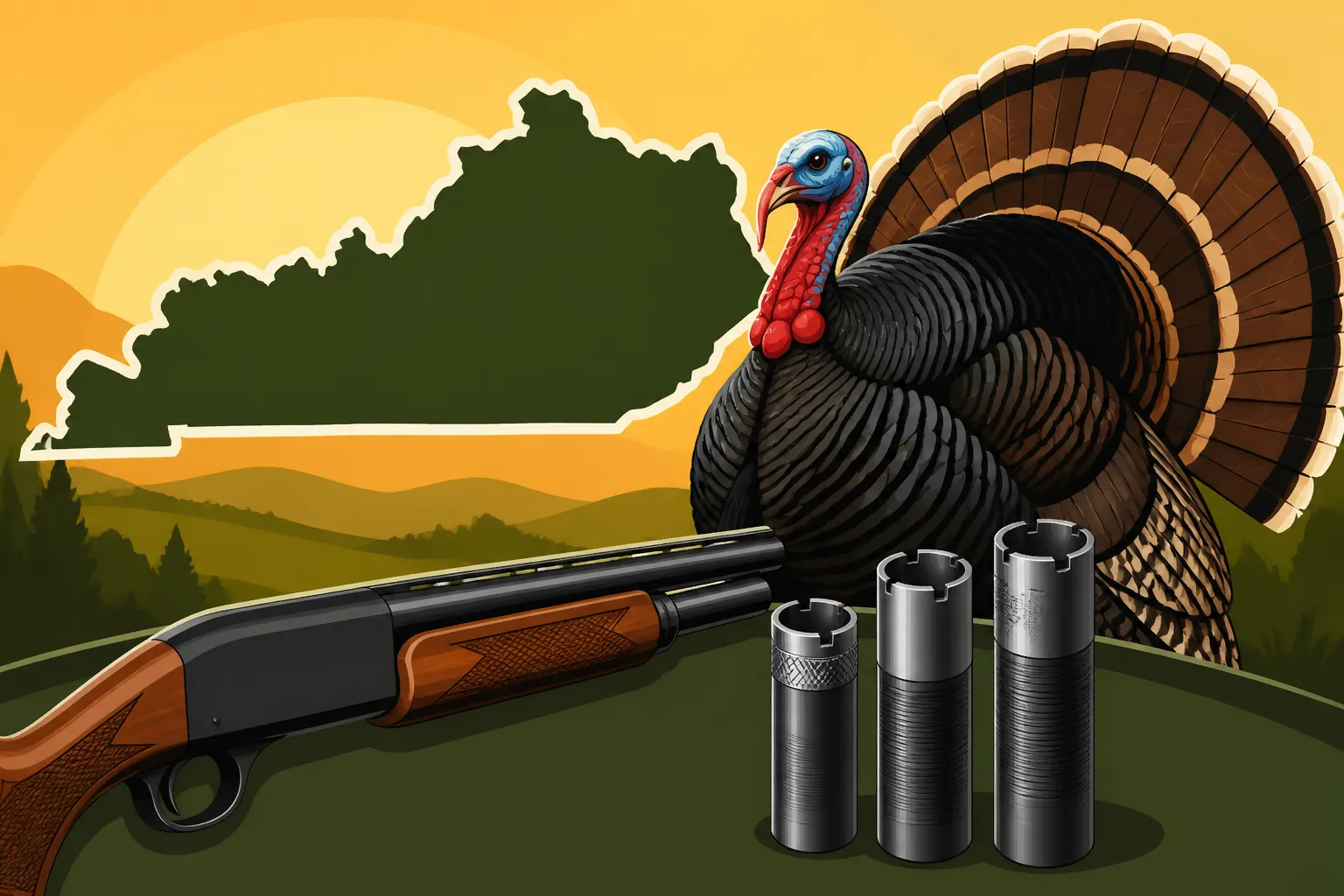
Turkey Shotguns and Chokes
There's nothing quite like the sound of a spring gobbler hammering on the roost, or the sight of a big tom strutting into your setup. But that heart-pounding moment can quickly turn to heartbreak if your turkey shotgun isn't dialed in. Many Kentucky hunters grapple with inconsistent patterns, leading to either clean misses or, worse, crippled birds. This guide is here to untangle the complexities of turkey shotguns and chokes, helping you build a reliable setup that puts more gobblers in your vest.
Choosing Your Turkey Shotgun
Picking the right shotgun for Kentucky turkey hunting isn't just about what looks good; it's about what performs reliably when that longbeard steps into range. There are several factors to weigh, from the gauge to the action type, all of which contribute to your success in the turkey woods.
Gauge Selection and Why it Matters
The gauge of your shotgun is perhaps the most fundamental decision you’ll make. For years, the 12-gauge reigned supreme as the undisputed king of turkey guns, and for good reason. It offers a substantial payload capacity, allowing you to throw a large volume of shot downrange, which translates directly to more pellets hitting a turkey’s vital head and neck area. Modern 12-gauge ammunition, especially with advanced heavier-than-lead loads, can achieve incredible pattern density and effective range, making it a versatile choice for nearly any turkey hunting scenario you might encounter in Kentucky.
However, the 20-gauge has been rapidly gaining traction, and it's no longer just for youth or recoil-sensitive hunters. Advances in ammunition technology, particularly with Tungsten Super Shot (TSS), have allowed 20-gauge shotguns to deliver patterns that rival or even surpass traditional 12-gauge lead loads. A 20-gauge offers reduced recoil, a lighter overall gun weight, and often a more compact profile, which can be a huge advantage when you're navigating the thick, steep hills of Eastern Kentucky or executing a quick run-and-gun maneuver. If you find yourself needing to move quickly and set up in tight spots, a lighter 20-gauge can make a significant difference in your comfort and agility. For those considering a new setup or looking to reduce felt recoil, the 20-gauge, especially when paired with modern loads, is a formidable option that shouldn't be overlooked. Just be sure to check the specific Kentucky Spring Turkey Season Rules regarding legal firearms.
Then there's the .410 bore. This super-compact, super-light option has become a buzzword in recent years, almost exclusively due to the incredible performance of TSS. A .410 loaded with TSS can put a surprising number of heavy, dense pellets on target. It’s a specialized choice, however, typically favored by experienced hunters who appreciate its minimal recoil and feather-light carry weight. It demands a very precise shot placement and isn't typically recommended for beginners, but for those who master it, the .410 can be an extremely satisfying and effective turkey tool.
Shotgun Action Types for Turkey Hunting
Beyond the gauge, the mechanical action of your shotgun plays a role in its feel, reliability, and how you interact with it in the field. Each type has its devoted followers and distinct advantages.
The pump-action shotgun is a classic for a reason, embodying rugged reliability and straightforward operation. Many turkey hunters appreciate the positive control they have over each shell, and the familiar sound of a pump being cycled is as iconic as a gobbler's strut. They are generally less expensive than semi-autos and can withstand a lot of abuse in the field, making them a fantastic choice for those who hunt hard and aren't afraid of a few scratches on their gear. The drawback, of course, is the need to manually cycle the action, which can be a bit slower for follow-up shots, though in turkey hunting, one well-placed shot is usually all you need.
Semi-automatic shotguns offer a distinct advantage in felt recoil reduction, as some of the recoil energy is used to cycle the action. This can be a huge benefit when shooting heavy turkey loads, making for a more comfortable shooting experience and allowing for quicker recovery for a potential (though ideally unnecessary) follow-up shot. Semi-autos tend to be more complex mechanically, which can mean a higher price point and a bit more attention to cleaning. However, for many hunters, the reduced recoil and smooth operation are well worth the investment. They are particularly popular among hunters who may also use the same gun for Waterfowl Hunting Kentucky Lakes and Rivers or other pursuits where faster follow-ups are common.
Finally, the single-shot shotgun represents the pinnacle of simplicity and lightweight design. With only one shell capacity, it demands absolute confidence in your shot and forces you to focus entirely on making that first one count. There's no racking a slide or worrying about malfunctions, just a pure, unadulterated hunting experience. These guns are often the lightest to carry, making them ideal for hunters who value minimalism and spend long hours on foot, perhaps still-hunting Eastern Kentucky ridges. While certainly not for everyone, a single-shot can be a rewarding choice for the disciplined turkey hunter.
Barrel Length and Weight Considerations
When you're out chasing gobblers across Kentucky, every inch and every ounce of your shotgun matters, especially when you're deep in the woods or making a last-minute adjustment in a tight spot.
Shorter barrels, typically ranging from 20 to 24 inches, are the preferred choice for most dedicated turkey shotguns. Their primary advantage lies in maneuverability. Imagine being hunched behind a blowdown, a gobbler just out of sight, and needing to make a slight adjustment as he circles into view. A shorter barrel allows you to pivot and swing with greater ease, preventing hang-ups on branches or bumping your gun against a tree. This compact length is particularly beneficial for hunters who employ Run-and-Gun Turkey Tactics on Public Land or often find themselves setting up in dense cedar thickets or tight hollows. It’s easier to handle in ground blinds or when quickly shouldering the gun after a surprise close-range encounter. While historically, longer barrels were thought to offer better patterns or velocity, modern ammunition and choke technology have largely negated these perceived advantages for turkey hunting distances.
Conversely, longer barrels, often 26 to 28 inches, might offer a marginal increase in velocity and a smoother swing, which can be desirable for wing shooting. However, for stationary turkey hunting where precise aiming at a static target is paramount, the added length can quickly become a hindrance. They're more prone to getting caught on brush, can feel unwieldy in a ground blind, and simply add unnecessary weight when you're carrying your setup for miles. For dedicated turkey hunting, prioritize a barrel length that enhances your ability to quickly and quietly get on target in confined spaces. The overall weight of your shotgun also plays into this. A lighter gun is a joy to carry, especially on those long treks through rugged terrain. However, too light, and the recoil can become punishing with heavy turkey loads. It's a balance between comfortable carry and manageable recoil, and often, a slightly heavier shotgun in a 20-gauge or a 12-gauge with a shorter barrel hits that sweet spot.
The Critical Role of Turkey Chokes
If your shotgun is the engine, the choke tube is the finely tuned carburetor, directing all that power precisely where you need it. For turkey hunting, the choke is arguably the most critical component for achieving those dense, lethal patterns.
Understanding Choke Constriction
At its core, a choke tube is a constricted section at the muzzle end of your shotgun barrel, designed to control the spread of the shot pattern. Standard chokes, like improved cylinder, modified, and full, are common for wingshooting, where a wider, more forgiving pattern is often desired. However, for turkey hunting, our goal is the exact opposite: we want the tightest, most concentrated pattern possible at the specific distances a gobbler is likely to present itself – usually between 20 and 50 yards.
This is where specialized turkey chokes come into play. These are typically designated as "extra full," "super full," or even proprietary names like "Gobbler Stopper" or "Dead Ringer." They are designed with much tighter constrictions than standard full chokes, forcing the shot column into a much narrower stream. The objective is to deliver a dense core of pellets, often within a 10-inch circle, precisely to the turkey’s head and neck, which are the only truly vulnerable areas. Without this tight constriction, your pattern would spread out too quickly, resulting in insufficient pellet density to reliably anchor a bird beyond very close range.
Chokes can also be internal or extended. Internal chokes sit flush with the muzzle, offering a clean look. Extended chokes protrude from the barrel, which can sometimes offer subtle advantages in protecting the muzzle, making them easier to change, and occasionally featuring wad-stripping technology or porting. While the type of choke (internal vs. extended) is often a personal preference, the degree of constriction is paramount for turkey hunting.
Choke Material and Design
The material and design of your turkey choke tube aren't just cosmetic; they contribute directly to pattern performance and the longevity of the choke itself. Modern turkey chokes are often crafted from robust materials like stainless steel, heat-treated alloys, or even titanium. These materials are chosen for their durability, allowing them to withstand the intense pressures and friction generated by heavy turkey loads, especially those containing harder shot materials like Tungsten Super Shot (TSS). A cheaply made choke can warp or wear out prematurely, leading to inconsistent patterns or even damage to your barrel.
Beyond the material, specific design features can enhance a choke's performance. Some turkey chokes feature "porting," which are small holes or slots near the muzzle end. These ports are designed to vent gas, reducing perceived recoil and muzzle jump, which can help with faster follow-up target acquisition (though ideally not needed for turkey). However, ported chokes can also be louder and produce more muzzle flash, which might be a consideration in low-light conditions. Another important design element found in many high-performance turkey chokes is wad-stripping technology. This involves internal rings, grooves, or specialized angles designed to separate the shot wad from the pellet column as quickly and cleanly as possible. The goal is to prevent the wad from interfering with the pellets as they exit the barrel, which can cause erratic patterns. A choke that effectively strips the wad ensures a more consistent and dense core of pellets, which is exactly what you need for a clean harvest. When you're looking for that perfect choke, considering its material and internal design can be just as important as its constriction level.
Matching Chokes to Ammunition
This is where the rubber meets the road: your choke and ammunition must work together as a system. It's a common misconception that one "perfect" turkey choke exists that will perform optimally with any shell. The truth is, different loads, even within the same shot size and gauge, can react differently to various choke constrictions and designs. What patterns beautifully with one brand of #5 lead shot might throw a wild pattern with a different brand, or with TSS #9s.
For traditional lead loads, you might find that an extra-full or even a standard full choke, depending on the specific gun, provides an acceptable pattern out to 35-40 yards. However, once you venture into heavier-than-lead options like TSS (Tungsten Super Shot) or bismuth, the game changes. These materials are significantly denser and harder than lead, allowing for smaller shot sizes (like #7 or #9 in TSS) to carry more energy and penetrate deeper. These smaller, harder pellets often respond best to extremely tight chokes, sometimes even tighter than those designed for lead. Some chokes are specifically marketed and designed for TSS, with internal geometries optimized for these modern loads. You can spend hours researching different combinations, and that's where resources like GoHunt can be invaluable for cross-referencing user experiences and manufacturer recommendations. The key takeaway is that you absolutely cannot assume a choke that worked well with one type of ammunition will work equally well with another. Always, always test your chosen combination at the range. Neglecting this crucial step is a recipe for disappointment in the field and is one of the biggest reasons hunters miss birds or wound them. This critical relationship between your Tungsten Turkey Loads Worth the Price and your choke is truly the foundation of an effective turkey setup.
The Non-Negotiable Art of Patterning Your Turkey Gun
You’ve got your shiny new shotgun, picked out a promising choke, and loaded up with top-shelf turkey shells. Now what? The most critical step, one that too many hunters rush or skip entirely, is patterning your shotgun. This isn't just a suggestion; it's an absolute requirement for ethical and effective turkey hunting.
Why Patterning is Absolutely Essential
Let's be blunt: if you haven't patterned your turkey gun, you're guessing, and guessing has no place in responsible hunting. The simple truth is that every shotgun, every choke, and every ammunition load is a unique combination. What patterns perfectly in your buddy's identical shotgun might not do the same in yours. Minor manufacturing tolerances, barrel harmonics, and even the way a choke seats in your specific barrel can all influence how the shot leaves the muzzle and spreads downrange. You might assume your point of aim is your point of impact, but many shotguns, especially when throwing dense turkey patterns, can shoot high, low, left, or right, even with fixed sights.
Patterning isn't just about knowing where your gun shoots; it’s about understanding the density and distribution of your pellet pattern at various distances. You need to know that at 30, 40, or even 50 yards, you're putting enough pellets into a turkey’s head and neck to achieve a quick, humane kill. A scattered pattern with large gaps can result in a clean miss or, far worse, a crippled bird that suffers and is never recovered. This is not only unethical but incredibly frustrating. Walking into the Kentucky spring woods with a patterned gun gives you immense confidence, allowing you to focus on the hunt itself rather than second-guessing your equipment. It’s an investment of time at the range that pays dividends in both success and ethical hunting practices.
The Step-by-Step Patterning Process
Patterning your turkey shotgun isn't rocket science, but it does require a methodical approach to ensure accurate results. Don't just blast away at a target; take your time, and follow these steps.
First, gather your materials: several large paper targets (the bigger, the better, often 30×30 inches or larger, with a distinct bullseye or turkey head outline), your chosen ammunition (bring a box or two, as you'll shoot a few rounds), ear and eye protection, and a stable shooting rest. A lead sled, sandbags, or a sturdy bipod are ideal for eliminating human error and focusing solely on the gun's performance.
Next, set up your targets. The most crucial distances for patterning are typically 30 and 40 yards. While a turkey might come closer, 40 yards is often the maximum ethical range for many setups, and it's essential to know your gun's limitations there. If you're confident in your setup's performance at 40, you can test at 50 yards, but always start closer. Position your target squarely, ensuring it's not swaying in the wind.
Now, it's time to shoot. From your stable rest, aim precisely at the center of the turkey head or bullseye on your target. Take your time, control your breathing, and squeeze the trigger as if you were aiming at a live bird. Shoot at least three shots at each distance with your chosen choke and load combination. It’s imperative to take multiple shots because even the most consistent setups can throw slightly different patterns from one shot to the next. What you're looking for is a consistent average, not a one-off "lucky" pattern. After each shot, approach the target safely to assess the impact. Mark your targets clearly, noting the distance, ammunition type, and choke used. This record-keeping is invaluable. If you're looking for more detailed instruction on exact yardage, check out our guide on Patterning a Turkey Gun at 40 Yards.
Interpreting Your Patterns
Once you've shot a few patterns at various distances, it's time to analyze the results. This is where you truly understand what your shotgun is doing. The goal is two-fold: confirm your point of impact aligns with your point of aim, and ensure adequate pellet density and distribution within the turkey’s kill zone.
Start by drawing a 10-inch circle around the densest part of the pattern, typically where you aimed. Then, count the number of pellets that hit within that 10-inch circle. For a reliable turkey hunting pattern, you generally want at least 100-150 pellets within that 10-inch circle at your maximum ethical range (e.g., 40 yards). More is always better, but this range provides a strong probability of hitting the brain and spinal column, leading to a clean kill. Critically, also look for "holes" or voids in the pattern. A patch large enough for a turkey's head to pass through cleanly at your target distance is a deal-breaker. Even if your pellet count is high, large voids mean there’s a chance of missing those vital areas.
If your point of impact is off-center, you'll need to adjust your aiming system. If you're using open sights, this might involve adjusting the rear sight or, if fixed, learning to hold slightly off. If you're using a red dot or scope, adjust its windage and elevation turrets until your point of aim matches the densest part of the pattern. If your pellet count is too low, or you have significant voids, it's time to experiment. Try a different choke tube—perhaps one with slightly more or less constriction. Often, trying a different brand or shot size of ammunition can yield dramatically different results. Sometimes, a specific choke and load just click, creating a devastatingly tight pattern. Don't be afraid to try several combinations until you find one that gives you the confidence you need.
Here’s a general guideline for what to look for in your patterning efforts:
| Target Distance | Minimum 10-inch Circle Pellets | Desired Pattern Characteristics | Action Needed for Poor Pattern |
|---|---|---|---|
| 20-25 yards | 200+ | Very dense, almost solid core, no significant voids | Adjust aiming if off-center, try less constriction if too tight |
| 30-35 yards | 150-200 | Dense core, minimal voids, good spread across head/neck region | Fine-tune aiming, ensure consistency, check for minor voids |
| 40 yards | 100-150 | Sufficient density for vital hits, no "gobbler head" sized voids | Adjust choke/load combo, verify aiming, confirm max ethical range |
| 50+ yards | 80-100 (TSS only) | Marginal density, extremely tight core needed, no large voids | Only attempt with proven TSS loads & choke, confirm ethics |
Enhancing Your Setup: Optics and Ammunition
Once you have the core shotgun and choke combination locked in, you can further optimize your setup with smart accessory and ammunition choices that enhance your accuracy and comfort in the field.
Optics for Precision Turkey Hunting
While many turkey hunters still rely on traditional bead sights, integrating optics into your setup can provide a significant advantage, especially when a gobbler unexpectedly closes the distance or appears in challenging lighting conditions.
Red dot sights have become incredibly popular for turkey hunting, and for good reason. They offer rapid target acquisition – simply put the dot on the turkey’s head and squeeze. Unlike traditional sights, red dots are parallax-free within practical turkey hunting distances, meaning that as long as the red dot is on your target, that's where the shot will go, even if your head position isn't perfectly consistent. This is invaluable when you're in an awkward position or need to make a quick shot. They also excel in low-light conditions, like those moments right after legal shooting light begins, or in deep shadows where a dark bead sight might be hard to pick up. For more details on these specialized sights, consider our guide on Red Dots on a Turkey Shotgun.
Another option is a low-magnification scope, typically in the 1-4x range. These provide a slightly magnified view, which can aid in precise aiming at longer ranges (where legal and ethical) or when trying to identify anatomical features on a distant bird. However, scopes can be slower to acquire a target at very close ranges, and they add more bulk and weight than a red dot. For most Kentucky turkey hunting scenarios, where shots are typically 40 yards and under, a red dot provides the optimal balance of speed, precision, and low-light performance without the added weight or bulk of a scope. Open sights, while perfectly functional, simply can't compete with the speed and accuracy benefits that a good red dot sight offers, especially when a big tom suddenly pops up out of nowhere just 20 yards away, leaving you with little time to adjust your head position for a perfect sight picture.
Ammunition Choices and Performance
The ammunition you choose is just as important as your shotgun and choke, if not more so. The market offers a range of options, each with different performance characteristics and price points.
Traditional lead loads have been the staple of turkey hunting for decades. They are generally less expensive, making them more economical for patterning and practicing. Lead #4, #5, and #6 shot are common choices, offering good pattern density and sufficient energy for clean kills out to typical ranges of 30-40 yards. For many hunters on a budget, quality lead loads, when paired with the right choke, remain a perfectly viable and ethical option.
However, the real revolution in turkey ammunition has come with heavier-than-lead options, primarily Tungsten Super Shot (TSS) and, to a lesser extent, bismuth. TSS is incredibly dense, roughly 18 grams per cubic centimeter, compared to lead's 11 g/cc. This extreme density allows for much smaller shot sizes, like #7 or #9, to carry significantly more energy and penetrate deeper than larger lead pellets. The result is a dramatically increased pellet count and far greater effective range. With TSS, a 20-gauge can perform like a 12-gauge, and a .410 can perform like a 20-gauge loaded with lead. The downside, of course, is the cost. TSS shells are significantly more expensive than lead, making patterning a careful and calculated endeavor. Bismuth is another non-toxic, denser-than-lead option, offering a middle ground in terms of cost and performance between lead and TSS. It's often favored where non-toxic shot is required, such as some waterfowl areas, but TSS generally outperforms it for turkeys. When making your choice, consider your budget, the maximum range you realistically expect to shoot, and the recoil you’re willing to manage. Many hunters find the enhanced performance of TSS worth the investment for the confidence it brings. Remember, GoHunt can be a good resource for comparing different ammunition brands and types before you buy.
Slings and Comfort in the Field
It might seem like a minor detail, but a well-chosen sling can make or break your comfort and efficiency during a long day of turkey hunting in Kentucky. You're not just walking to a stand; you might be hiking miles through rugged terrain, navigating dense undergrowth, or executing a quick run-and-gun maneuver trying to cut off a hot gobbler.
A good sling frees your hands, allowing you to carry calls, decoys, or simply navigate uneven ground more safely. Look for a sling that is comfortable and distributes the weight of your shotgun evenly across your shoulder. Padded slings are a godsend, particularly when carrying heavier 12-gauge setups or when you’re on an all-day trek during Kentucky's Fall Turkey Season. That cushioning prevents the strap from digging into your shoulder, reducing fatigue and allowing you to focus on the hunt, not your aching shoulder.
Beyond comfort, functionality is key. Many excellent slings feature quick-adjust buckles or sliders, allowing you to rapidly shorten the sling to keep the gun tight to your body when moving through thick brush, and then just as quickly lengthen it for a smooth, unhindered transition to the shooting position. This quick adjustability is especially vital for dynamic hunting styles, such as Run-and-Gun Turkey Tactics on Public Land, where stealth and speed are paramount. Imagine navigating a steep hollow on Daniel Boone National Forest land; a good sling keeps your gun secure and ready, freeing your hands to grab branches or use trekking poles. Don't underestimate the value of a quality sling; it's a small investment that can significantly improve your hunting experience.
Kentucky-Specific Considerations for Turkey Hunting
Kentucky offers fantastic turkey hunting opportunities, but like any state, it has its own nuances, from regulations to terrain, that demand specific considerations for your gear and tactics. Being prepared for these specific conditions can greatly enhance your success.
Legalities and Regulations
Before you even step foot in the woods, understanding Kentucky’s specific hunting laws and regulations is paramount. The Kentucky Department of Fish and Wildlife Resources (KDFWR) sets the rules, and they can change year to year. Knowing the legalities surrounding firearms for turkey hunting is critical. Generally, shotguns are the standard, but it's important to be aware of any restrictions on specific WMAs or public lands, such as those designated as "Pioneer Weapons Only." Always double-check the current hunting guide.
Another crucial aspect is harvest reporting. In Kentucky, once you've successfully harvested a turkey, you are required to report it through the Telecheck system. Familiarize yourself with this process before you go hunting, so you're not scrambling to figure it out with a gobbler over your shoulder. These regulations are designed to manage the turkey population sustainably and ensure fair chase. Ignoring them can lead to fines, license revocation, and a tarnished reputation. Websites like GoHunt often link directly to state fish and wildlife resources, making it easier to stay informed about current rules and Kentucky Turkey Bag Limit Rules. Staying on the right side of the law ensures you can enjoy Kentucky's fantastic turkey hunting for years to come.
Terrain and Tactical Adaptations
Kentucky's diverse landscapes present a variety of challenges and opportunities for turkey hunters, and your shotgun setup should reflect these realities.
In Eastern Kentucky, you'll encounter steep hills, rugged ridges, and dense timber. This is classic "mountain hunting" territory, where maneuverability and light weight are paramount. A shorter-barreled shotgun, perhaps a 20-gauge, is a significant advantage when you're navigating thick cover, climbing steep inclines, or trying to quickly shoulder your gun in a tight setup. Tactics here often involve listening for a gobbler Calling a Kentucky Gobbler Off the Roost, then quickly hiking to get into position before he flies down. A lighter, more compact shotgun will be your best friend in these scenarios, reducing fatigue and preventing hang-ups on brush.
Contrast that with Western Kentucky’s flatter, more open farmland and river bottoms. Here, turkeys might be visible at longer distances, and shots across fields or open timber blocks are more common. While a tight pattern is always preferred, you might occasionally face a slightly longer shot opportunity (within ethical limits and your proven pattern). The terrain also allows for different calling and decoying strategies. On these field edges, your ability to get into a ground blind and set up your Decoy Placement for Pressured Kentucky Birds might be more important than your ability to navigate thick undergrowth with your gun.
Regardless of the region, understanding the specific type of ground you'll be hunting will help you choose not only the right shotgun features but also the most effective Turkey Tactics for Farmland Field Edges or timber strategies. A general-purpose shotgun might work, but optimizing your rig for the specific Kentucky terrain you frequent can give you a noticeable edge.
General Maintenance for the Kentucky Woods
Kentucky's weather can be unpredictable, especially during the spring turkey season. You might start a morning hunt in crisp, clear conditions only to be caught in a torrential downpour by noon. This variability means your turkey shotgun needs regular, thoughtful maintenance to perform reliably season after season.
Weatherproofing is key. Your shotgun will be exposed to moisture, dirt, and debris. Before the season, ensure all moving parts are lightly oiled, and consider applying a water-displacing lubricant or rust preventative to external metal surfaces. If your hunt takes you through a rainy morning, make it a habit to wipe down your gun thoroughly as soon as you get back, paying special attention to the barrel, receiver, and any exposed metal. Don't let moisture sit on the gun, especially in tight crevices or under slings, where rust loves to hide.
Regular cleaning, beyond just wiping down, is crucial for maintaining performance. Turkey loads, especially the heavier-than-lead varieties, can leave significant residue in the barrel and choke tube. This fouling can, over time, affect your patterns and even cause accuracy issues. After each hunting trip, or at least every few trips, give your barrel and choke a good scrub with a quality bore cleaner and brush. Pay particular attention to the choke tube itself, as lead or TSS can build up rings of residue that alter its constriction. Disassemble your shotgun according to the manufacturer's instructions and clean the action, ensuring no grit or grime affects its smooth operation. Proper storage, in a dry, temperature-controlled environment, will also go a long way in preserving your investment. By taking these steps, you ensure your turkey rig is always ready for action, no matter what the Kentucky woods throw at it.
Disclaimer
This article is for general informational purposes only and does not constitute professional advice. Laws, prices and regulations vary by location and change over time. Consult a qualified professional for guidance on your specific situation.