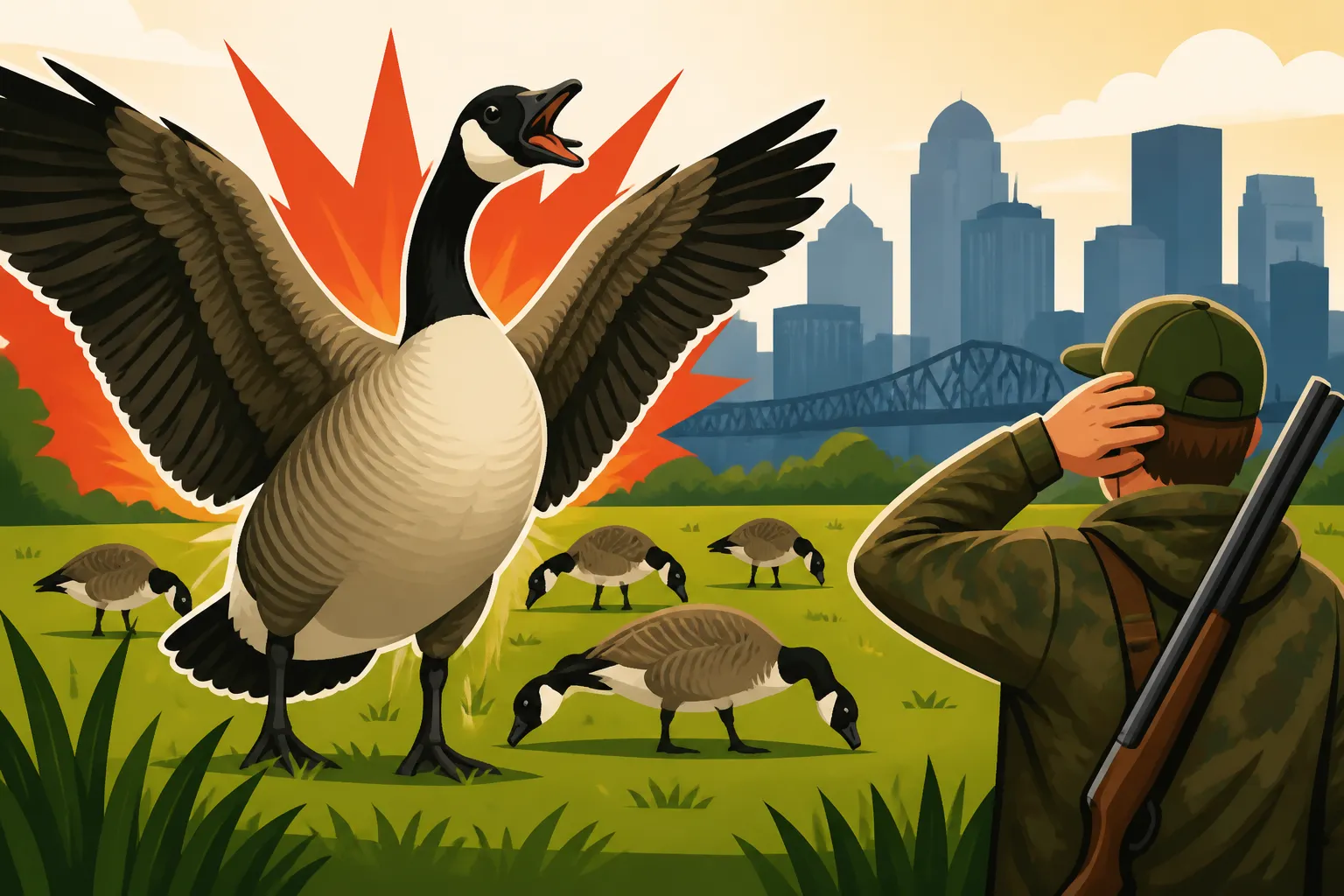
Resident Goose Problems Near Louisville
For folks living in and around Louisville, the sight of Canada geese used to be a special thing, a sign of migration, a herald of seasons changing. But these days, for many, the ever-present flocks of resident Canada geese have become less a wonder and more a significant nuisance, causing property damage, health concerns, and general frustration. This guide will dive deep into why these beautiful birds have become such a problem in our urban and suburban landscapes, and what options exist for managing their impact on our community and environment.
The Burgeoning Population of Resident Geese in Kentucky
It’s easy to look at a flock of geese honking away on a golf course or a city park and just see a bird, but behind that image is a fascinating story of conservation success that inadvertently led to a widespread management challenge. Unlike their migratory cousins who spend their summers breeding in the far north and winters here in the south, resident Canada geese have adapted to living in Kentucky year-round. This shift started decades ago with reintroduction efforts aimed at boosting waterfowl populations, and it worked, perhaps a little too well in certain areas.
These resident geese don't have the same migratory instinct; they find everything they need right here: abundant food in manicured lawns and agricultural fields, safe nesting sites near water bodies, and a distinct lack of natural predators in urban and suburban environments. This perfect storm of conditions has allowed their numbers to explode, particularly in regions like the Ohio River corridor around Louisville. They’re comfortable around people, often becoming quite bold, which further reduces any natural caution they might have. The result is a population that consistently grows, year after year, establishing larger and larger territories closer to human activity.
How Habitat Changes Fueled the Goose Boom
Think about how much the landscape around Louisville has changed over the last 50 years. We've seen an increase in suburban developments, golf courses, corporate parks with retention ponds, and countless community parks – all with meticulously mowed green grass leading right up to a convenient water source. This is goose paradise! Short grass is easy to graze, providing a constant food supply. Ponds and lakes offer safe refuge from ground predators, and their islands or banks provide ideal nesting locations.
These man-made habitats offer precisely what a Canada goose needs to thrive and reproduce. They avoid the grueling migration, which saves energy and reduces mortality risks, allowing more goslings to survive. The lack of hunting pressure in city limits also contributes significantly to their longevity and reproductive success. Without natural checks and balances, and with an abundance of ideal habitat, it’s no wonder we see them everywhere from the banks of the Ohio River to the smallest neighborhood retention pond. Waterfowl Hunting Kentucky Lakes and Rivers highlights hunting, which is a key management tool, but it's often unavailable in these urban settings where the problem is most acute.
The Lifecycle of a Resident Goose Flock
Understanding the annual cycle of these geese helps us grasp the scale of the problem. Early spring, typically March and April, sees nesting begin. Geese are fiercely territorial during this time, often chasing off people or pets who venture too close to their nests. Females will lay a clutch of 5-7 eggs, and both parents will guard them. By late spring to early summer, the goslings hatch. These young birds are incredibly vulnerable, but with devoted parents and few predators, many survive.
Around June and July, adult geese undergo their annual molt, where they shed all their flight feathers and become temporarily flightless for several weeks. During this period, they are highly concentrated around water bodies, making them even more noticeable and often leading to significant droppings accumulation in these areas. The goslings are also growing rapidly during this time. By late summer, the young are fledged, and the adults have regrown their flight feathers. Flocks then begin to consolidate, sometimes numbering in the hundreds, before dispersing somewhat in the fall and winter, though many will simply stay put in their chosen local habitat, continuing to graze and contribute to the problem year-round.
The Specific Challenges Posed by Geese Near Louisville
When you have large concentrations of any wildlife in close proximity to humans, issues are bound to arise, and resident Canada geese are no exception. For residents and property managers around Louisville, these challenges are very real and often quite costly. It’s not just about a few pretty birds; it's about significant impacts on public health, property aesthetics, and even safety.
Property Damage and Maintenance Nightmares
Let's be honest, geese eat a lot, and what goes in must come out. A single goose can produce a pound or more of droppings per day. Multiply that by a flock of 50 or 100 birds, and you’re looking at an astronomical amount of fecal matter covering lawns, sidewalks, golf courses, parks, and even private decks. This isn’t just unsightly; it makes surfaces slippery and unpleasant, requiring constant cleaning. Grass, especially newly planted or stressed turf, can be severely overgrazed and trampled, leading to bare spots and soil erosion. Hunting Land Between the Lakes Waterfowl offers a different perspective on goose management, but for urban areas, direct interventions are often needed.
Beyond grazing, geese can damage landscaping by pulling up young plants and flowers. Their constant foraging can compact soil, especially in high-traffic areas, impacting drainage and plant health. Golf courses, in particular, struggle with geese on greens and fairways, which can render sections unplayable and require extensive, expensive remediation. Businesses with attractive water features and manicured lawns often find their outdoor spaces becoming less inviting for customers and employees due to the sheer volume of goose droppings.
Public Health and Safety Concerns
While Canada geese are not typically aggressive, they can become quite bold and even confrontational, especially during nesting season when they are protecting their young. Charging, hissing, and wing-flapping displays are common, and while rarely leading to serious injury, they can certainly be intimidating, particularly for small children, the elderly, or pets. This can limit access to public spaces like parks or walking trails, as people avoid areas where geese are actively nesting or exhibiting defensive behaviors.
From a public health standpoint, goose droppings can carry various bacteria and parasites, including E. coli and Giardia. While direct transmission to humans is relatively uncommon from goose droppings themselves, large accumulations can contribute to water quality issues in ponds and lakes, especially those used for recreation. Contaminated water can be a concern for swimmers or even pets. Furthermore, geese nesting near airports or in flight paths pose a significant bird strike hazard, which is a serious safety concern for aviation.
| Impact Category | Specific Challenges | Who is Affected Most? |
|---|---|---|
| Aesthetics | Excessive droppings, grazed lawns, trampled vegetation | Homeowners, park visitors, golf courses, businesses |
| Property Damage | Overgrazing, soil compaction, plant destruction | Homeowners, golf courses, landscaping companies |
| Public Health | Bacterial contamination (e.g., E. coli), parasitic risks, water quality degradation | Swimmers, pet owners, general public using affected water bodies |
| Safety | Aggressive behavior during nesting, bird strike hazards (aviation) | Children, pets, airport personnel, pilots |
| Access | Unusable public spaces (parks, beaches, trails) due to droppings/aggression | Community members, recreational users |
Effective Strategies for Managing Resident Goose Populations
Dealing with resident geese is rarely a one-size-fits-all situation. It requires a comprehensive approach, often combining several different strategies, especially in densely populated areas like those surrounding Louisville. The key is consistency and understanding that managing wildlife populations is an ongoing effort, not a one-time fix.
Habitat Modification and Exclusion Tactics
One of the most proactive ways to address goose problems is to make your property less attractive to them in the first place. This is where habitat modification comes in. Instead of manicured lawns that offer an all-you-can-eat buffet, consider planting taller grasses or native vegetation along water edges. Geese prefer short grass because it allows them to easily see predators. Taller vegetation provides visual obstruction, making them feel less secure. Rocks, dense shrubs, or even small fences around water bodies can also deter them. Finding Ground That Sees Fewer Hunters applies to human hunters, but the principle of making an area less appealing is similar for geese.
Exclusion tactics can also be effective. Netting over ponds during nesting season can prevent them from settling. While more intensive, installing low-tension wire grids across small ponds can make landing difficult for geese. For smaller areas, even something as simple as a string of flags or reflective tape fluttering in the wind can provide a temporary deterrent, though geese are notoriously adaptable and may eventually ignore them. It's about breaking their routine and making the area less "comfortable."
Hazing and Harassment Programs
Hazing, or scaring geese away, is a common tactic, but it must be persistent and varied to be effective. Geese quickly habituate to static deterrents like plastic owls or fake coyotes. What works better are dynamic methods. This can include using border collies or other trained dogs to chase geese off properties, which mimics natural predation. Loud noises, pyrotechnics (used safely and legally, of course), or even remote-controlled boats can also be used to make an area feel unsafe for them.
The key to successful hazing is consistency. It's not enough to scare them once; you need to do it repeatedly, often multiple times a day, to convince them that the area is truly undesirable. This level of effort often requires dedicated personnel or a contracted service. For property owners looking to scout out areas and understand goose movements before implementing such programs, mapping tools like those offered by GoHunt can be invaluable for identifying key feeding and loafing areas and tracking their patterns on a given property or public land parcel. Understanding where the geese want to be helps you plan where to apply pressure.
Egg Addling and Nest Destruction
If you want to manage populations long-term, you have to address reproduction. Egg addling is a non-lethal method of preventing goose eggs from hatching. This involves shaking the eggs, oiling them with corn oil, or puncturing them, effectively terminating embryonic development without removing the nest. The crucial part is not to remove the eggs or the nest, because if you do, the geese will simply lay another clutch. By addling the eggs and leaving them in the nest, the female continues to incubate, wasting her reproductive effort for that season.
Nest destruction is another option, though typically only used when addling is not feasible or for nests that pose an immediate safety hazard. Both egg addling and nest destruction require specific permits from federal and state wildlife agencies (like the Kentucky Department of Fish and Wildlife Resources or the US Fish and Wildlife Service), as Canada geese are protected under the Migratory Bird Treaty Act. It is illegal to disturb nests or eggs without proper authorization, so always check with the authorities first.
Hunting and Other Control Methods in Urban/Suburban Settings
While hunting might seem like a solution more suited to remote areas, it can play a vital role in managing resident goose populations, even in more developed settings, though it requires careful planning and adherence to regulations. Beyond hunting, other more intensive control methods may be necessary in extreme cases.
Regulated Hunting Opportunities
For areas where it's safe and legal, hunting can be an effective tool to control resident goose numbers. Kentucky has specific seasons for Canada geese, and sometimes these seasons are structured to target resident populations. Hunters can contribute to population control and also put delicious, wild game meat on the table. Kentucky Duck and Goose Zone Rules outlines the regulations for migratory birds, which also apply to resident geese when they are hunted.
However, hunting within or very near developed areas like Louisville often presents significant challenges related to safety zones, noise ordinances, and public perception. Discharge of firearms or even archery equipment is often restricted or prohibited in city limits and densely populated suburban areas. This means that while hunting is a valid tool, its application near Louisville is often limited to larger private land parcels on the outskirts, or specific managed hunts approved by authorities on certain public lands where safety can be assured. Finding suitable spots can be tricky, but mapping tools like GoHunt can help identify larger tracts of land, public or private (with permission), where hunting might be a viable option, perhaps in adjacent counties.
Capture and Relocation/Culling Programs
In situations where goose populations are extremely high and other methods have failed, more intensive measures may be considered. Capture and relocation programs involve trapping geese, typically during their flightless molt period, and moving them to less populated areas. However, this is often a short-term solution as geese can return, or simply transfer the problem to a new location. It’s also logistically challenging and expensive, requiring significant resources and permits.
Culling, or lethal removal, is the most controversial but sometimes necessary option for severe overpopulation. This is usually a last resort, implemented only after all other methods have proven insufficient, and it is strictly regulated by federal and state agencies. It involves humanely dispatching geese, often by trained professionals, to reduce numbers to a manageable level. This is typically done to protect public health and safety, prevent extensive property damage, or address significant ecological impacts. Again, this requires strict adherence to regulations and is not something an individual can undertake without proper authorization. Public perception is also a major factor, and wildlife agencies often engage in extensive public education before implementing such programs.
The Role of Public Education and Community Involvement
Ultimately, managing resident goose populations around Louisville requires a community-wide effort. Educating the public about why feeding geese is detrimental – it encourages them to stay, concentrates them, and often provides them with unhealthy food – is crucial. Promoting responsible waste disposal, which reduces food sources, also helps.
For landowners and property managers, forming neighborhood groups or engaging with local wildlife agencies can facilitate coordinated management efforts. When everyone in a neighborhood or on a complex works together on habitat modification, hazing, and applying for necessary permits for addling, the chances of long-term success are much higher. A fragmented approach where one property manages geese but the adjacent one does not will rarely yield lasting results. Even using an app like GoHunt to understand the layout and potential flight paths of geese across different properties could aid in a unified management strategy among neighbors. Kentucky Deer Camp Traditions shows how communities come together for hunting; a similar spirit, though for a different purpose, can benefit goose management.
Disclaimer
This article is for general informational purposes only and does not constitute professional advice. Laws, prices and regulations vary by location and change over time. Consult a qualified professional for guidance on your specific situation.