Kentucky Whitetail Color Phase Rarities
Every hunter who spends enough time in the Kentucky woods eventually develops a keen eye for the subtle variations in a whitetail deer's coat. You learn to spot the slight shift from summer russet to winter gray, the faint darker stripe along the back, the crisp white belly. But what about those truly rare, almost mythical deer that stand out from the herd with strikingly different color patterns? This guide dives deep into the fascinating world of Kentucky whitetail color phase rarities, exploring the genetics behind these unique animals and offering insight into why you might occasionally catch a glimpse of something truly extraordinary.
The Standard Whitetail Palette: A Baseline Understanding
Before we can appreciate the truly rare, it's helpful to remember what's considered "normal" in the whitetail world. Most of the deer you'll encounter across the Bluegrass State, from the dense timber of Daniel Boone National Forest to the sprawling farmlands of western Kentucky, adhere to a remarkably consistent color scheme. This isn't by accident; it's nature's perfect camouflage, honed over millennia to help these animals blend seamlessly into their surroundings. Understanding this baseline is crucial for recognizing when something truly out of the ordinary crosses your path.
The Common Fawn and Gray-Brown Coats
The quintessential whitetail coat color is a masterclass in natural selection. In the warmer months, typically from late spring through early fall, deer sport a reddish-brown or "fawn" coat. This hue blends beautifully with the lush green foliage and the ruddy tones of fresh earth that dominate the Kentucky landscape during summer. It's a color that can make a deer seemingly disappear into a thicket of blackberry briars or stand of young saplings, even when they're relatively close.
As the seasons turn and the days shorten, you'll notice a gradual but distinct change. By late fall and throughout the winter, that rich fawn gives way to a duller, more grayish-brown coat. This transformation is just as vital for survival, allowing deer to melt into the muted grays and browns of bare timber, fallen leaves, and dormant fields. This shift is particularly noticeable when you're glassing a distant hillside or trying to pick out a deer moving slowly through a stand of hardwoods after a light snow. It’s the color we’ve come to expect when we head out for Kentucky's Statewide Modern Gun Season or are Hunting the Late-Season January Lull.
Seasonal Shifts and Environmental Factors
These seasonal color changes aren't merely cosmetic; they're a physiological response to temperature and light cycles. The thicker, grayer winter coat provides better insulation against the colder Kentucky temperatures, while the summer coat is lighter and less insulating. But beyond the seasonal rhythm, individual deer can also show subtle variations based on their age, diet, and even the local soil composition. A deer living in a mineral-rich area might have a slightly different sheen to its coat compared to one in a less fertile region, though these differences are usually minor and fall within the "normal" spectrum.
Sometimes, what appears to be an unusual color might just be a deer covered in mud, or one that's particularly wet from a morning dew. Hunters often share stories of seeing a deer that looks "off" only to realize it's just a trick of the light or environmental conditions. However, there are indeed genetic anomalies that produce genuinely unique and rare color phases, which we'll explore next.
Unveiling the Uncommon: True Albinism and Leucism
When most people think of a "white deer," they're often thinking of one of two distinct genetic conditions: albinism or leucism. While both result in a white or mostly white coat, the underlying biological mechanisms and associated characteristics are quite different. These deer are true standouts, garnering attention and sometimes even local legend status when they appear in a particular area. Kentucky, with its robust Kentucky Deer Population Estimate, certainly sees its share of these unique individuals.
The Striking White: Albinism Explained
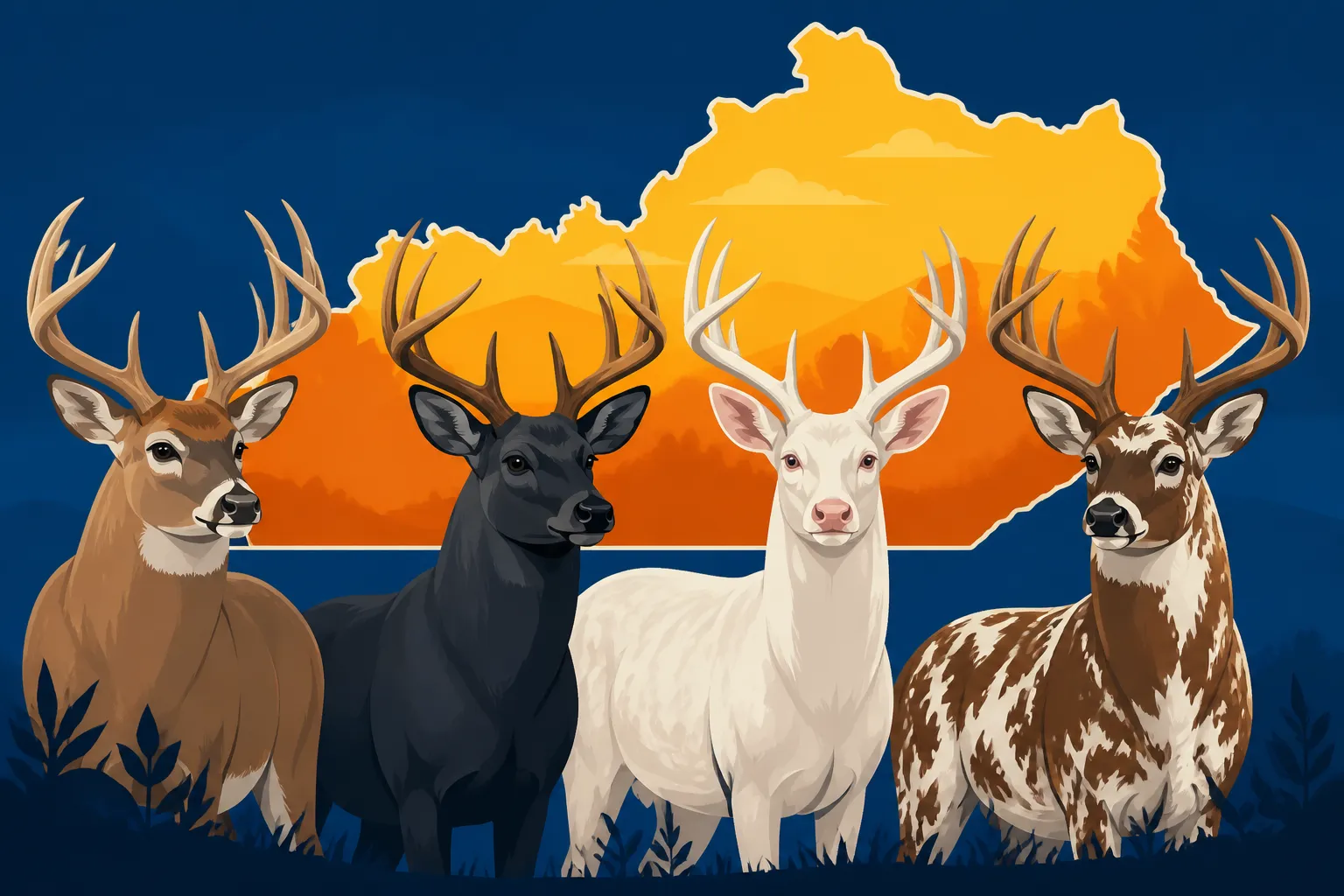
True albinism is a fascinating, though often challenging, genetic condition. It's caused by a complete lack of melanin, the pigment responsible for skin, hair, and eye color. For a whitetail deer, this means a coat that is pure, unblemished white, eyes that are distinctly pink or reddish due to the visible blood vessels, and hooves that are often pale. This complete absence of pigment is what sets a true albino apart from other white deer.
The genetic basis for albinism is a recessive gene. This means that both parents must carry the gene, even if they themselves display normal coloration, for an albino fawn to be born. Because it's a recessive trait, true albinos are incredibly rare. Their distinctive appearance, while beautiful to us, often comes with challenges in the wild. Their bright white coat makes them incredibly conspicuous, a significant disadvantage when trying to hide from predators or other hunters. Furthermore, the lack of pigment in their eyes can lead to vision problems, particularly sensitivity to bright sunlight, making navigation and foraging more difficult.
The More Common White: Leucism and Its Variations
More frequently seen than true albinism is a condition called leucism. Like albinism, leucism results in a lack of pigmentation, but it's usually a partial rather than a complete absence. Leucistic deer can range from mostly white to exhibiting patchy white areas interspersed with their normal brown coat. The key distinguishing feature from albinism, and often the easiest way for a hunter to tell the difference, is eye color. Leucistic deer will have normal-colored eyes (usually brown) and often normal-colored noses and hooves. This is because leucism affects only the pigment cells in the hair and skin, not the eyes.
Leucism is also genetically based, but it can manifest in various ways. Sometimes you'll see a deer that's almost entirely white but has dark eyes, fitting the definition of a leucistic deer. Other times, the partial loss of pigment results in what we commonly call a "piebald" deer. These deer have irregular patches of white and brown, creating a striking, almost painted appearance. While still rare, leucistic deer, particularly piebalds, are seen more often than true albinos in the wild. Their normal eye color generally means they don't suffer the same vision impairments as albinos, which can give them a slight edge in survival.
The Dark Horse: Melanism in Kentucky Whitetails
If white deer are rare, imagine a whitetail that is almost entirely black. That's melanism, and it's an even more elusive and rarely documented color phase in whitetail deer. While albinism and leucism are about a lack of pigment, melanism is about an overabundance of it, making these deer strikingly dark, sometimes appearing solid black. Seeing one of these animals in the wild is truly a once-in-a-lifetime experience for most hunters, akin to winning the Kentucky Elk Quota Hunt Rules lottery.
The Elusive Black Whitetail: What Melanism Is
Melanism is caused by a genetic mutation that results in an excessive production of melanin, specifically the dark pigment eumelanin. Instead of the typical brown and tan tones, melanistic deer have coats that range from a very deep, rich chocolate brown to a true coal black. Their eyes, nose, and hooves will also be dark, sometimes even darker than a normally colored deer. This is not just a trick of the light or a very dark-coated typical whitetail; it's a distinct genetic variation.
The rarity of melanistic whitetails is extreme. While some species, like jaguars or leopards, have relatively common melanistic phases (often called "black panthers"), it is incredibly uncommon in whitetail deer. Most documented cases of melanism in whitetails have been confined to specific, small geographic regions, suggesting that the gene might be localized to certain populations. In Kentucky, if a melanistic deer were sighted, it would likely generate significant interest and discussion among the hunting and wildlife communities.
Why You Might Never See One: Challenges of Observation
The primary reason most hunters will likely never lay eyes on a melanistic whitetail in Kentucky is their extreme scarcity. They are far less common than even albino or piebald deer. If you consider the sheer number of White-Tailed Deer Across Kentucky, and the vast majority are "normal" brown, the odds of encountering one of these black deer are astronomical.
Beyond their inherent rarity, melanistic deer face their own set of survival challenges. While a dark coat might offer some camouflage in very dense, shadowy timber or during twilight hours, it makes them stick out dramatically in open fields, against snow, or in typical deciduous forests during daylight. This lack of effective camouflage could potentially make them more vulnerable to predators, reducing their chances of reaching maturity and reproducing, thus further limiting the spread of the melanistic gene. This natural selection pressure contributes to why they remain such a rare sight.
Other Noteworthy Color Anomalies
Beyond the well-known albinism, leucism, and the ultra-rare melanism, there are other, more subtle, but still distinct color anomalies that can occur in Kentucky whitetail deer. These variations might not be as dramatic as a pure white or black coat, but they certainly catch a hunter's eye and spark curiosity about the diverse genetics within our deer herds. Understanding these, combined with tools like Scouting With the Kentucky Hunt Fish App, can help you identify unique deer populations in specific areas.
Piebald Deer: A Spectrum of White Patches
As mentioned earlier, piebald deer are a form of leucism, but they warrant their own discussion because of their relatively higher frequency compared to true albinos. A piebald deer is characterized by irregular patches of white hair mixed with areas of normal, brown coloration. The size, shape, and distribution of these white patches can vary wildly from one individual to another. You might see a deer with just a large white blaze on its face or neck, while another could have significant white areas across its body, legs, and even its tail.
Interestingly, piebald deer often exhibit other physical deformities in addition to their unique coat patterns. These can include a Roman nose, short or bowed legs, an arched spine (scoliosis), and internal organ abnormalities. These associated traits suggest that the gene responsible for the piebald coloration can have pleiotropic effects, meaning it influences multiple seemingly unrelated traits. While beautiful in their uniqueness, these physical challenges can sometimes impact a piebald deer's agility and overall health, making survival more difficult. However, many piebalds live perfectly normal lives, and encountering one is always a memorable experience.
Erythrism: The Red Deer of the Whitetail World
Erythrism is perhaps one of the most subtly beautiful and least recognized color anomalies in whitetail deer. Sometimes called "red deer," these animals display an unusual reddish or cinnamon hue to their coats, often more intense and consistent than the typical summer fawn color. This condition is caused by an overproduction of red pigments (pheomelanin) or a reduction in dark pigments (eumelanin), leading to a much more pronounced reddish cast.
Unlike the stark contrast of white or black deer, erythristic whitetails might simply look "really red" to the casual observer. It takes a discerning eye, perhaps developed after years of comparing the browns and grays of countless deer, to truly appreciate the distinctness of an erythristic animal. They blend surprisingly well into certain environments, especially during the fall when the leaves are turning, making them even harder to spot. Given their subtle appearance and extreme rarity, photographic evidence of erythrism in Kentucky whitetails is exceedingly scarce, making a verified sighting a truly special event for any hunter or wildlife enthusiast.
Here’s a quick overview of these fascinating color phases:
| Color Phase | Description | Pigment Level | Eye Color | Rarity in Whitetails | Associated Issues (Often) |
|---|---|---|---|---|---|
| Normal | Brown/gray, seasonal shifts | Normal | Brown | Common | None |
| Albino | Pure white coat, no pigment | None (Complete) | Pink/Red | Extremely Rare | Vision impairment, increased predation |
| Leucistic | Mostly or patchy white coat, partial pigment absence | Partial/Variable | Brown (Normal) | Rare | Sometimes none; may have issues if severe |
| Piebald | Irregular white patches, a form of leucism | Partial/Variable | Brown (Normal) | Rare (Most common anomaly) | Skeletal deformities, organ issues |
| Melanistic | Dark brown to black coat, excessive pigment production | Excessive (Complete) | Dark (Normal) | Exceptionally Rare | May stand out to predators in certain environments |
| Erythristic | Unusually reddish or cinnamon-colored coat | Abnormal Red/Reduced Dark | Brown (Normal) | Extremely Rare | None known |
Hunting Considerations and Ethics
Encountering a whitetail with a rare color phase in Kentucky is an unforgettable experience. It's the kind of story that gets told around the campfire for years, and a photo that becomes a cherished memory. But for hunters, it also raises interesting questions about ethics, personal choice, and the role we play in wildlife management. Whether you're hunting in Daniel Boone National Forest Hunting or a small private tract, these encounters are special.
The Hunter's Dilemma: To Shoot or Not to Shoot?
This is a deeply personal question, and there's no single "right" answer. From a biological standpoint, a deer with a rare color phase is just another deer. It doesn't receive special protection under Kentucky hunting regulations (unless it falls within specific Kentucky Deer Management Zone Rules for antler point restrictions or bag limits, which are color-independent). If it's legal game, it's legal game.
However, many hunters feel a strong pull to let these unique animals walk. Some view them as trophies of a different kind—a rare sighting that adds beauty and mystique to the woods. Others might feel a conservationist's instinct, hoping the animal will reproduce and pass on its rare genes, even though recessive genes like those for albinism and melanism require specific pairings to manifest again. There's also the element of public perception; while ethical hunters understand the legality, non-hunters or anti-hunters might sensationalize the harvest of a "white deer" in a negative light. Ultimately, the decision rests solely with the individual hunter, weighing personal values, local sentiment, and the hunting laws.
Reporting Sightings and Genetic Interest
Regardless of whether you choose to harvest a rare color phase deer, reporting a sighting can be a valuable contribution to wildlife science. The Kentucky Department of Fish and Wildlife Resources (KDFWR) is always interested in unusual observations, as it helps them monitor genetic diversity and herd health. While there isn't a formal reporting system specifically for color anomalies, a call to your local conservation officer or regional biologist could provide valuable data, especially if you have photographic evidence.
For dedicated deer enthusiasts or those managing private land, keeping tabs on where these rare deer appear can offer fascinating insights into local genetics. Imagine observing a specific area for years, perhaps using tools like GoHunt to mark deer sightings on your maps and track movement patterns. If you consistently see piebald deer, for instance, it might indicate a localized genetic cluster. This kind of detailed observation adds another layer of appreciation to the intricate world of Kentucky's White-Tailed Deer. It’s a chance to be part of the ongoing story of Kentucky's wildlife, observing its most unique characters.
Disclaimer
This article is for general informational purposes only and does not constitute professional advice. Laws, prices and regulations vary by location and change over time. Consult a qualified professional for guidance on your specific situation.