Marsh Boats and Push Poles
For Kentucky waterfowl hunters, the dream of accessing those secret, shallow honey holes in flooded timber or expansive marshlands can quickly turn into a frustrating paddle or a stuck boat. Standard watercraft often draw too much water or lack the maneuverability needed to navigate dense vegetation and unforgiving mud. This guide is all about equipping you with the knowledge to conquer those tricky backwater spots by explaining the ins and outs of marsh boats and the indispensable push pole, ensuring you can reach birds that others simply can't.
The Challenge of Kentucky's Watery Backcountry
Kentucky might be known for its rolling hills and majestic deer, but for those of us with ducks and geese on the brain, its diverse waterways offer some incredible hunting opportunities. However, these aren't always wide-open lakes or deep rivers. A huge part of the waterfowl experience here lies in the shallow, often impenetrable marshlands, flooded timber, and intricate creek systems that require specialized gear to access.
Why Standard Boats Fall Short in Shallow Water
If you've ever tried to take a regular V-hull fishing boat, or even a typical aluminum johnboat with a standard outboard, into knee-deep or shallower water, you know the struggle is real. The propeller churns mud, gets tangled in weeds, or worse, hits submerged stumps and rocks, leaving you stranded or with a hefty repair bill. The draft of most recreational boats is simply too deep, and their maneuverability in tight, vegetation-choked areas is abysmal. You end up making more noise, spooking birds, and expending more effort just trying to get to your spot than actually hunting. It's a common scenario: you see ducks pitching into a slough just out of reach, or hear geese honking in a flooded field, knowing a regular boat won't cut it. This is precisely why specialized equipment is not just a luxury, but a necessity for serious waterfowlers in Kentucky's unique environments.
Understanding Kentucky's Prime Marsh and Backwater Habitats
Kentucky boasts a surprising variety of shallow-water habitats perfect for waterfowl, especially in its western regions. Think of the expansive bottomlands along the Mississippi and Ohio Rivers, like those found around the Sloughs Wildlife Management Area or parts of Land Between the Lakes. These areas are characterized by vast stretches of flooded timber, cypress swamps, and shallow sloughs that fluctuate with water levels, sometimes only being a few inches deep. You'll encounter dense stands of buttonbush, smartweed, and other aquatic vegetation that forms a formidable barrier to conventional boats. Further east, even smaller river systems and creeks can have backwater pockets and oxbows that hold birds but are too shallow or snag-filled for a prop. Understanding these environments is the first step to choosing the right gear, and an app like GoHunt can be invaluable for studying satellite imagery of these areas before you even set foot (or boat) in the water, helping you pinpoint potential access points and hidden hot spots. Knowing where the water is likely to be skinny, where the vegetation is thickest, and where those crucial pockets of open water might be, empowers you to plan your approach effectively.
Marsh Boats: Your Shallow-Water Workhorse
When you're serious about hunting Kentucky's backwaters, a marsh boat isn't just a boat; it's a strategic advantage. These specialized vessels are engineered from the keel up to navigate conditions that would leave other boats dead in the water. They are the backbone of any successful shallow-water waterfowl operation.
Key Features of a Dedicated Marsh Boat
What makes a marsh boat special? It starts with the hull design. Most feature an incredibly flat, or nearly flat, bottom. This design minimizes draft, allowing the boat to float in just a few inches of water, literally skimming over submerged obstacles. Low sides are another common characteristic, reducing the boat's profile for better concealment and making it easier to load and unload decoys, dogs, and gear. Durability is paramount; these boats are built to take a beating from stumps, ice, and rough usage. Materials typically include heavy-gauge aluminum for strength and longevity, or rotomolded polyethylene for incredible impact resistance and a slightly quieter ride. Stability is also a major design factor. When you're standing to pole, calling in birds, or retrieving a downed duck, you need a platform that won't feel like a canoe. Good marsh boats are designed to be stable even when laden with gear and a hunting dog. Their open layout also provides maximum space for decoys, guns, and your trusty retriever.
Types of Marsh Boats for Kentucky Hunting
The world of marsh boats is more diverse than you might first imagine, offering options for every budget and hunting style.
- Modified Jon Boats: These are perhaps the most common and accessible entry point. A standard aluminum jon boat, especially one with a wider beam and flatter bottom, can be modified for marsh hunting. This often involves adding a false floor to improve stability, building shooting rails, and applying camouflage paint. They are versatile and relatively affordable. While they might not be as purpose-built as other options, a well-outfitted jon boat can serve a Kentucky waterfowler admirably, particularly for areas where you might still run a small outboard on approach.
- Specialized Duck Boats: Companies like Go-Devil, Gator-Trax, Excel, or custom builders produce vessels specifically designed for the rigors of marsh and flooded timber hunting. These boats often incorporate features like reinforced transoms for mud motors, integrated spud pole receivers, and highly durable construction. They are typically wider, more stable, and often have completely open interiors for maximum cargo space. Some even have built-in dog ladders or platforms. These are investments, but for hunters who spend extensive time in challenging environments, they pay dividends in reliability and performance. When planning out your hunt using a tool like Scouting With the Kentucky Hunt Fish App, thinking about the type of terrain you'll be covering can help inform your boat choice.
- Layout Boats/Sneak Boats: While less common for general marsh access, these low-profile boats are designed for ultimate concealment, often used in conjunction with larger mother ships or for hunting open water where ducks are wary. They are built to blend seamlessly with the environment, often resembling a log or chunk of debris, allowing you to hide effectively in places without natural cover. These are typically one or two-person boats.
When considering a purchase, think about your primary hunting grounds. Are you always in flooded timber along a river, or are you navigating large, open marshes that require more gear? What's your budget? How will you transport it? A smaller, lighter boat might be easier to haul and launch, while a larger one offers more comfort and carrying capacity.
| Boat Type | Primary Use Case | Pros | Cons |
|---|---|---|---|
| Modified Jon Boat | Versatile, general shallow water | Affordable, widely available, customizable | Not purpose-built, can be less durable/stable than specialty boats |
| Specialized Duck Boat | Extreme shallow water, heavy vegetation | Superior durability, stability, performance | Higher cost, less versatile for other boating activities |
| Layout/Sneak Boat | Open water, ultimate concealment | Excellent stealth, low profile | Limited capacity, typically requires mother ship/tow |
Propulsion Options Beyond the Push Pole
While the push pole is the star for navigating the tightest spots, marsh boats often employ other propulsion methods for getting to the general hunting area or covering slightly deeper sections more efficiently.
- Trolling Motors: Electric trolling motors are a fantastic choice for stealthy navigation. They produce very little noise, are easy to control, and can be remarkably effective in shallow water, especially when paired with a good battery. Many modern trolling motors can be mounted on the bow or transom, and some even have GPS capabilities for spot-locking. They're great for subtle adjustments in the spread or moving slowly through open pockets of water without spooking birds.
- Mud Motors (Surface Drive/Long Tail): For the truly extreme shallow water and dense vegetation, nothing beats a mud motor. These specialized outboards are designed to run in inches of water, churning through mud, weeds, and stumps that would quickly foul a conventional prop.
- Long-tail mud motors feature a long shaft that extends from the engine to the prop, allowing the prop to run far below the engine, even in extremely shallow water. They offer incredible thrust in thick cover but can be slower and require more physical effort to steer.
- Surface drive mud motors have a shorter, more compact lower unit that operates just below the surface, allowing them to skim over obstacles. They are generally faster and more maneuverable than long-tails.
Both types of mud motors are game-changers for accessing areas like the deep recesses of Hunting Land Between the Lakes Waterfowl or the overgrown sloughs of Hunting the Ohio River Backwaters, where traditional outboards just won't cut it. They are loud, but they get you to your spot, where you then often switch to a push pole for the final, silent approach.
The Indispensable Push Pole
If the marsh boat is your workhorse, the push pole is its precision instrument. It's the silent, steady hand that guides you through the most challenging waterfowl habitat, allowing for unmatched stealth and control.
Why a Push Pole is More Than Just a Stick
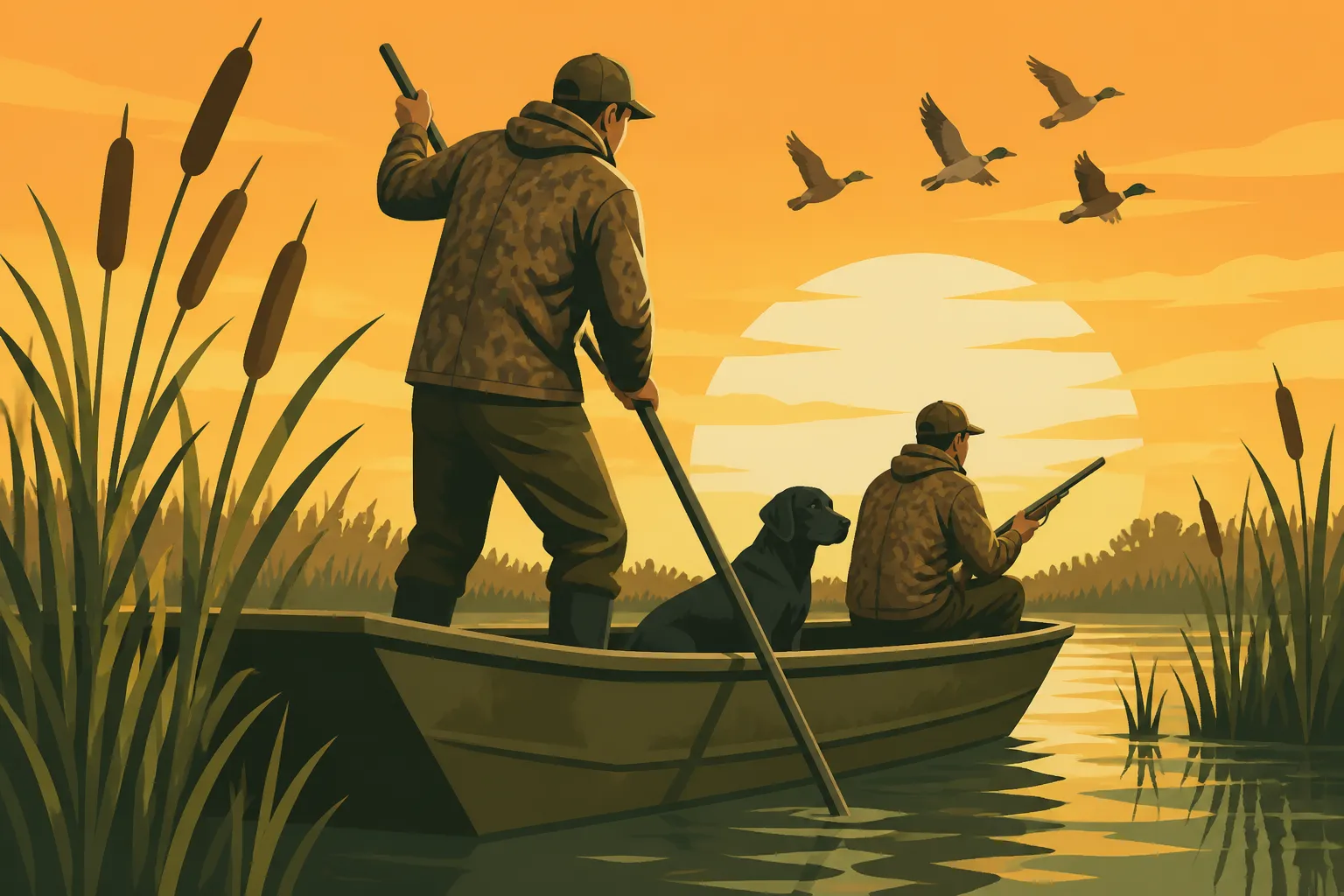
A push pole is far more than just a long stick; it's an essential piece of equipment for any serious shallow-water hunter. Its primary advantage is stealth. Unlike an outboard motor or even the splash of a paddle, a push pole allows for virtually silent movement. You can ease your boat through dense cattails, navigate around submerged logs, or approach a flock of feeding ducks without making a sound. This precision is crucial when you're trying to set up in a specific pocket of flooded timber or inch your way into a narrow slough. Beyond stealth, a push pole provides incredible control. You can stop on a dime, pivot in tight spaces, and use it to brace your boat against the wind or current. It's also an invaluable tool for getting unstuck. When your mud motor bogs down or your boat gets high-centered on a hidden sandbar, a push pole is often your only way out, allowing you to leverage your way back into deeper water. In environments where you might be Reading a Bottomland Slough for a Morning Flight, the silence of a push pole is critical for not blowing out the birds before you even set up.
Choosing the Right Push Pole for Kentucky Waters
Selecting the right push pole can significantly impact your hunting experience. It's not a one-size-fits-all tool.
- Materials:
- Fiberglass: This is a popular and relatively affordable option. Fiberglass poles are durable, offer good stiffness, and can withstand a lot of abuse. They might be a bit heavier than composite options, but they're reliable.
- Graphite/Carbon Fiber: These poles are the Cadillac of push poles. They are incredibly lightweight, offering exceptional stiffness and sensitivity. The reduced weight makes a huge difference over a long day of poling, minimizing fatigue. However, they come with a higher price tag. They are also typically more brittle if struck hard against a sharp object.
- Aluminum: Less common, but some poles incorporate aluminum sections. While strong, aluminum can be noisy if it scrapes against the boat or other objects, and it can become quite cold in frosty conditions.
- Length Considerations: The ideal length depends on a few factors: the depth of the water you typically hunt, your height, and whether you're poling from a standing or seated position. A good rule of thumb is to choose a pole that, when stood vertically on the bottom, reaches comfortably above your head by at least a foot or two. This provides enough leverage for pushing and allows you to clear the tops of taller vegetation. For most Kentucky marsh hunting, poles between 12 to 18 feet are common.
- Foot Design: The business end of your push pole matters.
- Duck Foot/Wedge Foot: This is the most popular design, featuring a wide, flat, or slightly cupped foot that provides excellent purchase in soft mud and prevents the pole from sinking too deeply. It disperses pressure over a larger area, making it easier to push.
- Spike/Pointed Foot: Some poles have a more pointed tip, which can be useful for breaking through ice, probing for submerged obstacles, or digging into harder bottoms. However, they are prone to sinking deeply in soft mud.
- Multi-Purpose Feet: Some innovative designs offer interchangeable tips or a combination of features to handle various bottom conditions.
- Storage and Transport: Consider how you'll store your pole in the boat and transport it. Many poles are now telescopic or two-piece, making them much more manageable for storage in tight spaces or on roof racks. A good pole clip or holder in your boat will keep it secure and readily accessible.
Tactics and Safety for Marsh Boat Hunting
Having the right gear is only half the battle; knowing how to use it effectively and safely is what truly sets a successful marsh hunter apart.
Navigating with a Push Pole: Techniques and Best Practices
Poling a marsh boat efficiently is an art that comes with practice. The basic technique involves pushing the pole into the bottom and leaning into it, propelling the boat forward. However, there are nuances that make a big difference. For consistent forward motion, try to keep the pole angled slightly behind you, pushing through your core rather than just your arms. To steer, you can angle the pole to one side, using it like a rudder, or push off one side more forcefully than the other. When encountering dense vegetation, you might need to use a "stabbing" motion to get the pole through the weeds to the bottom, then push firmly. For breaking through thin ice, a sharp jab with a sturdy pole can create a path. Always be mindful of your surroundings; use the pole to probe ahead for hidden stumps or sudden drop-offs. If you're hunting with a partner, communication is key. One person might pole while the other manages decoys or dogs, ensuring a smooth and silent approach.
Rigging Your Marsh Boat for a Successful Hunt
A well-rigged marsh boat enhances both efficiency and comfort. Think about what you need quick access to and how to keep it organized and secure.
- Decoy Storage: Mesh bags are excellent for decoys, allowing water to drain. Dedicated storage compartments or a simple bungee system can keep them from sliding around. Many marsh boats are designed with open floors for piling decoys, which means you need to manage them effectively so they don't impede movement.
- Gun Rests: Simple horizontal bars or dedicated V-shaped holders can keep your shotgun secure and accessible, preventing it from getting wet or damaged. Make sure they are positioned for quick, safe retrieval.
- Dog Platforms/Ladders: If you hunt with a retriever, a dedicated dog platform or a folding ladder over the side can make it much easier for your dog to get in and out of the boat, especially in cold water. This reduces stress on both you and your companion. Ensure the platform is non-slip. Before you hit the water, especially in colder weather, consider if your dog needs something like Dog Vests for Cold Water Retrieves.
- Camouflage: Beyond the factory paint job, consider adding natural vegetation from the area to the boat's edges to further break up its outline. A simple burlap or netting blind can be quickly erected once you reach your spot. For field edges, combining your boat with tactics from Layout Blind Hunting a Cut Cornfield can offer ultimate concealment.
- Anchoring: In shallow water, traditional anchors can be cumbersome. Spud poles are a fantastic alternative. These are simply long, sturdy poles (often aluminum or fiberglass) that you push directly into the soft bottom to hold your boat in place. Many specialized duck boats come with receivers for spud poles, making deployment quick and silent. Shallow water anchors, like those from Power-Pole or Minn Kota, are another excellent, albeit more expensive, option, using a hydraulic spike to silently secure the boat.
Essential Safety Considerations in Backwater Environments
Hunting in shallow, remote waters carries its own set of risks. Prioritizing safety is paramount.
- Personal Flotation Devices (PFDs): Always wear a PFD, especially in cold weather or when moving through unfamiliar waters. Modern inflatable PFDs are lightweight and unobtrusive, making them easy to wear all day. Even if you consider yourself a strong swimmer, a PFD is vital if you unexpectedly fall into frigid water while wearing heavy hunting clothes.
- Communication: Cell service can be spotty or nonexistent in remote marsh areas. Carry a fully charged cell phone in a waterproof bag, but also consider a satellite messenger or a two-way radio if you're with a group or in a truly isolated spot. Let someone know your float plan, including where you're going and when you expect to return.
- Cold Weather Precautions: Hypothermia is a real threat. Dress in layers with materials that insulate even when wet (like wool or synthetics). Carry extra dry clothes in a waterproof bag. A thermos of hot coffee or soup can be a lifesaver on a frigid morning. Be extra cautious about falling in when the water is near freezing.
- Familiarity with the Area: Scout your chosen hunting grounds beforehand if possible. Understand currents, potential hazards like hidden stumps or sudden deep holes, and the general layout. The Kentucky Hunt Fish app or services like GoHunt can provide invaluable aerial imagery for this pre-hunt scouting, allowing you to identify likely travel lanes and potential dangers. Remember that water levels can change rapidly, so what was a shallow mud flat last week could be a flowing creek this week. For managing varying water depths and terrain, a good pair of Chest Waders Versus Hip Boots for Flooded Timber might also be a critical part of your gear. Always be prepared for the unexpected, and respect the power and unpredictability of Kentucky's waterways.
Disclaimer
This article is for general informational purposes only and does not constitute professional advice. Laws, prices and regulations vary by location and change over time. Consult a qualified professional for guidance on your specific situation.