Fixed Versus Mechanical Broadheads
You’re standing there, bow in hand, the chill of a Kentucky October morning biting at your exposed skin, and all you can think about is that moment of truth. You’ve put in the scouting, found the perfect Treestand Setups in Daniel Boone National Forest, and practiced countless hours. But when it comes down to sending that arrow toward a big Bluegrass buck, a critical choice hangs in the balance: fixed blade or mechanical broadheads? It's a debate as old as modern bowhunting itself, and honestly, the sheer volume of opinions out there can make your head spin. This guide is going to cut through the noise, validate those nagging uncertainties, and help you understand the real-world implications of each broadhead type for your Kentucky hunting adventures.
The Unyielding Edge: Understanding Fixed Blade Broadheads
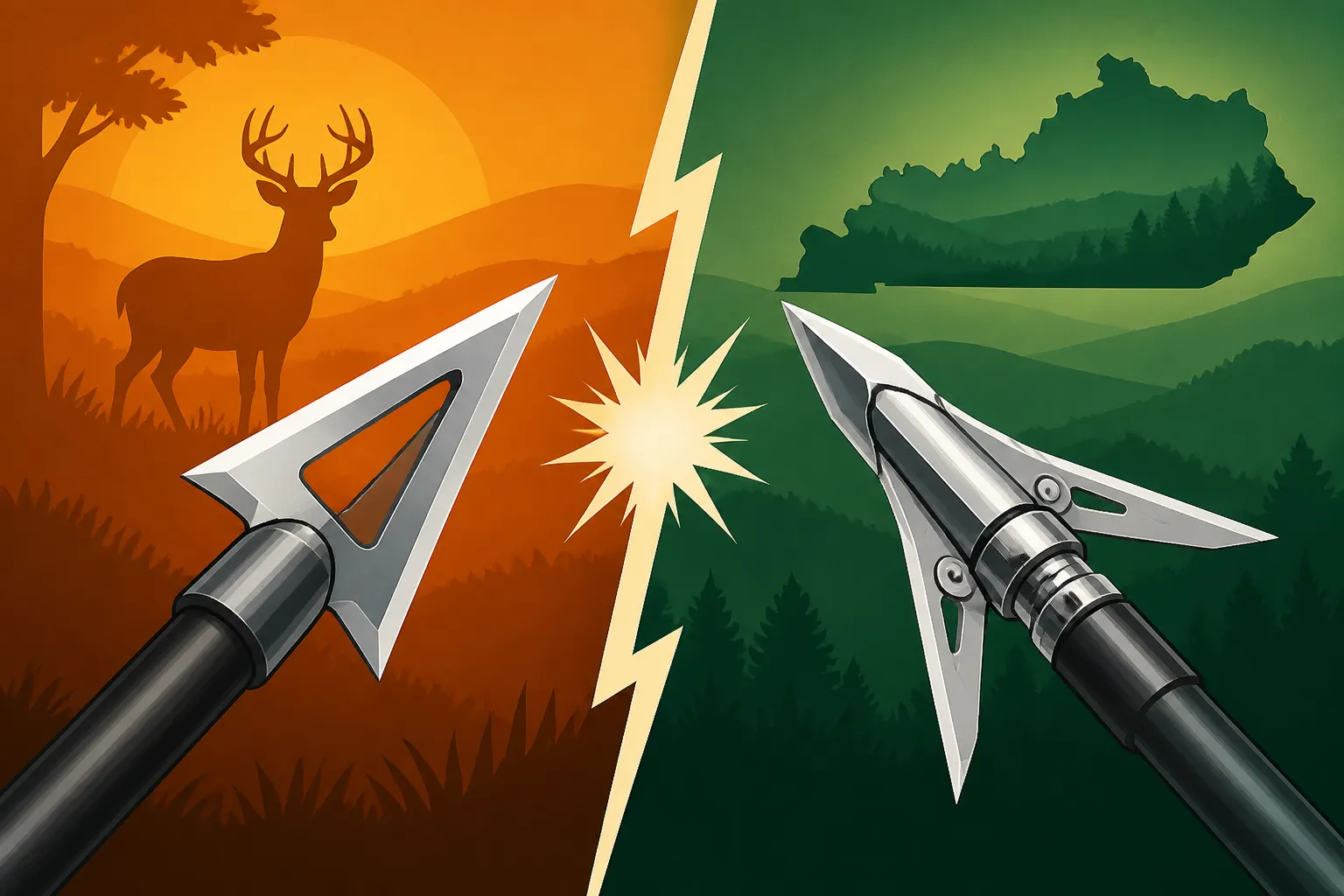
Let’s be real, there’s something reassuringly simple and robust about a fixed blade broadhead. These are the workhorses, the tried-and-true choice for generations of bowhunters. A fixed blade broadhead, at its core, is a cutting head where the blades are permanently affixed to the ferrule (the main body that screws into your arrow insert). They don't move, they don't expand, and that's their biggest strength. When that arrow leaves your string, those blades are exactly where they’re going to be when they hit their mark.
One of the biggest advantages you’ll hear sung about fixed blades, particularly among those who hunt gnarly, thick Kentucky timber or chase larger game like elk, is their unparalleled penetration. Because there are no moving parts to absorb kinetic energy upon impact, all that force is transferred directly into driving those sharp edges through hide, muscle, and bone. Think about hitting a deer quartering away slightly, where the arrow might have to punch through a rib on the entry side before getting to the vitals. A well-placed fixed blade broadhead, especially one with a good Arrow Weight for Short Shots and a solid front-of-center (FOC) arrow setup, can absolutely shine in these tougher penetration scenarios. They maintain their integrity incredibly well, even after smashing through denser tissue or bone, meaning you often get two holes—entry and exit—which is crucial for a good blood trail. Many seasoned hunters swear by their durability and the confidence they instill, especially when every single ounce of energy matters.
However, it’s not all sunshine and roses with fixed blades. The most common frustration hunters voice is around tuning. Unlike field points, which are perfectly aerodynamic, those fixed blades can act like little rudders on your arrow, causing it to plane or fly inconsistently if your bow isn't impeccably tuned. This means more time on the practice range, carefully adjusting your rest, cam timing, or nock point to get those broadheads to hit precisely with your field points. It can be a real headache, especially if you're like me and your hunting time is already precious enough. But when you get it right, when those fixed blades zing true out to 40 yards, there’s a deep satisfaction in knowing your setup is dialed. Many bowhunters who utilize a platform like GoHunt find detailed discussions and tips on broadhead tuning for various setups, which can be incredibly helpful.
The Expanding Advantage: How Mechanical Broadheads Work
Then you have the mechanical broadheads, often called "expandables." These broadheads represent a leap in technology aimed at addressing some of the traditional frustrations with fixed blades. The core idea here is clever: the blades are tucked away during flight, making the broadhead more aerodynamic and fly much closer to the trajectory of a field point. This usually translates to better accuracy out of the box for many hunters, often requiring less fine-tuning of their Bow and Crossbow Setups for Kentucky.
The magic happens on impact. Upon striking the target, the force of the impact causes the blades to deploy or expand, creating a significantly larger cutting diameter than most fixed blades. This wider cut means a massive wound channel, which is exactly what you want for a quick, humane kill and a strong blood trail. Imagine a deer shot in a field, running into a thick patch of honeysuckle or briars common in Kentucky. That larger wound can mean the difference between a short, easily followed trail and a long, frustrating search. For hunters focused on quick incapacitation and easier tracking, the mechanical’s ability to create a devastating wound channel is its primary draw. They are particularly popular with hunters who appreciate the confidence of field-point accuracy, especially if they are newer to archery or have less time for extensive bow tuning.
But, as with all things in hunting, there are trade-offs. The very mechanism that makes mechanicals so appealing—those deploying blades—can also be their Achilles' heel. Upon impact, some of your arrow's kinetic energy is used to deploy those blades, which can slightly reduce penetration compared to a fixed blade. While often negligible on a perfectly placed shot on a broadside deer, it becomes a concern on marginal shots, or if you hit heavy bone. There's also the potential for mechanical failure: blades not deploying properly due to striking something hard, or even deploying prematurely in flight if they’re not designed well or if your bow produces incredibly high speeds. While modern mechanicals are incredibly reliable, these possibilities are always in the back of a hunter's mind. It's why paying attention to your Minimum Draw Weight for Kentucky Deer is important when considering mechanicals, as adequate kinetic energy is vital for reliable deployment and penetration.
Choosing for Kentucky: Matching Broadhead to Quarry and Conditions
So, which one is right for you and your Kentucky hunting scenario? The answer isn't a simple either/or; it's about understanding your personal setup, your hunting style, and the specific game you're pursuing.
Your Bow Setup and Hunting Style
First, consider your bow's capabilities. If you’re shooting a compound bow with a heavier draw weight (say, 60+ pounds) and a good arrow setup, you likely have plenty of kinetic energy to confidently shoot either fixed or mechanical broadheads. If you're on the lower end of the draw weight spectrum, or if you're hunting with a traditional recurve or longbow, a fixed blade will almost always be the more reliable choice for penetration. The same goes for crossbow hunters; modern crossbows generate incredible speeds and energy, making mechanicals a very popular and effective choice, but fixed blades are still excellent.
Think about where you hunt most often. Are you typically in dense, unforgiving woods, where a shot might clip a small twig or brush before reaching your target? Fixed blades often perform more predictably through minor obstructions. Their sturdy, unyielding design means less chance of deflection or blade damage compared to a mechanical with exposed blades that could prematurely deploy. However, if your typical shot involves an open field edge, or a longer shot across a food plot where pinpoint accuracy is paramount, the field-point-like flight of a mechanical might give you the edge you desire. Using mapping tools on GoHunt to scout areas can help you visualize typical shot distances and cover density, which can influence your broadhead decision.
Quarry and Ethical Harvest
For white-tailed deer, both fixed and mechanical broadheads are incredibly effective when properly placed. The goal, regardless of broadhead type, is always a quick, ethical harvest. Mechanicals create larger cutting diameters, which typically results in quicker bleed-outs and easier-to-follow blood trails on lung or heart shots. This can be a huge advantage when Tracking a Deer Through Kentucky Leaf Litter in a dark, late afternoon. Fixed blades, with their superior penetration, can be advantageous on less-than-perfect shot angles or if you hit the shoulder blade.
If you’re lucky enough to draw an elk tag for Hunting Kentucky's Record Elk Herd, or if you’re chasing a black bear in Bear Hunting Southeastern Kentucky, the increased bone and muscle mass of these animals leans many experienced hunters towards robust fixed blade broadheads. While some heavy-duty mechanicals are designed for larger game, the consistent penetration of a fixed blade offers an added layer of confidence when punching through thicker hides and heavier bone structure. It's a risk assessment: do you prioritize the larger cutting diameter, or the absolute maximum penetration potential?
Here’s a quick overview of the general characteristics:
| Feature | Fixed Blade Broadhead | Mechanical Broadhead |
|---|---|---|
| Flight/Accuracy | Can require more bow tuning; prone to planing | Generally flies like a field point; easier to tune |
| Cutting Diameter | Typically smaller (e.g., 1"-1.25") | Typically larger (e.g., 1.5"-2.5" and sometimes more) |
| Penetration | Excellent; all kinetic energy drives forward; bone-friendly | Good to excellent; some energy used for blade deployment; can be inhibited by heavy bone |
| Reliability | Extremely high; no moving parts to fail | Very high in modern designs, but potential for mechanical failure exists |
| Durability | Very durable; blades less prone to bending/breaking | Blades can be more delicate or bend on heavy impact, especially older designs |
| Blood Trail | Good, but exit wound size can vary | Often excellent due to larger cutting diameter and exit wound |
| Cost (Shape) | Generally a bit more affordable per broadhead | Can be more expensive due to complex design and engineering |
| Practice | May require dedicated broadhead tuning practice | Often flies true with field points, simplifying practice |
Ultimately, the best broadhead is the one you are most confident and proficient with. Spend time practicing with your chosen broadhead, whether it's a fixed blade or a mechanical. Make sure your bow is perfectly tuned and that you can consistently hit your target precisely. Your confidence in your gear, combined with sharp blades and ethical shot placement, is what truly matters in the field. Don't be afraid to experiment, but always make sure to test your chosen broadhead extensively before heading into the woods for Hunting the Kentucky Rut in Early November or Bowhunting Kentucky's Long Archery Season.
Disclaimer
This article is for general informational purposes only and does not constitute professional advice. Laws, prices and regulations vary by location and change over time. Consult a qualified professional for guidance on your specific situation.