Hunting a Ridge-Top Saddle for Rutting Bucks
Trying to pin down a rutting buck in Kentucky can feel like chasing a ghost, especially when they're ranging miles in search of does. It's frustrating to sit patiently only to have a monster buck slip through unnoticed. This guide is all about simplifying that challenge, focusing on one of the most consistently productive locations: the ridge-top saddle. We'll dive deep into why these natural funnels are absolute magnets for bucks during the rut and how you can effectively hunt them to tag your next Kentucky giant.
Why Ridge-Top Saddles Are Buck Magnets During the Rut
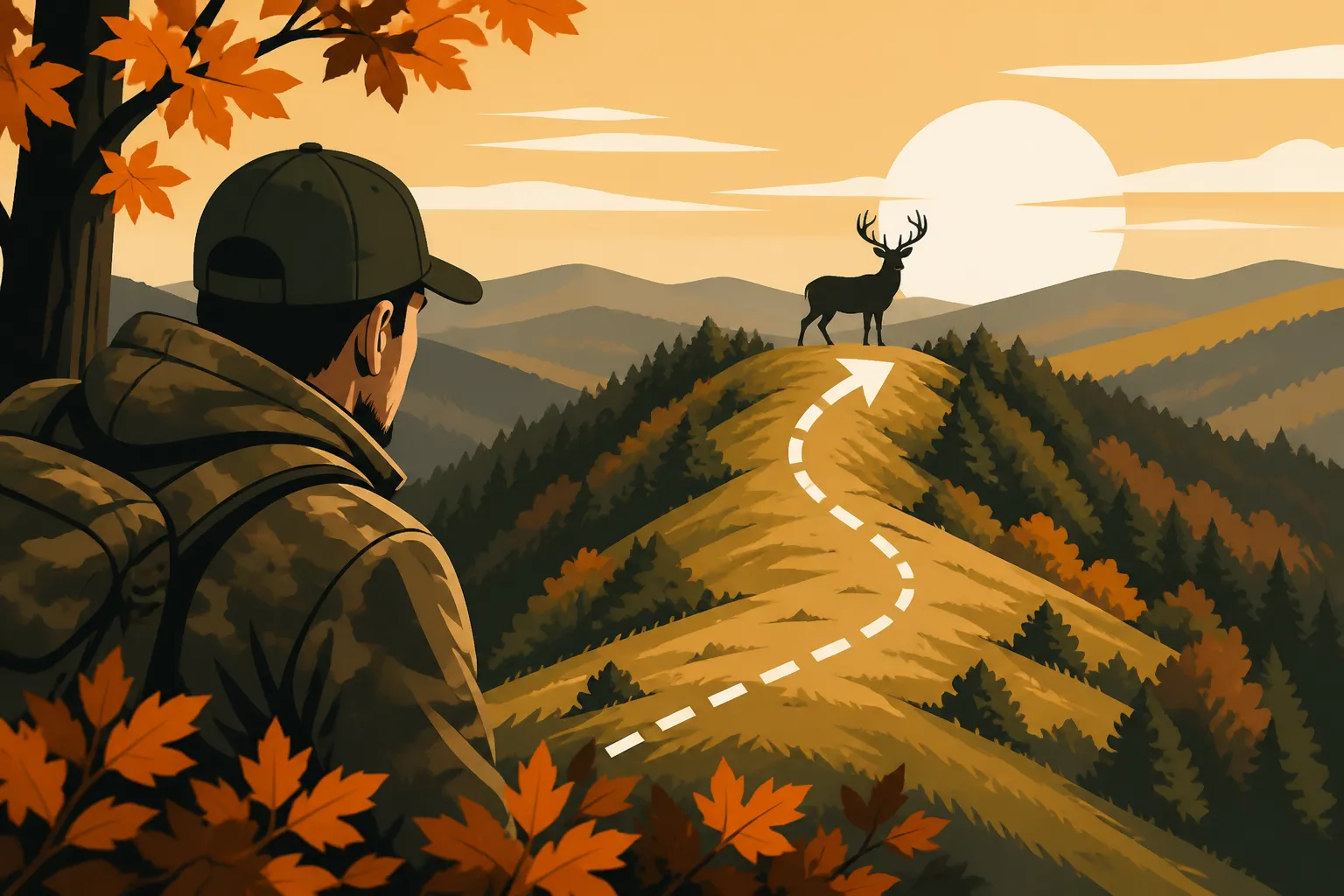
When you look at a topographical map or walk a Kentucky ridge line, a "saddle" might just look like a dip, a low spot in the otherwise continuous high ground. But for a rutting buck, it's far more than that. It's a strategic checkpoint, a high-traffic intersection, and often a safe haven rolled into one. During the frantic pace of the rut, bucks become hyper-focused on efficiency, and saddles offer just that. They funnel deer movement in predictable ways, making them a prime location for hunters who understand the nuances of the terrain.
Natural Funnels and Travel Corridors
Think of a ridge-top saddle as nature's highway interchange. Deer, especially bucks cruising for does, will almost always take the path of least resistance. Instead of expending extra energy climbing over the highest point of a ridge, they naturally drift into the lower, easier-to-traverse saddle. This makes these dips in the terrain natural funnels, concentrating deer movement into a smaller area.
During the rut, bucks are constantly moving between bedding areas, feeding areas, and doe groups. A saddle situated between two major ridge systems, or even between two sections of the same ridge, becomes an unavoidable travel route. These are often the main arteries of movement, connecting various parts of a deer's home range. Even if a buck isn't actively chasing, he's using these saddles to check for doe scent, listen for other deer, and conserve energy while covering ground. It’s like a hidden trail that every buck eventually discovers.
Staging Areas and Rub Lines
Saddles aren't just for passing through; they're also crucial staging areas for rutting bucks. A buck might pause in a saddle, out of the wind and with good visibility, before descending into a bottomland or ascending to another ridge point. This pause gives him a chance to survey his surroundings, scent-check the area for does, and perhaps even mark his territory. You'll often find concentrated sign in these areas, especially during the pre-rut and peak rut.
Keep your eyes peeled for rub lines that run right through saddles or along their edges. These aren't just random rubs; they're often indicators of dominant bucks repeatedly using that saddle as a travel or staging point. A fresh rub line tells you a buck is not only in the area but actively marking it. Similarly, scrapes in or near saddles can be gold mines. Bucks will paw out scrapes and urinate in them, leaving behind scent that communicates their presence and breeding readiness. These rub and scrape lines serve as signposts for other deer and, more importantly, for the observant hunter looking to intercept a rutting buck.
Overlooking Bedding and Feeding
One of the most appealing aspects of a ridge-top saddle is its strategic vantage point. From a well-chosen saddle, a buck can often observe both higher ground (potential bedding areas on the ridge itself) and lower ground (feeding areas in creek bottoms or hollows). This elevated position provides a sense of security and a panoramic view, allowing a buck to detect predators or rival bucks while also keeping an eye out for receptive does.
Consider a saddle positioned between a thick bedding area on one ridge and a lush food plot or acorn-laden flat in the hollow below. A mature buck might stage in that saddle just before dark, waiting for does to move to feed, or he might use it as a mid-day rendezvous point while checking for does traveling between different zones. The ability to survey significant portions of his territory from a relatively concealed position makes a saddle an irresistible draw for any wise old buck.
Scouting and Locating Key Saddles
Finding the perfect ridge-top saddle isn't about blind luck; it's about strategic scouting and understanding the terrain. You can start from the comfort of your home, but nothing beats getting your boots on the ground to confirm what your maps tell you. Combining digital reconnaissance with real-world verification will significantly increase your odds of success.
Topographical Map and Aerial Imagery Reconnaissance
Before you ever step foot in the woods, spend some quality time with detailed topographical maps and aerial imagery. Tools like GoHunt are invaluable for this type of digital scouting. Look for prominent ridge lines, then identify distinct dips or low points in those ridges. These are your potential saddles. Pay attention to the contour lines: when they pinch together on either side of a dip, and spread out in the middle, you've likely found a saddle.
Beyond just identifying the saddle itself, use the aerial imagery to look for connecting features. Are there thick areas of cover on either side that could be bedding? Are there open fields, old clearcuts, or creek bottoms nearby that could be feeding areas? Look for faint lines that might indicate existing deer trails leading into and out of the saddle. Identify potential staging areas, funnels between two hollows, and even how far from major roads or access points these saddles might be. This armchair scouting allows you to narrow down your focus and create a prioritized list of locations to investigate further.
Boots-on-the-Ground Verification
Once you've marked some promising spots on your map, it's time to hit the woods. This is where you confirm your theories and gather crucial, real-time intelligence. Approach these saddles quietly, ideally well before the season or on a day when you're not hunting, to avoid disturbing the area. Look for well-worn deer trails leading into and out of the saddle. These "highways" are unmistakable.
Next, search for fresh buck sign. This includes rub lines on trees (especially larger diameter trees, indicating a mature buck), and active scrapes. Pay attention to the direction of rubs; do they indicate bucks traveling through, or pausing and rubbing as they check the wind? Look for bedding areas nearby – thickets, brush piles, or dense stands of young timber. You'll also want to evaluate the surrounding cover. Does the saddle offer good concealment for a buck moving through, or is it too open? Understanding these details on the ground will help you choose the precise tree for your stand. You can get more insight into this process by reading about Scouting Kentucky Public Land Before Season.
Reading the Wind and Thermals
Understanding wind and thermals is paramount when hunting ridge-top saddles. The wind currents behave differently on ridge lines compared to flat ground. Saddles, being dips, can often create swirling winds, especially at certain times of the day. A buck's nose is his primary defense, so you must position yourself where your scent will not be carried into his likely travel path.
On a typical Kentucky ridge, thermals will rise as the air warms in the morning and fall as it cools in the evening. This means that in the morning, your scent will likely rise up the ridge, while in the evening, it will sink into the hollows. However, saddles can disrupt this predictable pattern. It's vital to study how the wind and thermals interact in each specific saddle you intend to hunt. Carry a wind checker (a small bottle of powder works great) and use it frequently throughout your sit. This knowledge, coupled with knowing Wind and Thermals on a Kentucky Ridge, is the difference between success and failure. Don't be afraid to back out of a spot if the wind isn't right; it's better to preserve the spot for another day than to blow it entirely.
Optimal Stand Placement and Hunting Tactics
Once you've identified a promising saddle and understood its deer movement patterns, the next step is precise stand placement and employing the right hunting tactics. This isn't just about finding a tree; it's about setting up a strategic ambush that maximizes your shot opportunity while minimizing your detection.
Playing the Wind and Entry/Exit Routes
The cardinal rule of deer hunting, especially for mature bucks, is playing the wind. In a ridge-top saddle, this becomes even more critical due to the potentially tricky air currents. Your stand location should be downwind of where you expect the buck to travel. This sounds obvious, but many hunters make the mistake of setting up directly in the travel corridor, only to have their scent blow into the approaching buck.
Consider your entry and exit routes carefully. Can you get to and from your stand without busting deer? This often means approaching from a different ridge or circling around, using the lowest ground or the densest cover to conceal your movement. Avoid walking directly through the saddle or along known deer trails. A stealthy approach is half the battle. If hunting public land, learn about Hanging a Stand on an Eastern Kentucky Ridge and consider your stand options to minimize disturbance, as well as Treestand Setups in Daniel Boone National Forest. Remember, one noisy or careless entry can ruin an entire day's hunt, or even several days, in a hot rutting spot.
Decoying and Calling Strategies
While bucks in the rut are often on the move, sometimes a little persuasion is needed. Decoys can be incredibly effective in saddles, especially a buck or doe decoy strategically placed to draw attention. A buck decoy can challenge a dominant buck, while a doe decoy can draw in a cruising buck looking for a receptive partner. Always position your decoy so that an approaching buck will present a good shot opportunity to you as he circles downwind to scent-check the "deer."
Calling can also be a game-changer. During the rut, bucks are vocal and responsive. Grunt calls can attract cruising bucks, making them think another buck is with a doe. Rattling antlers can simulate a fight between two bucks, drawing in curious or territorial males eager to get in on the action or challenge a rival. Start with softer calls and escalate if there's no response. Learn about the nuances of Rattling and Grunting in Kentucky or effective Grunt Calls in Mature Kentucky Timber to perfect your technique. Combine calling with a decoy for a potent combination that can stop a rutting buck right in your shooting lane.
All-Day Sits and Timing
The rut is often unpredictable, but one thing is certain: bucks can move at any time of day. While many hunters focus on dawn and dusk, mature bucks often do their primary cruising and chasing during the mid-day lull, especially in pressured areas where they feel safer moving when most hunters are out of the woods. Therefore, an all-day sit in a productive ridge-top saddle can be incredibly rewarding.
Pack plenty of food, water, and extra layers of clothing, especially during a Kentucky November when temperatures can fluctuate wildly. Be prepared to sit from before first light until after last light. Patience is key. The buck you're after might not show up until 11 AM or 2 PM. During these long sits, remain vigilant. Even a fleeting glimpse of a distant buck could indicate his travel pattern and help you adjust your strategy. It’s during these long, sometimes cold, hours that the most dedicated hunters are often rewarded.
Common Mistakes and How to Avoid Them
Even the most seasoned hunters can fall into common traps when hunting ridge-top saddles. Recognizing these pitfalls and proactively avoiding them will greatly increase your chances of success and minimize frustration.
Hunting the Wrong Wind
This is perhaps the most common and devastating mistake. As discussed, the wind can be tricky in saddles. Hunting a saddle with swirling or unfavorable wind will almost certainly result in a blown hunt. A mature buck will typically circle downwind of any suspected deer or scent source, and if he catches your scent, he's gone.
To avoid this, always check the wind diligently before heading out, and continually verify it throughout your hunt. If the wind is even marginally wrong for your chosen stand, have a backup plan or simply opt to hunt another location that day. Don't try to "make it work" with a questionable wind, especially for an all-day sit. It's better to save your effort and preserve the integrity of your hunting spot for when conditions are perfect. Remember, a good hunting app like GoHunt can often give you very specific wind predictions for your exact stand location, helping you make informed decisions.
Over-Pressuring a Hot Spot
When you find a saddle that's absolutely covered in fresh buck sign, it's tempting to hunt it relentlessly. However, over-pressuring a hot spot is a surefire way to make those rutting bucks go nocturnal or simply abandon the area. Deer are incredibly sensitive to human intrusion, and if they detect your presence too often, they will adjust their patterns.
Instead of hunting the same saddle day after day, consider a rotation strategy. Hunt a prime saddle for a morning or an evening, and then give it a day or two of rest. This allows the deer to feel safe returning to their natural patterns. Have multiple promising saddles scouted out, perhaps even on different ridges or in different areas, so you always have options. This rotational approach is key to consistently taking mature deer, preventing them from catching on to your routine. Understanding Hunting Pressure on Kentucky Public Land can help you refine this approach.
Ignoring Local Deer Behavior
While general rutting behavior is universal, specific deer behavior can vary based on local conditions, food sources, and hunting pressure. What works in a Western Kentucky bottomland might not be as effective on a steep Eastern Kentucky ridge. Ignoring these local nuances can lead to missed opportunities.
Pay close attention to what the deer in your specific hunting area are doing. Are they heavily utilizing Scrape Lines Along a Logging Road? Are they traveling through specific types of timber? What are their primary food sources that year, especially if it was a Hunting After a Poor Acorn Year? Talk to other ethical hunters in your area, review local harvest reports, and observe trail camera footage if you use them. Adapt your tactics to the observed patterns, rather than rigidly adhering to a textbook approach. Deer are creatures of habit, but they are also adaptable, and so must you be. Don't forget to report your successful harvests through Kentucky Deer Harvest Reporting Rules to help the KDFWR gather valuable data on local populations.
| Saddle Type | Description | Key Hunting Considerations |
|---|---|---|
| Primary Ridge Saddle | A significant dip in the main ridge line, connecting large sections of high ground. | High traffic, can connect major bedding/feeding areas. Often holds concentrated sign. |
| Secondary Ridge Saddle | A dip on a smaller finger ridge extending off a main ridge. | Good for intercepting bucks branching off main travel. Can be overlooked by other hunters. |
| Drainage Saddle | A low spot where a small drainage or creek originates, often creating a natural funnel. | Excellent for catching bucks moving between different elevation levels, especially near water. |
| Concealed Saddle | A saddle with thick cover, often dense evergreens or young timber, providing security. | Bucks may spend more time here, staging or scent-checking. Requires stealthy entry/exit. |
Disclaimer
The information provided in this guide is for general educational and informational purposes only. Hunting regulations and conditions can change rapidly. Always consult the most current Kentucky Department of Fish and Wildlife Resources regulations before planning any hunting trip. Ensure you comply with all local, state, and federal laws. Hunter safety is paramount; always follow safe firearm and archery practices.