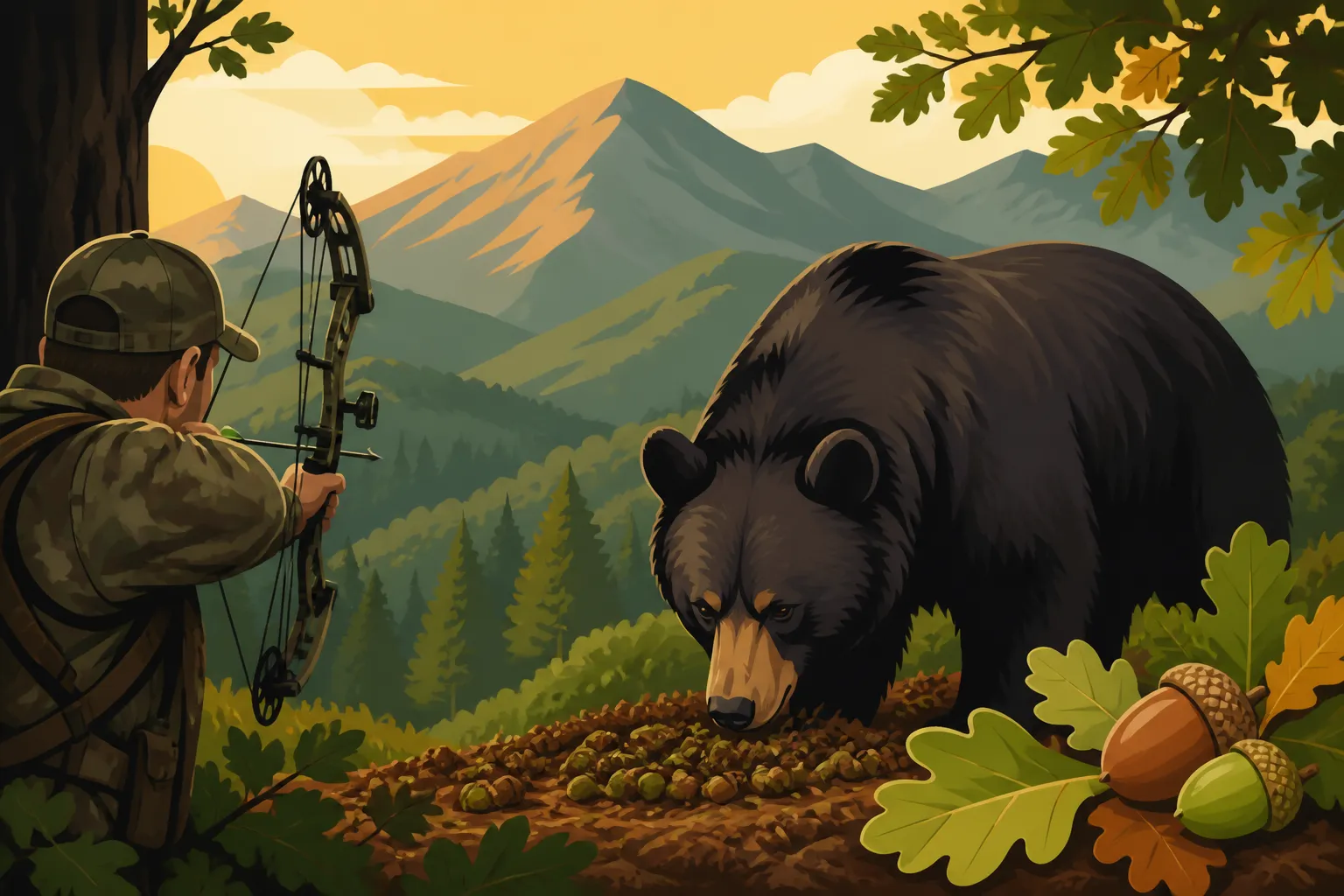
Hunting Bears Over Natural Mast in the Mountains
Hunting black bears in Kentucky's rugged mountain terrain presents a unique challenge, especially when these intelligent animals are focused on the ever-changing bounty of natural mast crops. It’s incredibly frustrating to spend hours scouting, only to find last week's hotspots are now barren. This guide will walk you through the essential strategies for locating and successfully hunting bears by truly understanding and leveraging their dependence on nature's wild food pantry.
Understanding Natural Mast Cycles in Kentucky's Mountains
The foundation of a successful bear hunt in Kentucky’s mountains isn't just about finding a bear; it's about finding where the bears will be based on their primary food source: natural mast. Bears are opportunistic feeders, and their movements are almost entirely dictated by the availability and ripeness of these seasonal foods. Ignoring this fundamental principle is like looking for fish in a dry creek bed.
Key Mast Species and Their Bearing Habits
Kentucky's mountains, particularly the sprawling eastern ranges like the Cumberland Mountains and Pine Mountain, are rich with a variety of mast-producing trees. Understanding these species and their typical fruiting cycles is paramount. White oak acorns, for instance, are often the first major acorn crop to drop in late summer or early fall, and bears absolutely gorge on them. These acorns are lower in tannins, making them sweeter and highly palatable. Red oak acorns, while dropping a bit later and having a higher tannin content, become a critical food source as white oaks are depleted, often sustaining bears well into late fall and early winter.
Beyond oaks, don't underestimate the power of other mast. Hickories, with their hard, oily nuts, are a high-calorie food source bears will seek out, especially if acorn crops are poor. Beechnuts, though less common in some areas, are also highly prized. Even soft mast like wild persimmons and black gum berries, while typically consumed earlier in the season, can draw bears into specific areas for a brief, intense feeding frenzy. For hunters targeting the archery season, focusing on early-dropping white oaks or soft mast can be incredibly productive. As the season progresses and into the cooler months, shifting your focus to red oaks or areas with persistent hickory crops becomes vital. Knowing the specific tree species in your hunting area is like having a cheat sheet for a bear’s diet.
The Role of Weather and Elevation on Mast Production
The abundance and timing of natural mast are heavily influenced by environmental factors, primarily weather and elevation. A late spring frost, for example, can devastate the delicate flowers of oak and hickory trees, leading to a poor mast crop in that particular year or region. Conversely, a mild spring followed by a wet summer can result in a bumper crop, scattering bears over a wider area as food becomes plentiful everywhere. These yearly fluctuations mean that a "honey hole" from one season might be completely barren the next, requiring consistent pre-season scouting.
Elevation also plays a significant role. Trees at lower elevations or in sheltered coves might produce mast earlier than those on exposed ridge tops, or vice-versa, depending on temperature and moisture gradients. This creates a natural progression of food availability that bears exploit. During periods of drought, bears might concentrate more heavily in creek bottoms and shaded north-facing slopes where moisture-loving mast producers like beech trees or even certain types of berries might still be thriving. Understanding these nuances helps you predict bear movement, rather than just reacting to it. In the rugged terrain of the Appalachian foothills and the eastern Kentucky coalfields, slight elevation changes can mean the difference between a barren forest and a bear buffet.
Scouting for Mast and Bear Sign
Effective scouting is non-negotiable for bear hunting, especially when you're relying on natural mast. It’s not a one-and-done activity; it’s an ongoing process that begins well before the season opens and continues right up to your hunt. Without boots-on-the-ground reconnaissance, you're essentially hunting blind.
Pre-Season Reconnaissance: From Maps to Boots on the Ground
Your scouting mission should start long before you ever set foot in the woods. Begin with topographical maps and satellite imagery. Tools like GoHunt or similar mapping applications allow you to identify large stands of mature timber, particularly those on ridge systems, saddles, and benches that are historically known for oak and hickory production. Look for areas with diverse forest compositions, as a mix of mast species provides a more consistent food source. These digital insights can help you narrow down vast areas of public land, such as sections of the Daniel Boone National Forest, to more manageable zones for physical scouting. You can also gain an edge by studying areas known for Scouting Kentucky Public Land Before Season.
Once you have a few promising locations marked on your map, it’s time to hit the woods. Ideally, this should happen in late summer or early fall, several weeks or even months before the season starts. This early reconnaissance allows you to assess the actual mast crop. Are the white oaks heavy with acorns? Are the hickory trees loaded? What about the red oaks? Don't just look for quantity; check the quality. Are the acorns healthy, or are they riddled with weevils? Pay attention to areas with multiple mast types; if one crop fails, bears will shift to the next available food. Focus your efforts on these diverse areas that offer a sustained buffet, because bears, like us, appreciate variety.
Interpreting Bear Sign in Mast-Rich Areas
Once you're in a productive mast area, the real work of finding bear sign begins. Bears are not always visible, but their presence leaves undeniable clues. The most obvious, and often freshest, sign is bear scat. Look for droppings rich with undigested nuts, berries, or even corn kernels if they've been venturing near agricultural fields. The color and consistency can tell you how recently the bear was there and what it's been eating. Fresh scat, especially if it’s still moist, indicates a very recent presence.
Beyond scat, keep an eye out for other specific indicators. Bears love to scratch and rub on trees, often leaving claw marks or patches of rubbed bark, particularly on softer woods or at traditional rubbing posts. Broken limbs, especially on fruit-bearing trees like apple or cherry, are a clear sign of a bear feeding. In soft ground near water sources, creek beds, or muddy game trails leading into dense mast areas, you might find distinct bear tracks. Look for the large, relatively flat paw prints with five distinct toes. Finally, be on the lookout for daybeds – depressions in thick cover, often at the base of a large tree or in dense laurel thickets, where bears rest after feeding. Finding fresh sign means you’re in the right zone; finding old, dried-up sign means the buffet has moved on, and so should you.
Hunting Strategies for Mast-Driven Bears
With a thorough understanding of mast cycles and diligent scouting, you're ready to formulate your hunting strategy. This isn't about calling a bear from a mile away; it's about being in the right place at the right time, with patience and stealth.
Stand Placement and Still-Hunting Tactics
When hunting bears over natural mast, your stand placement is absolutely critical. You want to position yourself overlooking a productive mast area, but also considering the bear's approach and escape routes. Look for pinch points, saddles, or benches on mountain ridges that bears might use to travel between their bedding areas (often dense laurel thickets or steep north-facing slopes) and their feeding grounds. A great spot might be a small oak flat nestled into a larger ridge, especially if it funnels into a creek bottom or a thicker bedding area. If you're hunting in the more accessible regions of Pine Mountain State Forest Hunting, consider how natural terrain features guide movement.
Ground blinds can also be incredibly effective, particularly if you can brush them in naturally to blend with the surroundings. They offer excellent concealment and can be set up quickly near a fresh feeding area. Regardless of whether you're in a stand or a blind, always consider the wind. Bears have an incredible sense of smell, and a shift in wind can instantly ruin your hunt. Thermals in mountainous terrain are also crucial – understand that air rises in the morning and falls in the evening. As for still-hunting, this involves moving incredibly slowly through mast-rich timber, taking a few steps, and then pausing for several minutes to scan and listen. This tactic is especially productive during low-light hours when bears are more likely to be actively feeding. Remember, bears are often found in the same areas as deer, so Still-Hunting Eastern Kentucky Ridges tactics can often apply to bears too.
Patience, Persistence, and Adapting to Bear Behavior
Hunting bears that are focused on natural mast requires a tremendous amount of patience and persistence. These animals are incredibly intelligent and wary, and they don't follow a strict schedule. A productive mast site might see heavy bear activity for a few days, then go quiet as the bears move on to another dropping crop. This means you need to be prepared for long sits and be willing to move if the sign indicates a shift in feeding patterns. Don't fall into the trap of hunting "memory spots" from previous years; bears are constantly adapting.
Minimizing your scent and movement is also paramount. Use scent-control measures, play the wind meticulously, and move as little as possible once you're on stand. Bears can detect even the slightest movement or unnatural sound. Be prepared to adapt. If the white oak crop you scouted heavily in September is now picked clean by mid-October, you need a backup plan. This might mean shifting to a different ridge system known for its red oaks, or even exploring creek bottoms for late-season soft mast. The ability to read the forest and adjust your strategy based on current conditions is what separates successful bear hunters from those who just get lucky. Hunting in challenging environments like Bear Zone One and Two Rules demands this level of dedication and flexibility.
Gear Considerations for Mountain Bear Hunts
Hunting bears in Kentucky’s mountains is physically demanding, and having the right gear can make or break your hunt. You'll often be far from the truck, navigating steep terrain, and potentially dealing with a large animal recovery. Being prepared is key.
Essential Optics and Navigation Tools
For mountain bear hunting, high-quality optics are not a luxury; they are a necessity. A good pair of binoculars, like 10×42 or even 12×50, will be your best friend for scanning vast timbered slopes, identifying distant mast trees, and, crucially, spotting a feeding bear before it spots you. Look for binoculars with good low-light performance, as bears are often most active during dawn and dusk. A reliable rangefinder is also non-negotiable, especially in varied mountain terrain where judging distances can be deceptive. Knowing the exact yardage to your target is vital for ethical shot placement on a powerful animal.
Beyond optics, navigation tools are paramount. While a smartphone app like GoHunt with its robust mapping layers is excellent, never rely solely on your phone. A dedicated GPS unit provides redundant navigation and often better battery life in remote areas with no cell service. Use these tools to mark productive mast areas, track your path in and out, and precisely mark the location of a shot or a downed animal. Remember to carry spare batteries or a portable charger. Hunting deep in the Daniel Boone National Forest Hunting means you'll be far from civilization, and getting lost is a real concern. These tools not only aid in finding bears but ensure your safe return.
Suitable Weaponry and Meat Care in the Field
When it comes to weaponry for Kentucky black bears, you need enough power to ensure a quick, ethical kill. For rifle hunters, calibers like a .30-06, .308, .300 Win Mag, or a .45-70 are popular and effective choices. Focus on bullet construction that offers deep penetration and reliable expansion. Shot placement is absolutely critical; bears are tough, and a poorly placed shot can lead to a long, arduous tracking job, or worse, a lost animal. For archery hunters, a sufficient draw weight (typically 60+ pounds) and heavy, sharp, fixed-blade broadheads are recommended. If you're hunting during the Kentucky Bear Archery Season Dates, practice shooting from various angles and at different distances to prepare for real-world scenarios in the timber.
The recovery and meat care aspects are just as important as the shot itself. Bears are large animals, and dragging one out of a steep hollow can be an exhausting, multi-person endeavor. Carry a robust backpack capable of handling heavy loads, especially if you plan to quarter the animal in the field – a highly recommended approach for solo hunters or deep backcountry kills. Pack durable game bags to protect the meat from dirt and flies, and a sharp, sturdy field dressing knife. Consider bringing along a small bone saw if you're not comfortable with the gutless method. Remember, you might be dealing with warm temperatures during early bear seasons, so getting the hide off and the meat cooled quickly is vital to preserve the quality. Just like Field Dressing a Deer in Cold Weather, quick action is needed, but bears have a thick layer of fat that traps heat. This demands immediate attention to cooling the carcass to avoid spoilage.
| Mast Type | Primary Production Season | Bear Preference & Use | Key Scouting Notes |
|---|---|---|---|
| White Oak Acorns | Late Summer/Early Fall | High preference, lower tannin content makes them sweeter. Bears gorge heavily, often leading to concentrated activity. Prime early-season food source for building fat reserves. | Look for mature trees on ridges and flats. Check for falling acorns and fresh scat containing acorn fragments. |
| Red Oak Acorns | Mid-Fall/Late Fall | Lower preference initially but crucial once white oaks are depleted. Higher tannin content provides sustained energy. Can hold bears into early winter. | Identify red oak stands, especially on north-facing slopes. Search for older scat and signs of digging under leaves. |
| Hickory Nuts | Fall | High-calorie, oily nuts. Bears will seek these out, particularly in years with poor acorn crops. Requires more effort to crack, indicating persistent feeding. | Look for shagbark or mockernut hickories in creek bottoms and coves. Find cracked nut shells and bear sign under trees. |
| Beechnuts | Mid-Fall | Extremely high preference, but availability can be localized. Bears will travel significant distances for a good beech crop. Often found in specific, cooler, moist areas. | Locate American beech groves. Check for stripped hulls and fresh activity; beechnut crops can be inconsistent year to year. |
| Persimmons | Early Fall | Soft mast, highly palatable. Draws bears to specific trees. Activity often intense but short-lived as fruit drops quickly. | Find persimmon trees, especially near field edges or old clearings. Look for dropped, ripe fruit and fresh scat. |
Disclaimer
Hunting is an inherently dangerous activity. Always prioritize safety, understand and follow all Kentucky Department of Fish and Wildlife Resources regulations, and ensure you have the proper licenses and permits. The information provided here is for educational purposes only and should not replace professional guidance or personal judgment.