Grunt Calls in Mature Kentucky Timber
Hunting mature timber in Kentucky can be incredibly challenging, especially when those whitetails seem to melt into the shadows, offering barely a glimpse. It's frustrating to sit for hours, knowing big bucks are around, but never getting them to commit. This comprehensive guide is here to walk you through the nuances of using a grunt call effectively in these dense, often unforgiving environments, helping you draw those elusive deer into range.
Understanding the Whitetail Grunt in Mature Timber
When you're out in the vast, mature timber of Kentucky, the sounds you make with a grunt call aren't just random noises; they're attempts to mimic the very language of whitetails. Understanding what these sounds mean to a deer is paramount to using a call effectively. It’s not about blasting a call as loud as you can; it's about subtle communication that speaks to a buck's primal instincts.
What a Grunt Really Means to a Buck
A grunt call, at its core, is an imitation of vocalizations deer use to communicate with each other. For a buck, a grunt can mean several things, depending on its intensity and duration. A soft, tending grunt often signals a buck checking a doe, or a buck that's on the move, asserting his presence. These are low, guttural sounds, usually short and repeated. Then you have the more aggressive grunts, sometimes called "growls," which indicate a buck is challenging another male or is highly agitated. Think of it as the difference between a casual conversation and a heated argument. The key is knowing which message you want to send and when. If you're looking to pique the interest of a cruising buck without immediately alarming him, a tending grunt is often your best bet. However, if you've spotted a buck that seems to be ignoring a doe in heat or is simply passing through, a more aggressive grunt might be necessary to get his attention and challenge his dominance.
Distinguishing Grunt Types in the Woods
There are indeed several types of grunts a whitetail can make, and learning to differentiate and replicate them can significantly boost your success rate. The most common you'll hear discussed are the basic "contact" grunt, the "tending" grunt, and the "challenge" grunt or "growl." A contact grunt is generally a short, singular sound used by deer to locate each other or signal presence. A tending grunt is a series of shorter, softer grunts made by a buck actively pursuing a doe in estrus; it’s a sound of excitement and courtship. The challenge grunt or growl is longer, deeper, and often more aggressive, used when bucks are confronting each other or asserting dominance. Some calls even mimic the fawn bleat, which, while not a grunt, can sometimes bring in curious does and, occasionally, a buck investigating the commotion. Knowing which sound to make starts with understanding the situation you're in and the buck's current demeanor. If you're on public ground, it’s also good to consider the potential for other hunters trying to mimic similar sounds, adding another layer of complexity.
How Mature Timber Affects Sound Travel
Mature timber, with its thick undergrowth, numerous trees, and varied terrain, is a completely different acoustical environment compared to open fields or younger clear-cuts. Sound doesn't travel nearly as far, and it's easily absorbed or deflected. This is a critical point that many hunters overlook. What sounds like a reasonable call in an open field might barely carry 50 yards in dense woods. The sound waves hit trees, leaves, and brush, losing energy rapidly. This means you often need to call more frequently or with slightly more volume than you might think, especially if you're trying to reach a buck a couple hundred yards away. However, too much volume can also be unnatural and startling if a buck is closer than you anticipate. You need to find that sweet spot. The way wind and thermals move through timber also dramatically impacts how your sound carries. A call made into a strong headwind will be muffled and travel a shorter distance, whereas a call with the wind at your back will carry further but also broadcast your position. For deep woods hunting, this acoustic challenge means you have to be extra strategic with your calling and your stand placement.
When and How to Use a Grunt Call Effectively
Timing and technique are everything when it comes to grunt calling. It’s not just about blowing into a tube; it’s about understanding the rhythm of the woods and reacting to the deer's behavior. A perfectly executed call at the wrong time or in the wrong way can still send a trophy buck scurrying in the opposite direction.
Timing Your Calls with the Rut Phases
The most effective time to use a grunt call is undoubtedly during the various phases of the rut, from the pre-rut through the peak and into the post-rut. During the pre-rut, bucks are actively scraping, rubbing, and beginning to cruise for does. A contact grunt or a light tending grunt can pique their curiosity, signaling a potential rival or a hot doe. This is also a great time to implement other calling methods like rattling, as bucks are beginning to challenge each other, as outlined in our guide on Rattling Volume in Thick Cover. As the rut intensifies in early November, especially during the cruising phase, bucks are almost constantly on the move, looking for receptive does. A well-placed tending grunt can stop a buck in his tracks, or better yet, divert him off his travel corridor and directly to your setup. Our detailed insights into Hunting the Rut in Early November offer even more specific timing strategies. Even during the peak rut, when bucks are locked down with does, an aggressive challenge grunt can sometimes pull a dominant buck away from his doe, as his competitive instincts kick in. Understanding the nuances of buck behavior during each phase is crucial for successful calling.
Calling Sequences and Volume Considerations
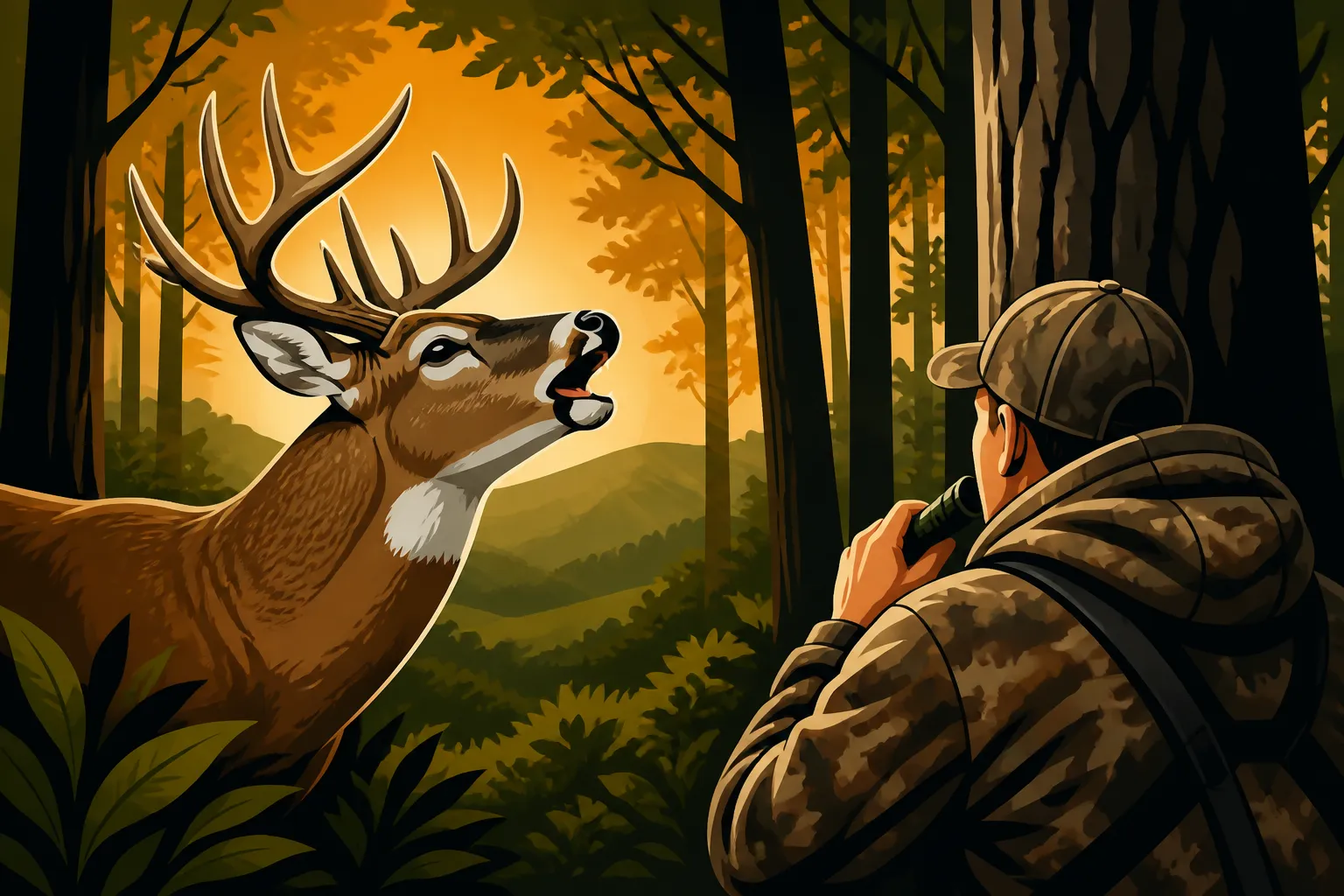
The sequence and volume of your grunts should mimic what you'd naturally hear in the woods. Start with soft, single grunts, listening for a response. If no response, you might increase the volume slightly or try a short series of tending grunts (2-3 short grunts in succession). The goal is to sound natural, not like a human trying to blow a kazoo. When you're dealing with mature timber, remember that sounds don't carry far. If you're setting up for a hunt in the Daniel Boone National Forest, for instance, you might need to use a slightly higher volume than you would in more open country, but always with control. After a calling sequence, remain absolutely still and scan intensely. Bucks will often circle downwind to get a scent check before committing, so be prepared for them to approach from unexpected angles. Don't call continuously; give pauses, especially after an initial series. Think of it as a conversation: you make a statement, then wait for a reply. A good grunt tube, like those from Primos or Buck Commander, allows for a range of tones and volumes, letting you adjust on the fly.
Reading Buck Behavior Post-Call
This is where the art of grunt calling truly comes into play. Once you make a call, every twitch, every head turn, every pause from a buck is a piece of information. If a buck immediately stops and looks in your direction, you've got his attention. At this point, resist the urge to call again too quickly. Let him process, let his curiosity build. If he turns and starts walking towards you, great! Keep quiet and prepare for the shot. If he seems hesitant, looks away, or continues on his path, then a softer, follow-up grunt might be warranted. A common mistake is to keep calling relentlessly, which can sound unnatural and scare deer away. Pay close attention to how deer use their ears, constantly swiveling to pinpoint the source of the sound. If a buck starts to circle, he’s likely trying to get downwind to scent check. This is your cue to anticipate his path and adjust your shot angle if possible. Understanding their body language – a raised head, flicking ears, or a stiff-legged walk – will tell you if your call is drawing them in or pushing them away.
Common Mistakes and Advanced Strategies
Even experienced hunters can fall into common grunt calling traps. Avoiding these pitfalls and adopting more advanced strategies can elevate your success, especially when targeting cagey, mature whitetails that have heard it all before.
Overcalling and Calling Blind
One of the biggest mistakes hunters make is overcalling. Imagine someone shouting at you constantly without a break; it would be jarring and unnatural. The same goes for deer. Continuous or overly loud calling can alert deer to your presence, not entice them. Bucks are smart, especially in heavily hunted areas or on public land where deer drives are common. They've learned to associate unnatural sounds with danger. Another common error is "calling blind," meaning you're grunting without seeing any deer. While this can work sometimes, it's often more effective to call to a deer you can see, tailoring your call to its specific behavior and direction of travel. Calling blind increases the chances of a buck circling downwind and busting you before you even know he's there. Using mapping tools like GoHunt can help you scout key terrain features like funnels or saddles where deer might be moving, giving you a better idea of where to anticipate a response, even if you can't see the deer yet. But always remember to keep wind direction in mind; a call into a shifting wind can carry your scent right to an approaching buck.
Using Visuals with Your Grunt Calls
Sometimes, sound alone isn't enough to seal the deal, especially with a wary mature buck. Integrating visual cues, like a decoy, can make your grunt calls exponentially more convincing. A doe decoy, particularly one positioned to look receptive, can be a powerful magnet when paired with tending grunts. A small buck decoy, or even just a set of antlers rattled in conjunction with aggressive grunts, can really stir up a territorial buck. The visual element confirms what the buck is hearing, validating the perceived presence of another deer. However, be cautious with decoys on public land, especially during gun season, as they can be mistaken for real deer by other hunters. Always prioritize safety. If you're hunting open timber or a field edge, consider setting up your decoy slightly off to the side, allowing any approaching buck to focus on it rather than your stand. Combining this with knowledge of Treestand Setups in Daniel Boone National Forest can give you an edge in placing your decoy effectively while maintaining your concealment.
Grunt Calling in Specific Kentucky Scenarios
Kentucky's diverse terrain, from the rugged eastern mountains to the western river bottoms, offers unique challenges and opportunities for grunt calling. In the thick, steep hollows of Eastern Kentucky, like those found around the Daniel Boone National Forest, sound doesn't travel far. Here, short, sharp, and slightly louder grunts might be necessary to cut through the dense foliage and reach a buck working a ridge. You'll also need to pay close attention to Wind and Thermals on a Kentucky Ridge, as they dictate where your sound – and your scent – will travel. In the more open, mature hardwoods of the Bluegrass region, where visibility might be better, you can afford to be more subtle, letting soft grunts carry further. If you're positioned on a primary travel corridor or a funnel between two hollows, as explored in Hunting a Funnel Between Two Hollows, a series of tending grunts can be incredibly effective at drawing a cruising buck into your shooting lane. Conversely, in the dense, often swampy bottomlands of Western Kentucky, where thick cover abounds, very close-range grunts are more appropriate to avoid startling deer already very near. Adapt your calling strategy to the specific habitat you're hunting, always considering how sound will propagate.
Gear and Setup for Grunt Calling Success
A good grunt call is only one part of the equation. Your entire setup, from your stand placement to the other gear you carry, plays a crucial role in making your calling efforts successful. Don't let your efforts be undermined by a poor setup or overlooked gear details.
Choosing the Right Grunt Tube
The market is flooded with grunt calls, from simple open-reed designs to elaborate adjustable tubes. The "right" one often comes down to personal preference and what sounds most natural to you. However, look for a call that allows for versatility – one that can produce soft tending grunts, aggressive challenge grunts, and maybe even a fawn bleat. Calls with a flexible tube or an adjustable reed system can offer a wider range of tones and volumes. It's often beneficial to practice with your call before hitting the woods, getting a feel for its capabilities and limitations. Blow into it gently, then with more force, learning how to manipulate the sound. Some hunters even carry two different calls to vary the sound and avoid sounding too repetitive. Brands like Primos, Flextone, and even simpler tube calls can be highly effective. Remember, the most expensive call isn't always the best; it's the one you can operate effectively and naturally. Checking online reviews, including those on outdoor platforms like GoHunt, can often provide insights into hunter preferences and real-world performance of various models.
Optimal Stand Placement for Calling
Where you set up is just as important as how you call. When planning to use a grunt call, consider a stand location that offers good visibility but also enough cover to conceal your movements. A key strategy is to position yourself where a buck is likely to approach from downwind, allowing you to intercept him before he winds you. This means setting up with the prevailing wind in mind, or even better, finding a spot that forces deer to approach from an unexpected direction, or within range before they can get a direct scent. Look for natural funnels, pinch points, or saddlebacks that channel deer movement. Placing your stand high enough to get your scent above a deer's nose, but not so high that your shot angle becomes too steep, is a fine balance. Remember that mature timber often limits your shooting lanes, so clear a few key lanes around your stand before the season starts. Scouting with the Kentucky Hunt Fish App beforehand can reveal topographical features and likely travel routes that are perfect for calling setups.
Combining Calls with Other Tactics
Grunt calls are powerful on their own, but they become even more potent when combined with other hunting tactics. As mentioned, decoys can add a crucial visual element. But don't stop there. Rattling antlers, especially during the pre-rut and peak rut, can simulate a full-blown buck fight, and a grunt call can add the sound of a third buck entering the fray or a tending buck nearby. A soft doe bleat or fawn bleat can sometimes precede a grunt, drawing in curious does and young bucks, which can, in turn, attract a larger buck. If you're on a long day hunt in areas like Daniel Boone National Forest, having a good pack like those discussed in Packs for a Daniel Boone Forest Day Hunt can ensure you carry all your calling gear, along with essentials like water, snacks, and perhaps a rangefinder. Moreover, don't underestimate the power of scouting. Knowing Where Daniel Boone Forest Bucks Bed or understanding typical travel patterns will inform where to set up and when to call, maximizing your chances of intercepting a deer. Think of calling as one tool in your extensive hunter's toolkit, designed to complement your scouting, stand placement, and patience.
Disclaimer
Always consult the latest Kentucky Department of Fish and Wildlife Resources regulations before heading into the field. Hunting laws and season dates can change, and it is every hunter's responsibility to be aware of and comply with all applicable rules and regulations.