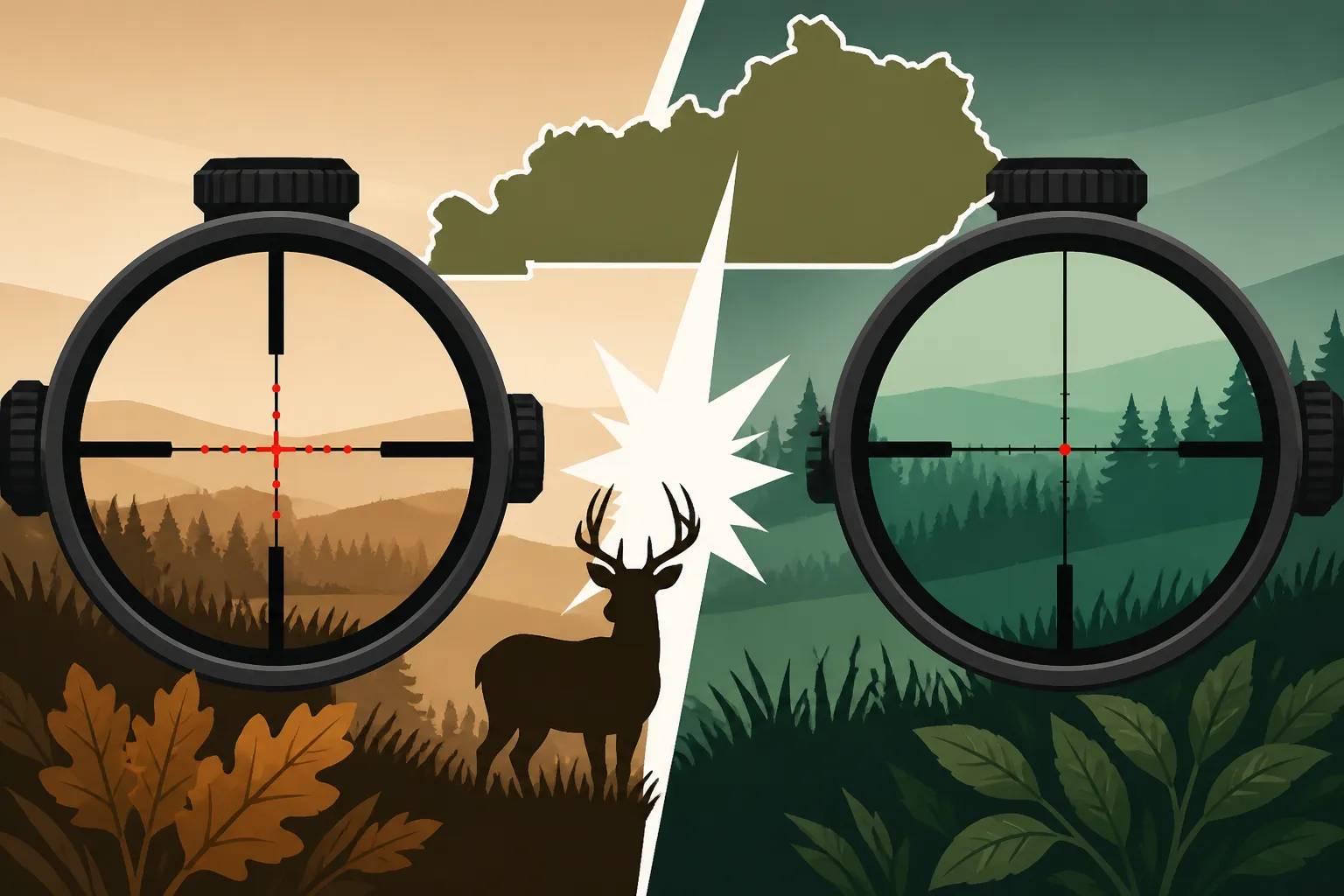
First Focal Plane Versus Second
One of the most head-scratching decisions a Kentucky hunter faces when picking out a new rifle scope often comes down to two seemingly simple acronyms: FFP and SFP. It's a technical choice that can truly impact your confidence and accuracy in the field, from wide-open agricultural fields to the tight timber of the Daniel Boone National Forest. This guide is here to untangle the mystery of first focal plane versus second focal plane scopes, helping you understand how each works and which one might be the perfect match for your hunting adventures across the Bluegrass State.
The Core Difference: Magnification and Reticle Behavior
When you look through a rifle scope, you see a reticle—those crosshairs or dots that help you aim. The magic of modern optics allows this reticle to be placed in one of two positions within the scope's internal mechanism, and where it sits determines how it behaves as you adjust your magnification. This fundamental difference is what separates first focal plane (FFP) from second focal plane (SFP) optics, and understanding it is key to making an informed choice that suits your specific hunting style.
What is First Focal Plane (FFP)?
Imagine your reticle living right there with the image you're seeing through the scope's objective lens. That's essentially what happens with a first focal plane (FFP) scope. As you crank up the magnification from, say, 3x to 9x, the reticle itself will appear to grow larger in your field of view, and conversely, it will shrink when you dial down the power. This isn't just an aesthetic change; it's a functional one. Because the reticle is magnified along with the target, its subtensions—the spacing between hash marks or dots on your reticle—remain constant relative to the target at any magnification setting.
Think about it like this: if your reticle has a dot that covers 1 MOA (Minute of Angle) at 100 yards, it will always cover 1 MOA at 100 yards, whether your scope is set to 3x or 15x. This consistency is incredibly valuable, especially for those who frequently use their reticle for range estimation, wind holds, or bullet drop compensation. You don't have to remember to switch to a specific magnification setting to ensure your holdovers are accurate; they're reliable no matter where your zoom ring is set. This makes FFP scopes a favorite among long-range shooters and tactical users, but their benefits extend to various hunting scenarios where precise holdovers are critical. When you're trying to figure out if that buck is 200 or 300 yards out on a powerline cut and you're using your reticle to bracket it, an FFP scope ensures your calculations are sound regardless of your current zoom.
What is Second Focal Plane (SFP)?
Now, picture a scenario where your reticle stays the same size, regardless of how much you magnify your target. That's the essence of a second focal plane (SFP) scope. With an SFP design, the reticle is positioned behind the erector system (the part that moves when you adjust magnification), meaning it appears to stay a constant size in your field of view while the target image gets larger or smaller around it. So, as you zoom in, the target seems to "grow" relative to the reticle.
This design has its own distinct advantages, primarily related to the apparent thickness of the reticle. At lower magnifications, an FFP reticle can become incredibly fine, almost disappearing in dense cover or low light. An SFP reticle, however, maintains its visibility at all power settings. This is a huge plus for hunters who primarily shoot at closer to moderate ranges and value a bold, easy-to-see aiming point. The trade-off, however, is that the subtensions of an SFP reticle are only accurate at one specific magnification setting, usually the highest power or a marked setting. If your scope's holdover points are calibrated for 10x, and you're shooting at 5x, those holdover points will no longer be accurate for bullet drop compensation or windage adjustments. You'd have to perform calculations or switch to the correct magnification. For many Kentucky deer hunters who might take a quick shot in a Hunting a Funnel Between Two Hollows situation or a whitetail that pops out on a Setting Up on a Western Kentucky Field Edge, the simplicity of a consistently sized reticle at their preferred magnification often outweighs the need for complex holdovers at varying powers.
Advantages and Disadvantages of First Focal Plane Scopes
First focal plane scopes have really gained popularity in recent years, and for good reason. They offer a level of consistency that many serious hunters and shooters find indispensable, but they also come with a few considerations that are worth thinking through before you invest. Understanding these pros and cons is crucial, especially when you're looking at the varied terrain and hunting situations we encounter here in Kentucky.
Consistency Across Magnification
The primary, undeniable advantage of an FFP scope is the consistency of its reticle subtensions across the entire magnification range. This means that if you have a bullet drop compensator (BDC) reticle or a reticle with hash marks for windage, those marks will always represent the same value relative to your target, whether you're zoomed in at 10x or out at 3x. This is a massive boon for anyone who relies on their reticle for anything other than a simple center aiming point.
Imagine you're hunting elk in the Hunting Kentucky's Record Elk Herd country of eastern Kentucky. You spot a bull at 400 yards across a clear-cut, but it's moving into some timber. You quickly dial down your magnification to get a wider field of view and track it. With an FFP scope, if you need to hold over for bullet drop or compensate for wind, those specific holdover points on your reticle are still accurate. You don't have to remember to zoom back to maximum power just to make your BDC work. This allows for faster decision-making and more confident shot placement, particularly when target distance and conditions are dynamic. For hunters who practice regularly at various ranges and utilize advanced shooting techniques, this consistency can significantly reduce mental math and potential errors in the field. It also ties in nicely with mapping and planning tools like GoHunt, where you might pre-plan shots based on terrain features, knowing your scope's reticle will hold true no matter the magnification you choose for the moment.
Weight, Cost, and Optical Challenges
While FFP scopes offer incredible utility, they do come with a few trade-offs. Historically, FFP scopes have often been more expensive to manufacture than their SFP counterparts due to the precision required to integrate the reticle with the magnification system. This cost difference has narrowed over time, but it's still a factor to consider in your budget.
Beyond cost, there can be optical challenges. At the lowest magnification settings, an FFP reticle can appear very fine, sometimes almost disappearing against a busy background or in very dim light. Conversely, at the highest magnifications, the reticle becomes quite thick, which can obscure a small or distant target's precise aiming point. This is a critical consideration for those who might be hunting tiny game or aiming for pinpoint accuracy on a distant target. For example, if you're trying to spot a squirrel's head at 50 yards through thick Kentucky hardwoods, an FFP reticle at max power might feel a bit clunky. Additionally, the increased complexity of the FFP design can sometimes lead to slightly heavier scopes, though advancements in materials and manufacturing have minimized this difference in many modern optics. It's not usually a dealbreaker for most deer hunters, but if you're counting ounces for a strenuous hunt in the Daniel Boone National Forest Hunting, every bit of weight matters.
Advantages and Disadvantages of Second Focal Plane Scopes
Second focal plane scopes have been the traditional workhorse for hunters for decades, and they continue to be a fantastic choice for many, especially given their straightforward operation and often more budget-friendly price point. However, just like FFP, understanding their unique characteristics is key to leveraging their strengths and being aware of their limitations in various Kentucky hunting scenarios.
Simplified Reticle at Low Power
One of the most immediate and appreciated advantages of a second focal plane (SFP) scope is how the reticle always appears the same size, regardless of your magnification setting. This means that at low power, which is often crucial for scanning dense timber or tracking a moving target, your reticle remains bold and easy to acquire. You'll never find yourself squinting, trying to find a hair-thin reticle that's seemingly vanished into the background foliage. This is particularly beneficial for hunters who spend a lot of time in the thick stuff, like Still-Hunting Eastern Kentucky Ridges or driving deer in heavy cover, where quick target acquisition at close range is paramount.
Imagine a whitetail buck bursting out of a thicket only 40 yards away. You rip your rifle up, and with an SFP scope, that familiar, clear reticle is right there, ready to go. You don't have to worry about the reticle being too fine to see instantly. For many, this simplicity and consistent visibility are huge confidence boosters. It also often means that SFP scopes can be more forgiving on the wallet, making them an excellent choice for hunters who want reliable performance without breaking the bank. For a new hunter getting into the sport, or someone simply looking for a dependable scope for general Rifle Setups for Kentucky Deer Hunting, an SFP often offers the best balance of performance and value.
Range Estimation and Holdovers at Varying Magnifications
The flip side of that constant reticle size is that the subtensions of an SFP reticle only provide accurate measurements or holdover points at a single, specific magnification setting. This is almost always the highest power of the scope, or sometimes a clearly marked intermediate power (e.g., 10x on a 3-12x scope). If you're using a BDC reticle or hash marks for windage and bullet drop, you must be at that specific magnification for those marks to be true.
This requires discipline and awareness from the hunter. If you're used to doing all your shooting and practice at, say, 9x on your 3-9x scope, and then you try to hold over for a 300-yard shot at 6x magnification, your holdover points will be off. The target will appear smaller relative to the reticle, meaning each hash mark on your reticle will subtend a larger area on the target than intended. For hunters who primarily hold dead-on at close to moderate ranges and use their turrets to dial for longer shots, this might not be an issue. However, if you rely heavily on your reticle for quick holdovers at various distances, or for range estimation using milliradian (mil) or MOA references, an SFP scope demands that you consistently return to the calibrated magnification. For complex scenarios where you might be Calling a Southeastern Kentucky Bull Elk from a distance and need to quickly range it with your reticle, an SFP scope could introduce a moment of hesitation or potential miscalculation if you're not at the correct magnification.
Choosing the Right Focal Plane for Kentucky Hunting Scenarios
Deciding between a first focal plane and second focal plane scope ultimately comes down to your personal hunting style, the type of terrain you frequent in Kentucky, and how you intend to use your reticle in the field. There's no single "best" option; rather, it's about matching the tool to your specific needs. Let's break down some common Kentucky hunting scenarios to help you make that choice.
Open Country vs. Thick Timber
Kentucky offers a fascinating mix of hunting environments, from wide-open agricultural fields in the western part of the state to the dense, rolling timber of the eastern mountains. Your typical hunting ground can heavily influence which focal plane might serve you better.
For open country hunting, such as targeting deer across a large cut cornfield in Henderson County, or glassing a powerline cut for elk in the Hunting Kentucky's Elk Restoration Zone, an FFP scope often shines. In these scenarios, shots can range from relatively close to several hundred yards, and you might need to quickly adjust your magnification to get a better view of a distant animal while still relying on your reticle for precise holdovers. An FFP reticle ensures that your bullet drop compensation marks remain accurate regardless of whether you're at 6x or 15x. This allows for quick decision-making when a trophy animal steps out and you don't have time to mess with turret adjustments or remember to crank your magnification up. If you're scouting with mapping tools like GoHunt and identify potential long-range shooting lanes, an FFP scope provides the consistency needed to execute those shots confidently. Glassing a Powerline Cut at Last Light often means you're watching for long distances, and the FFP's consistent subtensions are a huge advantage.
Conversely, in thick timber and dense cover, like the forested ridges of Daniel Boone National Forest or the creek bottoms where deer like to hide, shots are typically much closer and often come up quickly. Here, a clear, consistently visible reticle at all magnifications, especially at low power, can be more beneficial. This is where SFP scopes often have an edge. When a deer slips through the brush at 50 yards, you need to acquire that target and place a shot instantly. An FFP reticle at low magnification might become too fine to see quickly, especially in low light conditions. An SFP reticle, which maintains its thickness, offers a bolder aiming point that's easy to pick up, making it ideal for the fast, close-range encounters typical of Practical Range in Daniel Boone Forest Timber or hunting in dense undergrowth.
Precision Shooting vs. Fast Target Acquisition
Consider your priority: is it absolute precision over varying distances, or is it rapid target acquisition for quick shots? This distinction is crucial in scope selection.
For precision shooting, especially at longer ranges or when needing to make precise adjustments for wind and bullet drop using the reticle, an FFP scope is generally superior. Its reticle subtensions are true at every magnification, meaning you can precisely measure targets, estimate range, and apply holdovers without having to manipulate your zoom setting. This is invaluable if you're a hunter who frequently practices long-range shooting and incorporates advanced techniques into your hunting strategy. If you're working up load data and want to use your reticle for precise adjustments on the fly, an FFP scope ensures that your known values (e.g., 1 mil equals 3.6 inches at 100 yards) are always consistent. For those considering Rifle Scopes for Low-Light Hollows where precise aim is critical but light is fading, the FFP's consistency helps with careful shot placement.
For fast target acquisition and simplicity, an SFP scope often wins out. Many hunters in Kentucky primarily use their scope as a "point and shoot" device, zeroing at a common distance (like 100 or 150 yards) and holding dead-on for most shots within that rifle's effective range. For them, a consistently sized reticle that doesn't change thickness is less distracting and faster to use in a pinch. The reticle always appears clear and visible, providing a confident aiming point without any concern for what magnification setting you're on, as long as you're not trying to use complex holdovers at varying powers. For instance, if you're hunting deer in the timber and your primary concern is a 50 to 150-yard shot, the SFP's consistent reticle thickness is a huge advantage for quick, instinctive aiming. It reduces mental clutter and allows you to focus purely on the shot itself.
Matching Your Scope to Your Hunting Style
Ultimately, the best focal plane for you is the one that best complements your individual hunting style and the situations you most often find yourself in.
If you are a hunter who enjoys challenging yourself with longer shots, meticulously calculates bullet drop and windage, and frequently uses your reticle for these adjustments across varying distances and magnifications, an FFP scope is likely your best bet. It offers the precision and consistency that these techniques demand. This applies to someone who might be hunting Kentucky's Record Elk Herd or large crop fields where longer shots are common. Modern FFP scopes, especially those with good glass, minimize the issues of reticle thickness at low power, making them a versatile choice for those who push their limits. Many serious hunters, including those who use advanced mapping applications like GoHunt to analyze potential shooting lanes and distances, find FFP scopes to be an indispensable part of their setup.
However, if you're a hunter who prioritizes simplicity, rapid target acquisition at closer to moderate ranges, and prefers to dial turrets for longer shots rather than using reticle holdovers (or simply doesn't shoot beyond the effective point-blank range of your zero), then an SFP scope is an excellent and often more economical choice. Its consistently visible reticle and straightforward operation make it a joy to use for the vast majority of deer, turkey, and small game hunting scenarios found throughout Kentucky. For someone who hunts the Hunting Western Kentucky Bottomland Deer where shots are often across smaller food plots or down narrow timber rows, the SFP's bold reticle is often ideal.
Consider this table to help summarize your choice:
| Feature/Consideration | First Focal Plane (FFP) | Second Focal Plane (SFP) |
|---|---|---|
| Reticle Size | Appears to grow/shrink with magnification | Appears constant size at all magnifications |
| Reticle Subtensions | Always accurate at any magnification setting | Only accurate at one specific magnification (usually max) |
| Best Use Cases | Long-range shooting, tactical, precision holdovers | General hunting, fast target acquisition, closer ranges |
| Visibility at Low Power | Can be very fine, sometimes hard to see in dense cover | Always bold and easy to see |
| Visibility at High Power | Can be thick, potentially obscuring small targets | Remains fine, less likely to obscure |
| Complexity | Requires understanding of reticle scaling | Simpler, point-and-shoot operation at common ranges |
| Typical Cost | Generally higher | Generally lower |
Ultimately, the best way to make your decision is to get your hands on both types of scopes. Look through them, adjust the magnification, and simulate various hunting scenarios. What feels intuitive to you? What gives you the most confidence? What complements your existing Rifle Setups for Kentucky Deer Hunting and your preferred style? There’s a perfect scope out there for every Kentucky hunter, and knowing the ins and outs of FFP versus SFP is a big step toward finding yours.
Disclaimer
This article is for general informational purposes only and does not constitute professional advice. Laws, prices and regulations vary by location and change over time. Consult a qualified professional for guidance on your specific situation.