What Kentucky Trespass Law Requires
There's a knot in every hunter's stomach when they're out in the field, especially on public land that borders private property: the fear of inadvertently crossing a line and finding yourself on someone else's ground without permission. It's a quick way to ruin a hunt and potentially land in a heap of trouble, not to mention damaging the reputation of all hunters. This guide is all about demystifying Kentucky's trespass laws, ensuring you can hunt with confidence, respect landowner rights, and stay squarely on the right side of the law.
Understanding "No Trespassing" in Kentucky: The Legal Landscape for Hunters
Kentucky's trespass laws are designed to protect private property rights, and as hunters, it's our responsibility to understand and respect them. When we talk about trespassing in the context of hunting, it's not just about setting foot on someone's land; it's about doing so without the owner's explicit or implied permission. Ignorance of the law is never an excuse, and assuming you have permission can lead to some really unpleasant situations.
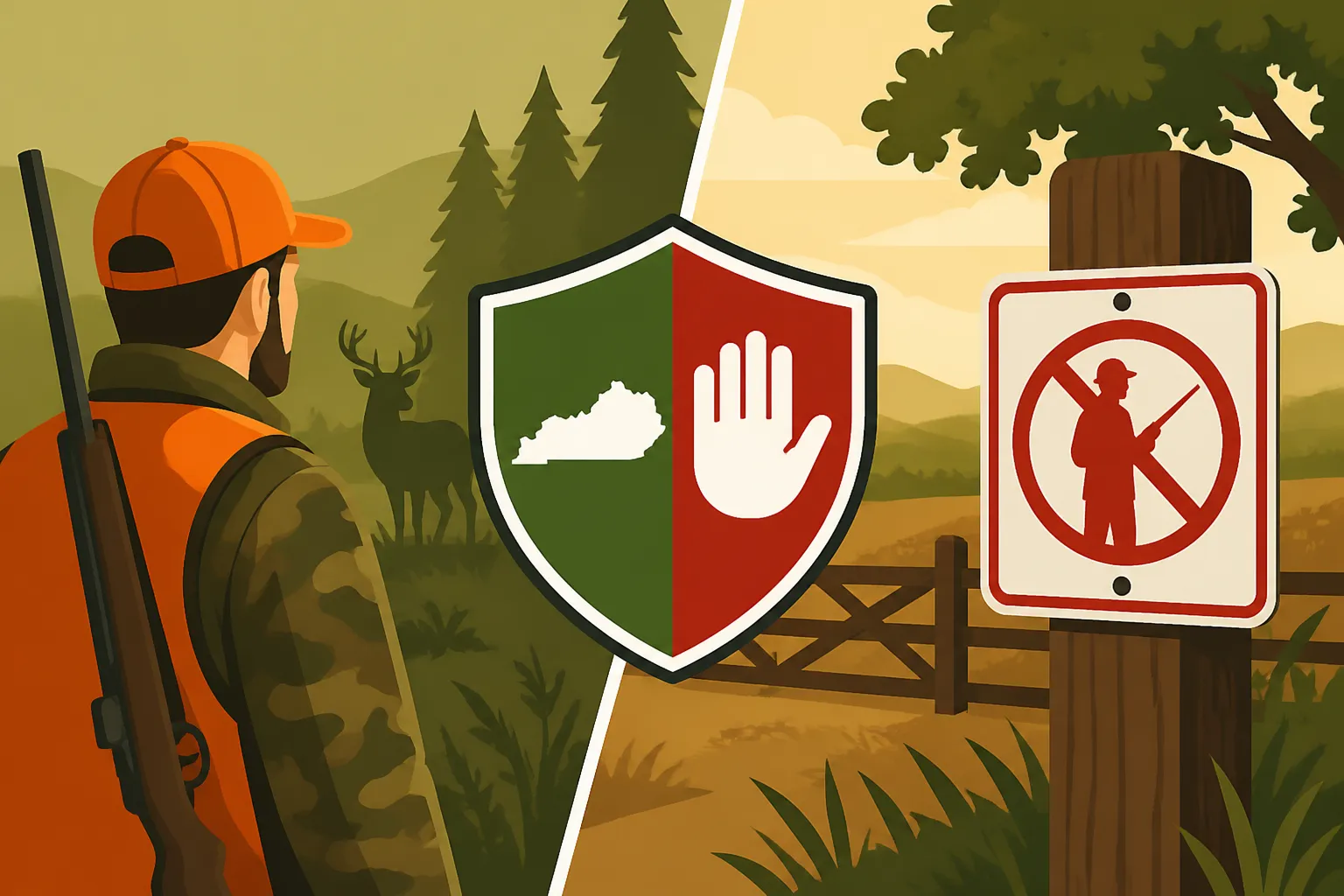
The core of Kentucky's trespass law, as it applies to hunters, states that you cannot enter or remain on private land for hunting, fishing, trapping, or any other recreational activity without permission from the landowner or their agent. This isn't some vague suggestion; it's a clear mandate. Landowners have various ways to communicate that their property is private and off-limits. This could be through traditional "No Trespassing" signs posted at regular intervals, but it's not the only method. A securely fenced property might imply "no trespassing," even without signs, as it clearly delineates a boundary. Furthermore, Kentucky is one of the states that recognizes the use of purple paint on trees or posts to mark private property boundaries. This "purple paint law" acts just like a "No Trespassing" sign, so if you see those tell-tale purple stripes, consider that property off-limits.
One of the biggest frustrations, especially for those who grew up in areas where some unposted land was considered "open," is the shift in how private property is viewed. Nowadays, with increasing pressure on land and more instances of irresponsible behavior, landowners are becoming much stricter. You simply cannot assume that if a property isn't explicitly marked, it's okay to enter. The burden of proof for having permission is almost always on the hunter, which is why diligent scouting and communication are so vital. Think about it from the landowner's perspective: they have invested in that land, they manage it, and they have a right to control who is on it and for what purpose. Respecting that right is the foundation of being an ethical hunter.
The consequences of trespassing while hunting in Kentucky can range from minor to severe. At the very least, you could be asked to leave, possibly with a stern warning. However, it can quickly escalate. You could face fines, confiscation of your hunting equipment, and even the loss of your hunting privileges. Imagine losing your rifle, bow, or truck, and then finding out you can't hunt for a year or more, all because you took a shortcut or didn't verify a property line. It's a harsh reality, but it underscores just how important it is to be absolutely certain of your location and permission status. Always ensure you are on solid legal ground before you step into the woods.
Securing Permission: The Hunter's Ethical and Legal Imperative
Alright, so we've established that you absolutely need permission to hunt private land in Kentucky. But how do you actually get it, and what's the best way to approach a landowner? This isn't just a legal formality; it's a social skill, a demonstration of respect, and often the beginning of a good relationship. Trust me, earning permission to hunt private ground is one of the most rewarding parts of being a hunter, and it opens up incredible opportunities beyond just public land like the Daniel Boone National Forest.
The debate of written versus verbal permission is an old one, and while verbal permission can be legally binding, it leaves a lot more open to interpretation and potential misunderstandings. My advice? Always, always push for written permission if at all possible. It protects both you and the landowner. A simple note with their signature, the dates you're allowed to hunt, and the specific activities permitted (deer, turkey, small game) can save a world of trouble. Kentucky law often requires written permission for certain activities, especially if you're not retrieving wounded game, so it's best practice across the board. If a landowner is hesitant to provide written permission, that's often a red flag, or it might just mean they haven't thought about it. You can even offer to draft a simple document for them to sign. This kind of proactivity shows you're serious and respectful. For more details on this, check out Do You Need Written Permission in Kentucky?.
So, how do you actually go about Asking a Kentucky Farmer for Permission? This is where your people skills come in. Don't just knock on the door opening weekend with your rifle slung over your shoulder. That's a surefire way to get a "no." Instead, try approaching landowners well before the season, perhaps in late summer or early fall. Dress neatly, don't wear your hunting clothes. Introduce yourself, explain why you're interested in their property (e.g., you've seen good deer sign, you're looking for a safe place to hunt), and offer something in return. This could be helping with chores, fixing a fence, splitting firewood, or even just offering a portion of your harvest if you're successful. Many landowners, especially farmers, appreciate the help or simply knowing who is on their land.
When you do secure permission, be incredibly specific about what's allowed. Is it for deer only, or can you hunt turkey too? Are you allowed to hunt the entire property, or only certain sections? What dates are you permitted to be there? Are you allowed to drive vehicles on their land, or only park in a designated spot? Can you bring a friend or family member? What about stands or blinds? All these details need to be ironed out upfront to avoid future conflict. I've heard too many stories of hunters losing valuable private land access because they assumed they could bring a buddy, only to upset the landowner. Over-communicate, be clear, and leave no room for doubt.
Finally, remember that permission is a privilege, not a right, and it can be revoked at any time. Even if you have written permission, a landowner can change their mind, and you must respect that. A bad experience with one hunter can spoil it for everyone, so always be on your best behavior. Thank them, check in periodically, and if you do harvest an animal, consider sharing some of the meat or offering to help them manage their property. Building these relationships is key, and it truly is what Getting Private Land Permission in Kentucky is all about. Many of the best private land hunting spots come from years of trust and mutual respect.
| Type of Permission | Definition | Best Practice for Hunter |
|---|---|---|
| Explicit Written | A signed document or agreement clearly stating terms. | Always seek this first. Provides legal clarity and protects both parties. |
| Explicit Verbal | A direct spoken agreement with the landowner. | Good, but follow up with a text/email to confirm details in writing for your records. |
| Implied | Not explicitly stated but understood (e.g., landowner waves you on). | Avoid relying on this for hunting. Too ambiguous and risky. |
| None | No communication or clear sign of permission. | Assume NO permission. Do not enter. |
Navigating Property Lines in the Field: Tools and Tactics to Stay Legal
Even with the best intentions and landowner permissions, actually staying on the right side of those property lines when you're deep in the Kentucky woods can be a real challenge. Ridgelines, creek bottoms, and thick timber can make boundaries disappear, and it's easy to get disoriented. That's why having the right tools and strategies is so crucial for every ethical hunter.
One of the most powerful tools in a modern hunter's arsenal is a good mapping application. Forget those old paper maps that were impossible to unfold silently in a treestand; today's GPS-enabled apps are a game-changer. Brands like onX Hunt and GoHunt offer detailed satellite imagery, topographic maps, and, crucially, property ownership overlays. You can see precisely where property lines are, who owns the land, and even mark your stands, trails, and observations. Before I even step foot on a new piece of ground, whether public or private, I'm poring over these apps. It allows me to scout from home, identify potential bottlenecks, and, most importantly, clearly understand the boundary lines. With onX Layers for Kentucky Land Status, you can toggle different map layers to see public land, private parcels, and even WMA boundaries, making it almost impossible to unintentionally cross into forbidden territory.
Physical scouting is still irreplaceable, of course. Once you've identified the property lines on your map app, it's vital to walk them if possible. Look for physical markers on the ground that correspond to your map. Are there old fence lines? A specific creek that acts as a boundary? A change in timber type? A logging road that follows a property line? These visual cues, when combined with your GPS, help you create a mental and physical picture of the boundaries. Sometimes landowners will have their own markings, perhaps flagging tape or even fresh purple paint on trees. The more you familiarize yourself with these real-world markers, the less likely you are to drift off course when you're focused on a game trail. Knowing Finding Kentucky Property Lines is not just about the digital map; it's about connecting that map to the physical landscape.
What happens if, despite all your preparation, you realize you've accidentally crossed a property line? It happens to the best of us, especially in unfamiliar terrain or when tracking a spirited animal. The most important thing is to stop immediately. If you're hunting, unload your firearm or uncock your crossbow. Do not continue to hunt. Take stock of your situation using your GPS app to confirm your location. If you've just barely stepped over the line, and you can safely and discretely retreat, do so. If you're deep inside someone else's property, and especially if you've harvested an animal, the situation becomes more complex, which we'll discuss next. But the general rule is: recognize the mistake, cease hunting activities, and reverse course as safely and respectfully as possible. Don't compound the error by continuing to hunt or trying to sneak out without acknowledging it. Being able to use Reading Aerial Photos for Eastern Kentucky Deer can help you visualize these boundaries from above, making it easier to stay within limits when you're on the ground.
Common Hunter Dilemmas: Game Retrieval and Boundary Challenges
Sometimes, despite our best efforts, the unpredictable nature of hunting throws us a curveball, especially when it comes to property lines. The most stressful scenario for any hunter is when a wounded animal crosses onto private land where you don't have permission. This is not only an ethical dilemma but a legal one that Kentucky law attempts to address.
Kentucky law recognizes the importance of Retrieving Game From Private Land in Kentucky to prevent waste and suffering. Generally, a hunter may enter private property without permission to retrieve a legally harvested game animal that has fallen on that property, provided no weapon is carried, and the hunter immediately leaves the property once the animal is retrieved. However, this isn't a blanket pass to just march onto someone's land. It's crucial to understand the nuances. The law specifically states "no weapon." This means your bow needs to be unstrung, your rifle unloaded and cased, or left behind entirely. You are there only to retrieve, not to continue hunting.
Even with this legal provision, the best practice is always to attempt to contact the landowner first. Knock on their door, call them, or try to find someone who knows them. Explain the situation calmly and respectfully. Many landowners, when approached politely and with honesty, will grant permission for retrieval, and some might even help you. This approach not only prevents potential confrontations but also fosters good relations between hunters and landowners. If you cannot reach the landowner, and the animal is down just over the line, you have a legal right to retrieve it without a weapon. But if you're tracking a wounded animal through dense cover, and you don't know where it dropped, the situation is much riskier. You don't want to accidentally appear to be hunting on their land.
Consider a hypothetical: you shoot a magnificent Kentucky buck on public land near a known private property boundary. You watch it run and disappear. You wait, then take up the blood trail, which clearly leads onto a meticulously maintained private farm with "No Trespassing" signs everywhere. Your best bet here is to use your phone, if you have service, to try and find contact information for the landowner (often available through mapping apps like onX Hunt or county property records). If you can't, and you can see the deer just a short distance in, you may enter unarmed to retrieve it. If the trail is long and unclear, and you can't contact the owner, you might have to make the heartbreaking decision to back out and involve local law enforcement or game wardens. They might be able to assist in making contact or mediating the retrieval. Always remember, a deer isn't worth a criminal charge or the loss of your hunting rights.
Beyond game retrieval, other accidental crossings can occur. Perhaps you're still-hunting a ridge and inadvertently take a wrong turn, finding yourself on posted property while looking for deer sign. Or maybe you're walking back to your vehicle after dark and get disoriented. In these cases, the advice remains the same: as soon as you realize your mistake, cease all hunting activity, use your GPS to orient yourself, and calmly and directly exit the private property back onto public land or your permitted area. Don't try to hide or sneak around. If you encounter the landowner, be honest, apologize, and explain how you made the mistake. Transparency and genuine remorse go a long way.
Finally, if you are a landowner or you manage private land for hunting, understanding and clearly communicating your own property boundaries is just as important. Utilizing signage, purple paint, and clear boundary lines helps prevent accidental trespass and provides legal backing if someone deliberately ignores your wishes. Take a look at Kentucky Posted Land Rules to ensure your property is adequately marked according to state guidelines. Clear communication and visible boundaries protect everyone involved and contribute to a more respectful hunting culture in Kentucky.
Disclaimer
This article is for general informational purposes only and does not constitute professional advice. Laws, prices and regulations vary by location and change over time. Consult a qualified professional for guidance on your specific situation.