Red Dots on a Turkey Shotgun
There’s a special kind of frustration that settles in when you’ve called in a big Kentucky gobbler, he’s strutting perfectly, and you shoulder your shotgun, only to fumble with that tiny front bead as he closes the last few yards. Maybe he skirts that perfect range, or perhaps your position is awkward, and suddenly, that precise head-and-neck shot feels like a Hail Mary. This guide is all about cutting through that uncertainty and giving you the aiming confidence you deserve by exploring the powerful advantages of using red dot sights on your turkey shotgun.
The Problem with Traditional Shotgun Sights for Turkeys
For generations, hunters relied solely on a single bead sight, or maybe a simple fiber optic, to aim their shotguns. And for certain types of shooting, like flushing pheasants or ducks at longer ranges, that works just fine. But turkey hunting, especially with modern tight chokes and heavy loads designed for precision, demands a different level of aiming confidence.
The Limitations of a Bead Sight in the Turkey Woods
Let's be honest, that small bead at the end of your barrel can feel like trying to thread a needle in the dark sometimes. In the dim pre-dawn light of a Kentucky spring morning, or when a gobbler's head is subtly bobbing and weaving as he approaches, getting that bead perfectly aligned with your eye and the target can be a real struggle. Your eye naturally wants to focus on the bird, not the bead, which can lead to improper alignment and a miss. It's a classic example of parallax, where the apparent position of the target changes based on your eye's position relative to the sight. This tiny misalignment can be the difference between a clean kill and a frustrating whiff, sending that wary longbeard scurrying back into the timber.
Think about it: you're often hunkered down, maybe leaning against a tree, or in a ground blind, with your head at an odd angle. Trying to get that perfect "figure eight" alignment with the front bead and a mid-rib bead can be incredibly difficult and slow. You spend precious seconds trying to line everything up, and those are seconds a smart gobbler might use to put a tree between you or simply walk out of range. It’s a challenge many of us have faced, and it’s enough to make you consider if there’s a better way to prepare for Kentucky Spring Turkey Season Rules.
Why Turkeys Present Unique Shooting Challenges
Unlike deer, where a vital zone is fairly large, a turkey’s kill zone is incredibly small and specific: the head and neck. We're talking about a target the size of a golf ball or a tennis ball, at ranges that can vary dramatically from ten yards to forty yards or more, depending on your setup and confidence. This tiny target requires absolute precision, especially when you're patterning your shotgun to throw a dense, tight cloud of pellets at that specific area.
Furthermore, turkey hunting rarely offers the luxury of a bench rest. You're often shooting from an uncomfortable seated position, perhaps twisted slightly, or even kneeling. The bird might be on an incline, or behind a slight rise, forcing you into an awkward angle. In these situations, quickly acquiring a precise aiming point is paramount. The adrenaline is pumping, the bird is strutting and gobbling, and your heart is probably doing a drum solo. That bead needs to be on target, and it needs to be there now. This isn't snap shooting a rabbit; it's a careful, deliberate shot on a small, moving target, often from a less-than-ideal posture.
How Red Dots Revolutionize Your Turkey Hunt
Stepping into the world of red dot sights for your turkey shotgun can feel like a revelation. It takes a lot of the guesswork and physical strain out of aiming, letting you focus more on the hunt itself and less on fiddling with iron sights.
Speed and Accuracy: The Core Advantages
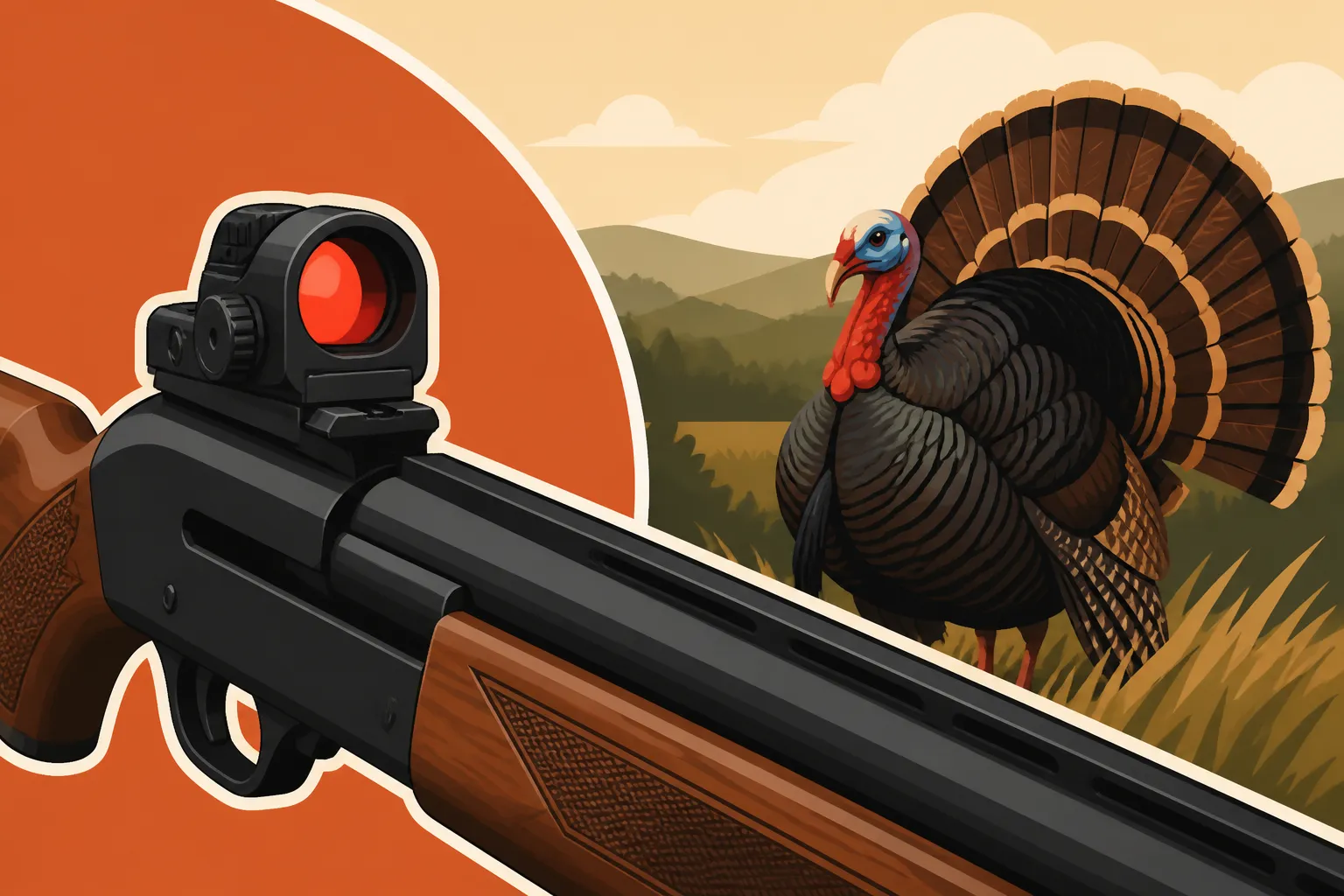
The primary benefit of a red dot sight is its ability to provide a single, luminous aiming point that floats in your field of view. There's no front bead, no rear sight to align—just a dot. This simplicity translates directly to speed. When that gobbler steps out, your eye naturally finds the dot, places it on the turkey's head, and you're ready to squeeze the trigger. It’s significantly faster than aligning traditional sights, which can be critical when a bird only offers a brief window.
Another huge advantage is the ability to shoot "both eyes open." With a bead sight, many hunters instinctively close one eye, narrowing their field of view and potentially losing track of other birds or what's happening around them. A good red dot is designed to be parallax-free, or very close to it, within typical shotgun ranges. This means that as long as the dot is on the target, regardless of slight head movement or imperfect cheek weld, your shot will go where the dot is pointing. This is a game-changer when you're tucked into an awkward spot, like leaning against a big oak for a Setting Up Against a Big Oak. This feature alone makes aiming from those less-than-perfect positions far more forgiving and reliable.
Choosing the Right Red Dot for Your Turkey Shotgun
Not all red dots are created equal, and choosing the right one for turkey hunting involves a few key considerations. You want something rugged, reliable, and perfectly suited for the task.
Key Features to Look For:
- Dot Size (MOA): For turkeys, a dot size between 2-5 MOA (Minute of Angle) is generally ideal. A smaller dot (2-3 MOA) offers more precision for that small target at longer ranges, while a slightly larger dot (4-5 MOA) can be quicker to acquire in dense cover or close quarters.
- Battery Life: You absolutely do not want your red dot dying mid-hunt. Look for models with excellent battery life, sometimes measured in tens of thousands of hours, and always carry a spare. Some even have shake-awake features to conserve power.
- Durability and Weather Resistance: Your turkey gun is going to be exposed to dew, rain, and possibly a tumble in the woods. Choose a red dot that is truly waterproof, fog proof, and built to withstand the bumps and knocks of hunting season.
- Mounting Options: Ensure the red dot you choose has a mounting system compatible with your shotgun. Many popular turkey shotguns come drilled and tapped for optics, or you can get aftermarket rails. GoHunt is an excellent resource for checking reviews and compatibility with different shotgun models before you invest. They often have detailed breakdowns of optics performance in real-world hunting scenarios.
- Size and Weight: While not as critical as on a bow, a lightweight, compact red dot is always preferred. You don't want to add unnecessary bulk to a shotgun you might be carrying for miles, especially during a Run-and-Gun Turkey Tactics on Public Land.
Remember, you're looking for a tool that enhances your precision and confidence, not one that adds complexity. A simple, robust red dot is usually the best bet.
Mounting and Zeroing Your Red Dot
Getting your new red dot sight ready for the field involves a few crucial steps that you absolutely cannot skip. Proper mounting and meticulous patterning are non-negotiable for success.
- Mounting: First, ensure your shotgun is unloaded and safe. Follow the manufacturer's instructions for mounting the optic. Use a quality scope mount or rail that is specifically designed for your shotgun model. Use Loctite (blue, not red!) on the mounting screws to prevent them from loosening under recoil. Don't overtighten, but make sure it's snug and secure.
- Bore Sighting (Optional but Recommended): While not strictly necessary for a shotgun, bore sighting can get you on paper faster. You can use a laser bore sighter or visually align the bore with a target at a close range (10-15 yards).
- Patterning, Patterning, Patterning: This is the most critical step. You absolutely must pattern your shotgun with the exact load (shot size, brand, dram equivalent) and choke tube you intend to hunt with, at the distances you expect to shoot.
- Start at 20 yards with a large paper target that has a clear aim point. Fire a shot, and adjust your red dot so the point of impact (center of the pattern) aligns with your dot.
- Move back to 30 yards, then 40 yards, and potentially 50 yards (if you're confident in your setup's effective range and pattern density at that distance). Fine-tune your adjustments at each range. The goal isn't just to put the dot on target, but to ensure your pattern is dense and centered where you want it to be.
- Many hunters even use full-size turkey head targets to get a visual representation of how their pattern performs. You're looking for consistent, even pellet distribution to ensure vital hits. This meticulous patterning is what builds true confidence, letting you know exactly what your shotgun and red dot can do together.
Practical Considerations and Kentucky Regulations
Beyond the technical aspects, incorporating a red dot into your turkey hunting means thinking about how it integrates with your overall hunting strategy and the rules of the game in Kentucky.
Adapting Your Setup for Kentucky Gobblers
Kentucky's diverse terrain, from the sprawling hardwoods of the Daniel Boone National Forest to the rolling agricultural fields of the Bluegrass region, presents a variety of challenges. A red dot excels in many of these scenarios. Imagine trying to acquire a fast-moving gobbler that suddenly appears from behind a ridge while Still-Hunting Eastern Kentucky Ridges. With a red dot, you simply put the dot on the target, minimizing fumbling.
Similarly, in dense timber, where shots might be closer and acquisition needs to be instant, the red dot's speed is a massive advantage. If you're hunting field edges, say in Western Kentucky farm country where turkeys might step out into a green field, a red dot offers that precision for longer shots while still being quick for closer ones. Turkey Tactics for Farmland Field Edges can be greatly improved with a clear, fast aiming solution. It helps you stay focused on the bird, anticipating its moves, rather than struggling with your sight picture. It’s about increasing your situational awareness, which is vital when that wary old tom is hanging up at 60 yards, just out of range, but might commit at any second.
Legality and Best Practices for Red Dots
When it comes to Kentucky hunting regulations, the good news is that red dot sights are generally permissible for shotguns used in turkey hunting. The Kentucky Department of Fish and Wildlife Resources (KDFWR) typically regulates what type of firearm can be used (shotgun, specific gauges, bow, crossbow, etc.), not the specific sighting system, as long as it doesn't violate rules against electronic calls or certain night vision devices which aren't applicable here. However, it's always smart practice to double-check the current KDFWR regulations booklet or their website each season, as rules can change. GoHunt often compiles regulatory updates, which can be super helpful for staying informed.
Beyond legality, best practices dictate:
- Ethical Shot Placement: A red dot helps you be more precise, but it doesn't extend your ethical range. Stick to shots where you know your pattern is dense enough to ensure a clean kill.
- Safety First: Always follow fundamental firearm safety rules. Treat every gun as loaded, keep the muzzle in a safe direction, keep your finger off the trigger until ready to shoot, and be sure of your target and what's beyond it.
- Practice: Don't just mount it and go. Practice in various field positions. Get comfortable with how the red dot feels and functions from a seated, kneeling, or even slightly awkward position.
Potential Downsides and How to Overcome Them
While red dots offer incredible advantages, they aren't entirely without potential drawbacks. Being aware of these and having a plan to mitigate them ensures they don't spoil your hunt.
- Battery Failure: This is probably the most common concern. Imagine getting that bird to commit and, as you shoulder your gun, the dot is gone. Always, always replace your battery at the start of each season, and carry at least one spare in your vest. Many modern red dots have excellent battery life, but a spare is cheap insurance.
- Fogging or Rain: A quality red dot should be waterproof and fog-proof. However, extreme temperature changes or heavy precipitation can still challenge any optic. Keep your lenses clean and dry with a soft cloth. A small lens pen in your pack is a good idea. Some hunters use small elastic covers to protect the optic until the moment of truth.
- Learning Curve: While intuitive, there's still a slight adjustment period. If you've been using a bead your whole life, it might feel different initially. Dedicate time to practice at the range, not just patterning, but quick target acquisition from hunting positions. The "both eyes open" technique might take a few sessions to feel natural, but once it clicks, it's incredibly fast and effective.
| Feature / Sight Type | Traditional Bead Sight | Red Dot Sight |
|---|---|---|
| Aiming Principle | Align front bead with target and potentially a rear bead/rib for sight plane. | Project a luminous dot onto the target plane. |
| Speed of Acquisition | Can be slow due to alignment requirement; more mental effort. | Very fast; eye naturally finds the dot on target. |
| Accuracy / Precision | Good for general shotgunning; precise turkey shots can be challenging due to parallax and sight picture. | Excellent for precision; parallax-free design aids consistency from awkward positions. |
| Visibility | Relies on ambient light; can be difficult in low light or against busy backgrounds. | Illuminated dot is highly visible in all lighting conditions. |
| Field of View | Full, unobstructed field of view. | Full, unobstructed field of view (when shooting both eyes open). |
| Durability | Very durable, few moving parts, no electronics. | Highly durable in quality models; requires battery power. |
| Learning Curve | Familiar for most shotgun hunters. | Small initial learning curve for dot acquisition and both-eyes-open shooting. |
| Cost | Minimal to none. | Moderate to significant initial investment. |
| Key Advantage for Turkeys | Simplicity and no electronics to fail. | Speed, precision, and confidence for that small head shot. |
Disclaimer
This article is for general informational purposes only and does not constitute professional advice. Laws, prices and regulations vary by location and change over time. Consult a qualified professional for guidance on your specific situation.