When the Kentucky Rut Peaks
For many deer hunters in Kentucky, the rut feels like this mystical, fleeting period—a golden window where all the hard work of scouting and patience finally pays off. But nailing down exactly "when" that peak action happens, and how long it lasts, can feel like chasing a ghost. You hear stories, see trail camera pictures from different weeks, and it’s easy to get frustrated trying to pinpoint the sweet spot. This guide is here to unravel the mysteries of the Kentucky deer rut, helping you understand its true timing, the factors that influence it, and how to adapt your hunting strategies to capitalize on those precious days when bucks are truly on the move.
Understanding the Kentucky Deer Rut
The deer rut is undoubtedly the most anticipated time of year for Kentucky deer hunters, and for good reason. It’s when whitetail bucks, often reclusive and nocturnal for much of the season, become driven by an overwhelming biological urge to breed. This shift in behavior makes them more visible, more vulnerable, and significantly more active during daylight hours. But it's not a single event; it's a complex series of phases, each offering unique opportunities and challenges.
The Biological Imperative: Why it Happens
At its core, the rut is a biological imperative, a finely tuned process ensuring the perpetuation of the species. Female deer, or does, enter estrus, making them receptive to breeding, and bucks respond by actively seeking them out. This drive is so powerful that it overrides a buck's usual caution, making him travel farther, expose himself more, and engage in more aggressive behaviors like fighting with other bucks. This intense activity typically begins in late October and can extend well into December, though the "peak" is often a much shorter, more intense window within that larger timeframe. Understanding this fundamental drive is crucial, because it explains why deer suddenly abandon their typical patterns and become so focused on one thing.
Phases of the Rut: From Pre-Rut to Post-Rut
Thinking of the rut as a single, uniform event is a common mistake that can lead to missed opportunities. Instead, it's best to break it down into distinct phases, each with its own characteristics and recommended hunting approaches. These phases generally flow from early signs to intense activity, then taper off.
- Pre-Rut (Late October – Early November): This is the warm-up act. Bucks are beginning to feel the urge, rubs and scrapes start popping up everywhere, and sparring increases. Younger bucks might chase does, but the mature does aren't quite ready. Bucks are establishing dominance and getting ready, but they aren't totally consumed yet. This is an excellent time to target specific bucks based on trail camera intel. You might find success by scouting for active scrape lines along a logging road or by hunting a green field planted for deer, as bucks start cruising for receptive does.
- Peak Rut (Mid-November): This is the main event! Often centered around the second or third week of November in Kentucky, this is when the majority of does come into estrus. Bucks abandon all caution, actively trailing and chasing does throughout the day. This is when you'll see those "crazy" deer behaviors: bucks running does through fields, fighting, and generally moving with a purpose. It's truly a sight to behold and often coincides with the general firearm season, creating incredible hunting opportunities statewide. For many, this is the time to be in the woods all day, every day.
- Post-Rut (Late November – Early December): After the intense breeding period, bucks are exhausted and have lost significant body weight. While some does may still come into estrus, particularly younger does or those that weren't bred in the first wave, the frenetic activity cools down. Bucks begin to recover, focusing more on food sources to rebuild their fat reserves before winter truly sets in. This period can still be productive, especially if you focus on late-season food sources for Kentucky whitetails, but it requires a shift in strategy away from pure rut-driven aggression.
Key Factors Influencing the Rut Peak
While we talk about a "peak rut" as if it's a precise date on a calendar, the reality is a little more nuanced. Several factors play into when and how intensely the rut manifests itself, from biological triggers to environmental conditions.
Photoperiod: The Primary Driver
Hands down, the single most critical factor determining the timing of the rut is photoperiod, or the decreasing amount of daylight hours. As the days grow shorter in the fall, a deer's brain triggers hormonal changes that initiate the breeding cycle. This is why the rut tends to occur at roughly the same time each year, regardless of other external factors. It’s an evolutionary mechanism to ensure fawns are born at an optimal time in the spring, when food is abundant and weather conditions are favorable. This biological clock is remarkably consistent, giving us a reliable window to anticipate the primary breeding activity. This consistent timing is why the phrase "Hunting the Rut in Early November" is so commonly heard around Kentucky hunting camps; it's a predictable phenomenon driven by nature's calendar.
Weather, Moon Phase, and Hunter Pressure: Secondary Influencers
While photoperiod sets the overall timing, other factors can influence when you see the most visible rut activity during that window. These are often referred to as secondary influencers, and understanding them can help you fine-tune your hunting efforts.
- Weather: A sudden cold front can often kick rut activity into high gear. Cooler temperatures make bucks more comfortable moving during daylight hours, reducing heat stress from their strenuous activities. Heavy rain can temporarily suppress movement, but deer often become very active right before or after a storm. Conversely, unusually warm weather during the typical peak can make bucks more nocturnal, pushing their daytime movement into the cooler hours of dawn and dusk. So, if you see a significant drop in temperature coming during November, make sure you're in your stand!
- Moon Phase: This is a hotly debated topic among hunters. Some swear by a full moon, believing it triggers increased nocturnal activity, pushing daylight movement to the fringes of the day. Others believe a new moon, with its darker nights, encourages more daytime movement. The scientific consensus is less clear, suggesting the moon's influence is minor compared to photoperiod. However, many anecdotal accounts from veteran Kentucky hunters suggest that the few days around the full moon can see an increase in daytime movement as bucks attempt to breed under cover of darkness and extend their efforts into morning. It's worth paying attention to, but don't let it dictate your entire hunting schedule.
- Hunter Pressure: This is a massive, undeniable factor, especially on public lands or heavily hunted private tracts. During the Kentucky Modern Gun Season, which often coincides directly with the peak rut, increased human activity can push even rut-crazed bucks into thicker cover or make them more nocturnal. If you're on public land, this means you might need to hike deeper, climb higher, or look for ground others walk past. Using an app like GoHunt to study aerial photos and topo maps can help you identify remote pockets or overlooked pinch points where bucks might seek refuge from pressure while still searching for does. This might lead you to explore areas like the Daniel Boone National Forest, where you could find success with unique Treestand Setups in Daniel Boone National Forest, far from the crowds.
Regional Variations Across Kentucky
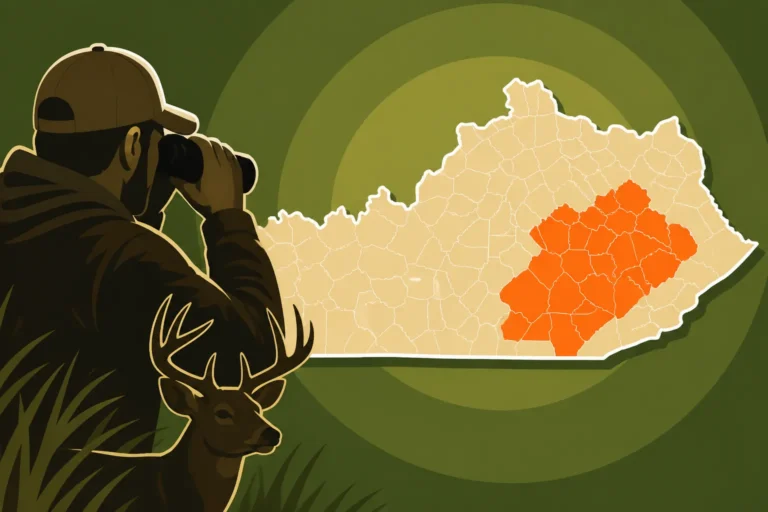
While the general timing of the rut is consistent statewide due to photoperiod, there can be subtle differences in the expression of the rut across Kentucky's diverse landscape. A good example of this is how the Kentucky Deer Population Estimate and habitat types vary from east to west.
- Eastern Kentucky: In the rugged, heavily forested terrain of Eastern Kentucky, deer densities can be lower in some areas, and the rut might feel a bit more spread out. Bucks might have to cover more ground to find receptive does, leading to more extensive cruising behavior. The steep hills and thick cover make it challenging to spot deer, but also offer excellent opportunities for still-hunting Eastern Kentucky ridges or setting up on a ridge-top saddle for rutting bucks.
- Central Kentucky (Bluegrass Region): This region, known for its fertile soils and larger agricultural fields, often boasts high deer densities and a generally older buck age structure. Here, the rut can be incredibly intense and localized. Bucks don't have to travel as far to find does, but competition can be fierce, leading to more visible chasing and fighting. If you’re looking for the Best Kentucky Counties for Big Bucks, the Bluegrass often ranks high, and the rut action can be spectacular.
- Western Kentucky: The flatter, often agricultural landscape of Western Kentucky, with its river bottoms and extensive farm fields, offers a different rut experience. Deer often congregate around specific food sources or thickets, making funnel points and field edges prime locations. Hunting Western Kentucky bottomland deer can involve long waits near known travel corridors between bedding and feeding areas, observing the intense rut activity when it kicks in.
The table below illustrates these general rut phases and characteristics across Kentucky:
| Rut Phase | General Timing (Kentucky) | Buck Behavior | Doe Behavior | Hunting Strategy Focus | Primary Influencer |
|---|---|---|---|---|---|
| Pre-Rut | Late October – Early November | Increased rubbing/scraping, sparring, early cruising | Not yet receptive, but starting to attract attention | Target fresh sign, food sources, historical buck travel. Use a hunting app like GoHunt for historical movement. | Photoperiod, increasing testosterone |
| Peak Rut | Mid-November (approx. Nov 10-25) | Active chasing, breeding, fighting, reduced caution | Majority in estrus, receptive to breeding, very active | All-day sits, focus on funnels, bedding edges, calling. Persistence is key. | Photoperiod (estrus cycle triggered) |
| Post-Rut | Late November – Early December | Exhausted, seeking food, secondary breeding (young does) | Some young/unbred does in estrus, recovering | Focus on recovery food sources, thick cover. Look for a "second rut" with young does. | Photoperiod, need for recovery after peak breeding |
| Late-Season Rut | Mid-December – January | Minor residual breeding, heavily food-focused | Very few in estrus, primarily recovering | Focus on persistent late-season food sources and bedding. Consider Hunting the Late-Season January Lull. | Residual estrus, photoperiod (winter solstice approaching) |
Hunting Strategies During the Peak Rut
When the Kentucky rut peaks, it’s not the time for casual hunting. It’s a period of intense activity, and your strategies need to match the deer's behavior. This is when dedication, smart setups, and aggressive tactics can truly pay off.
Being in the Right Place: High-Traffic Areas
During the peak rut, bucks are singularly focused on finding does. This means they will travel through areas they might normally avoid, and they’ll be covering a lot of ground. Your job is to position yourself where these paths intersect.
- Funnels and Pinch Points: These are natural constrictions in the landscape that force deer into a narrower travel corridor. Think about a narrow strip of woods between two large fields, a saddle on a ridge, or a thick brushy draw connecting two larger timber blocks. Bucks will use these to scent-check for does or to move from one area to another with minimal exposure. Studying a topo map or using a mapping tool like GoHunt to identify these terrain features is absolutely critical. Imagine a buck cutting across a field, but needing to duck into a narrow treeline for cover before continuing. That treeline is a prime funnel.
- Bedding Areas and Their Edges: While bucks are cruising, does still need to bed. Positioning yourself on the downwind side of a known doe bedding area can be incredibly effective. Bucks will often cruise the edges, scent-checking for does without fully entering the thickest cover. When you learn to read a ridge for Cumberland deer, you'll start to recognize preferred bedding areas and how bucks might approach them during the rut.
- Water Sources: In areas where natural water is limited, a water source can act as a subtle funnel, drawing deer in. Bucks might not be actively drinking during a chase, but a doe they’re pursuing might pause there, or a buck might swing through on his patrol.
Calling and Decoying Tactics
The rut is perhaps the only time of year when aggressive calling and decoying tactics truly shine for whitetails. Bucks are keyed into anything that signals a receptive doe or a challenging rival, making them much more responsive.
- Grunt Calls and Rattling: Bucks are more prone to respond to grunt calls during the rut because they associate them with other deer, potentially a receptive doe or a rival buck. Short, guttural grunts can draw in a curious buck, while aggressive snort-wheezes can challenge a dominant buck. Rattling and Grunting in Kentucky can be extremely effective, especially when paired with a decoy. Mimicking two bucks fighting can trigger an aggressive response from a mature buck looking to assert his dominance or steal a doe. I've had bucks come charging in, hackles raised, ready for a fight during this time.
- Decoys: A doe decoy can be a magnet for cruising bucks, especially if paired with subtle estrus bleats or a dominant buck decoy. A dominant buck decoy, particularly if placed facing you, can make an incoming buck feel challenged and approach from the front, offering a better shot opportunity. Just remember to set up your decoy where it's visible but also gives you a clear shooting lane downwind of it, as bucks will often try to scent-check a potential rival or doe.
- Estrus Scents: While some hunters swear by them, use estrus scents judiciously. They can be effective when a doe is truly in heat, attracting bucks from a distance. However, overuse or using them at the wrong time can sometimes alert deer to your presence or make them wary. A drag rag with a good quality estrus scent pulled to your stand can sometimes create an irresistible trail for a cruising buck.
Putting in the Hours: All-Day Sits
If there's one piece of advice that holds true for the peak rut, it's this: stay in your stand. Bucks are moving sporadically throughout the entire day, not just at dawn and dusk. A buck that was nowhere to be seen at first light could suddenly appear at noon, chasing a doe through a thicket.
- Extended Hunting Sessions: During the peak rut, I've seen some of my best bucks come through between 10 AM and 2 PM, hours when many hunters have already packed up for lunch. The sporadic nature of doe estrus means bucks are constantly on the move, and you never know when a hot doe will pull a big buck past your stand.
- Comfort is Key: To truly commit to an all-day sit, you need to be comfortable. This means having warm clothing (layering is essential for Kentucky's variable November weather), plenty of snacks and water, and a comfortable seat in your treestand or ground blind. I've found that a well-insulated ground blind on Kentucky public land can be a game-changer for all-day comfort, especially if you're not a fan of heights or need to stay out of the wind. The more comfortable you are, the longer you'll stay, and the better your chances of encountering that rut-crazed buck.
Beyond the Peak: What to Expect Next
Just because the most intense, frenzied days of the rut have passed doesn't mean your hunting season is over. Deer still need to be hunted, and understanding the phases that follow the peak can extend your success well into the late season.
The Late Rut: Second Wave Breeding
As the initial peak rut winds down, typically around late November and into early December, you might notice a secondary surge in activity. This is often referred to as the "late rut" or "second rut." It happens because younger does (yearlings) might come into estrus later than the mature does, or some mature does that weren't bred during the first wave will recycle and become receptive again.
- Renewed Buck Activity: While not as frantic as the peak, this period can still offer excellent hunting. Bucks, though often worn down, will respond to these remaining receptive does. You might see more cruising behavior, albeit perhaps a bit slower and less aggressive. This is an opportune time to catch a buck that avoided the early pressure. Focus on areas where younger does might frequent, which could be different from where you saw heavy activity earlier in November.
- Food Source Importance: At this stage, bucks are not only looking for does but are also desperately trying to recover from the strenuous activity of the primary rut. They've burned a lot of calories. This makes reliable food sources, like standing cornfields in farm country or persistent green plots, increasingly important. A buck might follow a hot doe right through a food plot, making it a dual-purpose draw.
Post-Rut Challenges and Opportunities
Once the breeding is largely complete, typically by mid-December, the deer's focus shifts dramatically. Bucks enter a recovery phase, prioritizing food and security. This is where your hunting strategy needs to adapt significantly from the aggressive tactics of the rut.
- Food, Food, Food: With the breeding finished, deer are all about refueling for winter. Targeting primary food sources becomes paramount. Think about late-season mast crops (if any are left), winter food plots, standing grains, or even browse in thick cover. Understanding what deer are eating and where can make all the difference. Using tools like GoHunt to identify agricultural fields or recent timber cuts can help pinpoint these critical resources.
- Cover and Security: As winter approaches and deer recover, they also seek out dense thermal cover for warmth and security from predators and hunters. Think thickets, cedar swamps, clear-cuts with dense regrowth, or deep hollows that offer protection from the elements. Bucks will spend a lot of time bedded in these areas, moving only to feed.
- Hunting the Kentucky Late Muzzleloader Tactics: For hunters participating in the Kentucky Late Muzzleloader Week in December, or continuing with archery, the post-rut means a return to more classic "cold weather" hunting. This involves focusing on food-to-bedding patterns, being patient, and capitalizing on cold fronts that force deer to move to feed. Dragging a deer out of a steep hollow after a late-season hunt can be brutal, but the sense of accomplishment is unmatched. Don't give up just because the peak rut has passed; new opportunities emerge for those willing to adapt!
Disclaimer
This article is for general informational purposes only and does not constitute professional advice. Laws, prices and regulations vary by location and change over time. Consult a qualified professional for guidance on your specific situation.