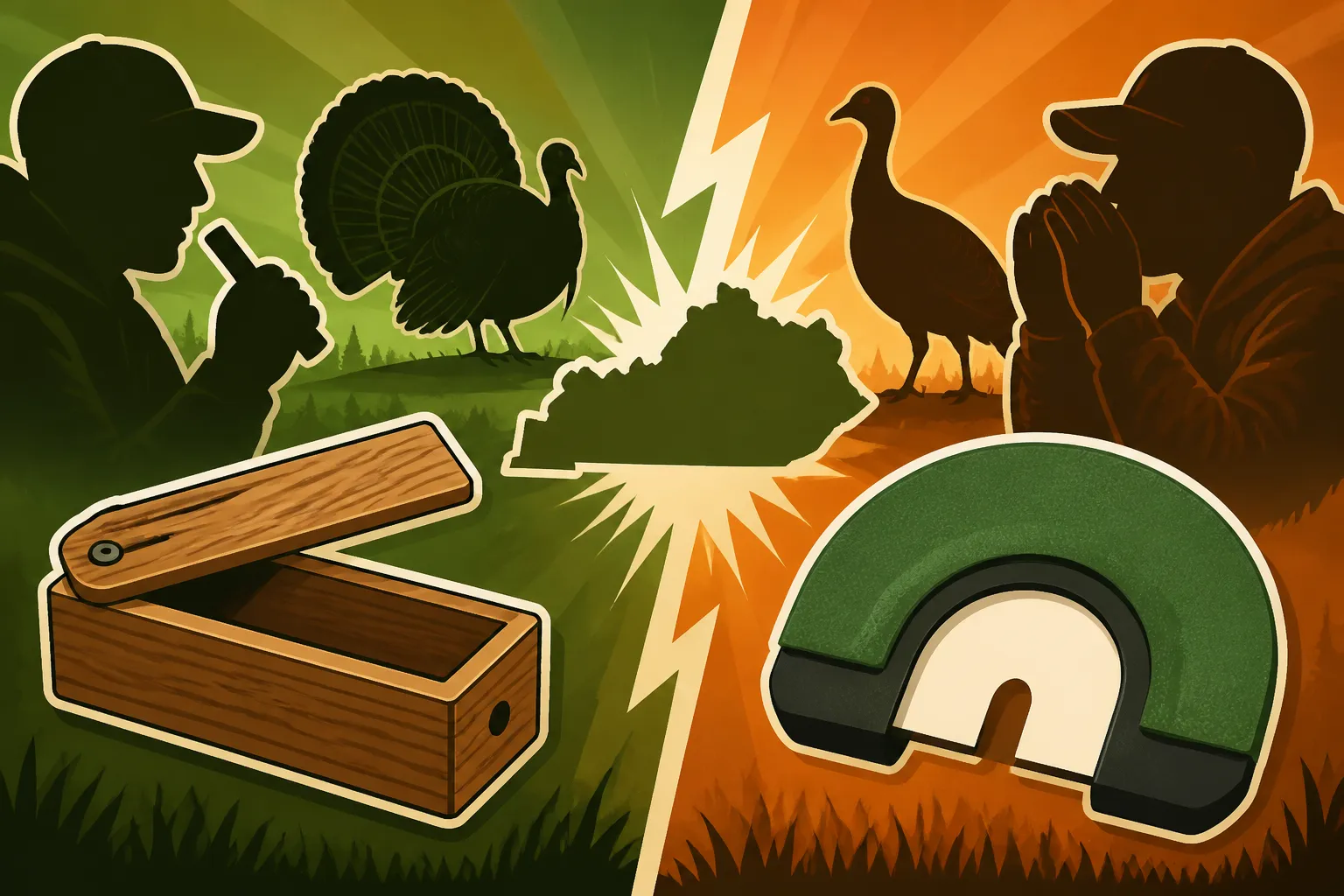
Box Calls Versus Mouth Calls
The anticipation of a gobbler answering your call is one of the greatest thrills in turkey hunting, but choosing the right tool to make that sound can be a real head-scratcher. Every Kentucky turkey hunter, from seasoned veterans to excited newcomers, has stood at the crossroads of box calls versus mouth calls. This comprehensive guide will break down the nuances of each, helping you understand their strengths, weaknesses, and how to effectively deploy them to put a longbeard in your vest.
The Classic Appeal of Box Calls
There's something inherently traditional and satisfying about a well-tuned box call. For many, it's where their turkey hunting journey began, and for good reason. These calls are often seen as the workhorses of the turkey woods, capable of producing a wide range of realistic sounds with relative ease.
The Mechanics and Sound Profile
A box call, in its simplest form, consists of a wooden box with a lid that pivots. When you drag or push the lid across the lip of the box, it creates friction, and the resulting vibration produces turkey sounds. The magic lies in the subtle variations you can achieve by adjusting pressure, speed, and the angle of the lid. You can make sharp, excited yelps, soft purrs, contented clucks, and even the throaty gobble with practice. The volume range is impressive, from booming calls that can carry across large Kentucky fields to delicate, close-in whispers.
Imagine setting up on a frosty spring morning in the Daniel Boone National Forest, the air still, and you need to reach out to a distant bird. A box call excels here. Its ability to project sound through timber and across hollows is unmatched by most other calls. You can lean into a loud series of yelps, letting them reverberate off the ridge, and then seamlessly transition to softer, more inviting clucks once you get a response. It’s an intuitive tool that often provides immediate gratification, a welcome relief when you're just starting out and trying to master the art of convincing a wary gobbler.
Advantages in Specific Kentucky Hunting Scenarios
Box calls truly shine in certain situations common to Kentucky's diverse turkey habitats. For instance, when you’re Calling a Kentucky Gobbler Off the Roost at first light, a box call's volume can be a significant advantage. You can send out those wake-up yelps that cut through the predawn quiet and get a bird to shock gobble, revealing his location. This is especially useful on large tracts of public land where gobblers might be spread out.
Another prime scenario is when you're hunting open areas like cut cornfields or powerline clearings in Western Kentucky. The call's robust sound can travel further, drawing in birds that might be out of earshot for a more subtle call. Hunters pursuing turkeys on big farmland field edges will often favor a box call for its reach. It’s also an excellent choice for setting up against a big oak or a fencerow, allowing you to use your hands freely to operate the call while keeping your gun shouldered and ready. The physical motion of running the call also feels natural to many hunters, making it easier to be consistent in their calling rhythm.
Disadvantages and When to Reconsider
Despite their undeniable charm and effectiveness, box calls aren't without their drawbacks. The most immediate concern for many hunters is the movement required to operate them. In a high-stakes, close-range encounter, the act of picking up the call and moving your hand can be enough to spook a sharp-eyed gobbler. This is particularly true when you've got a bird strutting within shotgun range, intensely scanning his surroundings. The rustle of clothing or the slight shift in position can blow your cover.
Another consideration is their bulk and susceptibility to weather. Box calls aren't exactly pocket-sized, and they can be a bit cumbersome to carry, especially if you're Run-and-Gun Turkey Tactics on Public Land and covering a lot of ground. Furthermore, moisture is the arch-nemesis of a box call. Rain, heavy dew, or even high humidity can dampen the wood, changing its tone and making it difficult to produce crisp, clear sounds. Imagine a sudden spring shower drenching your call just as a gobbler sounds off across the hollow; it's a frustrating experience that can render your primary tool useless. Regular maintenance, like sanding the lid and conditioning the box, is necessary, adding another layer of commitment beyond simply carrying it.
Mastering the Art of Mouth Calls
Mouth calls, often called diaphragm calls, are a different beast entirely. They demand a steeper learning curve but offer unparalleled versatility and the crucial advantage of hands-free operation. For many dedicated turkey hunters, these become the go-to once proficiency is achieved.
Types and Techniques for Realistic Sounds
Mouth calls consist of a small frame, usually plastic, holding one or more latex reeds stretched across it. You place the call against the roof of your mouth, and by forcing air over the reeds while manipulating your tongue, you produce a variety of turkey vocalizations. There's a wide array of mouth calls, from single-reed calls that are easier for beginners to multi-reed calls (double, triple, or even quad) that offer a broader range of tones and pitches. The cut of the reeds – batwing, ghost, v-cut – also influences the sound, allowing hunters to fine-tune their arsenal.
Learning to use a mouth call can feel like trying to play a musical instrument with your mouth – and for many, it is. The initial sounds might be squeaks, squawks, or something resembling a dying cat, which can be disheartening. However, with consistent practice, you'll start to form clear yelps, clucks, purrs, and even cutts. The key is finding the right tongue pressure, air flow, and shaping your mouth just right. The realism that can be achieved is astounding, often mimicking the subtle nuances of a real hen better than any other call type.
Benefits for Run-and-Gun and Close-Quarters Hunting
The primary advantage of a mouth call is its hands-free operation. This is an absolute game-changer when you're in a situation where movement means a busted hunt. When that gobbler is at 30 yards, strutting in the open, and staring a hole through your decoy spread, you can make soft clucks and purrs to keep him interested without moving a muscle. This is invaluable in those tense, close-quarters encounters that every turkey hunter lives for.
For the hunter who likes to keep moving, perhaps Still-Hunting Eastern Kentucky Ridges or employing a classic Run-and-Gun Turkey Tactics on Public Land, mouth calls are incredibly convenient. They are small, fit easily in a pocket, and are virtually impervious to the weather, unlike a box call. You can quickly make a series of calls, move silently to a new position, and call again without fumbling for equipment. This mobility allows you to cover more ground and react swiftly to changing situations, which is often critical when hunting public land where birds might be pressured. Plus, carrying less gear always feels good when you're deep in the timber.
The Steep Learning Curve and Frustrations
Let's be honest: learning to master a mouth call can be downright frustrating. Many hunters pick one up, make a few terrible sounds, and toss it aside, convinced it's not for them. The initial sounds are often far from turkey-like, leading to a quick loss of confidence. It takes dedication, patience, and a lot of practice, often in the quiet of your truck or home, to develop the muscle memory and technique required to make consistent, realistic sounds.
The frustration is real when you hear a gobbler sound off, quickly grab your mouth call, and all that comes out is a strangled chirp. It's easy to get discouraged, especially when the birds aren't responding. Another challenge is call hygiene and lifespan. Mouth calls need to be cleaned regularly and can lose their effectiveness over time as the reeds wear out or become stretched. They don't last forever, and finding "your" call, only to have it wear out, means starting the search for that perfect sound all over again. However, for those who persevere, the reward is a versatile and incredibly effective tool that offers a profound connection to the hunt.
Making the Choice: Box or Mouth (or Both)?
So, how do you decide which call is right for you? The truth is, there's no single "best" call, and often, the most effective strategy involves using both. Adaptability is key in the turkey woods, and having a diverse toolkit will only increase your odds.
Factors to Consider for Your Hunting Style
Your personal hunting style, the terrain you frequent, and even your experience level should heavily influence your call choice. If you're primarily a stationary hunter, sitting in a ground blind or a well-concealed Treestand Setups in Daniel Boone National Forest, a box call might be perfectly fine, especially if you set it down within easy reach before a bird commits. If you prefer to cover a lot of ground, aggressively seeking out birds and relocating frequently, the hands-free nature and portability of a mouth call will likely be more appealing.
Consider the habitat too. Are you often hunting tight, thick creek bottoms where visibility is limited to a few yards? A mouth call is ideal here, allowing you to call without any tell-tale movement. Are you primarily hunting big open fields or hilly country where you need to reach out and touch a bird from a distance? A box call will project much further. Beginners might find initial success and build confidence quicker with a box call, while experienced hunters often gravitate towards the advanced control of a mouth call. And remember, understanding the pressure the birds are under, which you might gauge by looking at hunting reports or even detailed maps from resources like GoHunt, can inform your volume and style of calling, making one call more suitable than the other for a given day.
Hybrid Approach: Leveraging Both Call Types
Many seasoned Kentucky turkey hunters swear by carrying both a box call and several mouth calls. This hybrid approach offers the ultimate versatility. You might start your morning with a loud series of yelps on your box call to locate a distant gobbler. Once you get a response and begin closing the distance, you can switch to a mouth call as the bird gets closer, allowing you to maintain continuous, subtle calling without any movement.
This strategy allows you to capitalize on the strengths of each call while mitigating their weaknesses. Use the box call for prospecting and long-range communication, then transition to the mouth call for the crucial final stages of the setup. It gives you options, ensuring you're prepared for whatever the gobbler throws at you. Perhaps you've located a bird across a hollow, and your box call is doing the heavy lifting. As he starts to close the distance, you realize the last 100 yards are thick with saplings, and you'll need quiet, hands-free calling to seal the deal. This is where the versatility of carrying both shines.
Practice, Confidence, and Field Realities
No matter which call you choose, or if you opt for both, practice is paramount. You wouldn't hit the rifle range just once before deer season, so don't expect to be a turkey calling virtuoso without putting in the time. The more you practice, the more confident you'll become, and confidence translates into more realistic, convincing calling in the field. Listen to real turkeys, study calling videos, and don't be afraid to experiment. When scouting public lands, a useful tool like GoHunt can help you find areas with varying terrain, allowing you to practice calling in different acoustic environments to see how your sounds carry.
Understanding Kentucky Spring Turkey Season Rules and the behavior of the birds is also crucial. A call is just a tool; it's how you use it in conjunction with your scouting, setup, and patience that truly makes the difference. Sometimes, a simple cluck is all it takes; other times, you need an aggressive series of cutts to provoke a response. Learn to read the bird, understand his mood, and adjust your calling accordingly. Ultimately, the best call is the one you can operate most effectively and confidently under pressure, drawing that wary gobbler into range.
| Feature | Box Call | Mouth Call |
|---|---|---|
| Ease of Use | Generally easier to learn for beginners. | Steep learning curve, requires significant practice. |
| Volume | Excellent for loud, long-range calling. | Can be subtle or loud, but less projection than box. |
| Realism | Very realistic, especially with practice. | Can achieve exceptional, nuanced realism. |
| Hands-Free | Requires hand movement to operate. | Completely hands-free operation. |
| Versatility | Good range of sounds, but one sound at a time. | Wide range of sounds, allows for multi-vocalization. |
| Portability | Bulkier, takes up pocket/vest space. | Small, lightweight, easily fits in mouth/pocket. |
| Weather Impact | Highly susceptible to moisture. | Mostly impervious to weather. |
| Maintenance | Requires occasional sanding/conditioning. | Requires cleaning, reeds wear out over time. |
| Best For | Locating, open terrain, beginners. | Close-quarters, run-and-gun, experienced hunters. |
Disclaimer
This article is for general informational purposes only and does not constitute professional advice. Laws, prices and regulations vary by location and change over time. Consult a qualified professional for guidance on your specific situation.