Are Cheap Binoculars Good Enough?
There's a question I hear all the time from folks just starting out in Kentucky's deer woods, or even seasoned hunters looking to stretch their dollar: "Do I really need those expensive binoculars, or are the cheap ones good enough?" It's a valid frustration, seeing optics prices skyrocket, especially when every dollar counts for licenses, tags, and fuel. This guide will dive deep into that very question, exploring when budget glass can serve you well, when it might let you down, and how to make the smartest choices for your Kentucky hunting adventures.
The Realities of Budget Glass in the Kentucky Woods
Let's be honest, hunting can be an expensive endeavor. Between the latest camo patterns, calls, scents, stands, and of course, firearms or bows, the gear list seems endless. Binoculars often fall into that category where hunters might try to economize, thinking "glass is glass, right?" The truth is, it's not quite that simple, especially when you consider the diverse and often challenging environments we hunt here in Kentucky, from the thick cover of Daniel Boone National Forest to the open fields of the Bluegrass region.
Understanding "Good Enough" for Hunting
"Good enough" is a relative term, and what qualifies as sufficient for one hunter might be utterly frustrating for another. For some, a pair of inexpensive binoculars might be perfectly adequate for short-range observation, like confirming antler points on a buck that's already within easy shooting distance, or simply enjoying the scenery from a stand. If your primary use is to occasionally scan a food plot from a ground blind just before shooting light, or to identify a turkey from a hundred yards across a field, then a basic pair might indeed fit the bill.
However, the "good enough" threshold rapidly changes when you introduce factors like low light conditions – those crucial first and last thirty minutes of legal shooting time – or when you're trying to pick apart a distant ridge line for a bedded deer. A hunter in Western Kentucky trying to spot ducks rafting up on a distant lake, or an elk hunter glassing an expansive reclaimed mine land in the southeastern part of the state, will have a vastly different definition of "good enough" than someone just needing to confirm a squirrel in a nearby oak. Your specific hunting style and the terrain you frequent play a huge role in determining if budget glass can truly perform when it matters most.
Common Frustrations with Inexpensive Optics
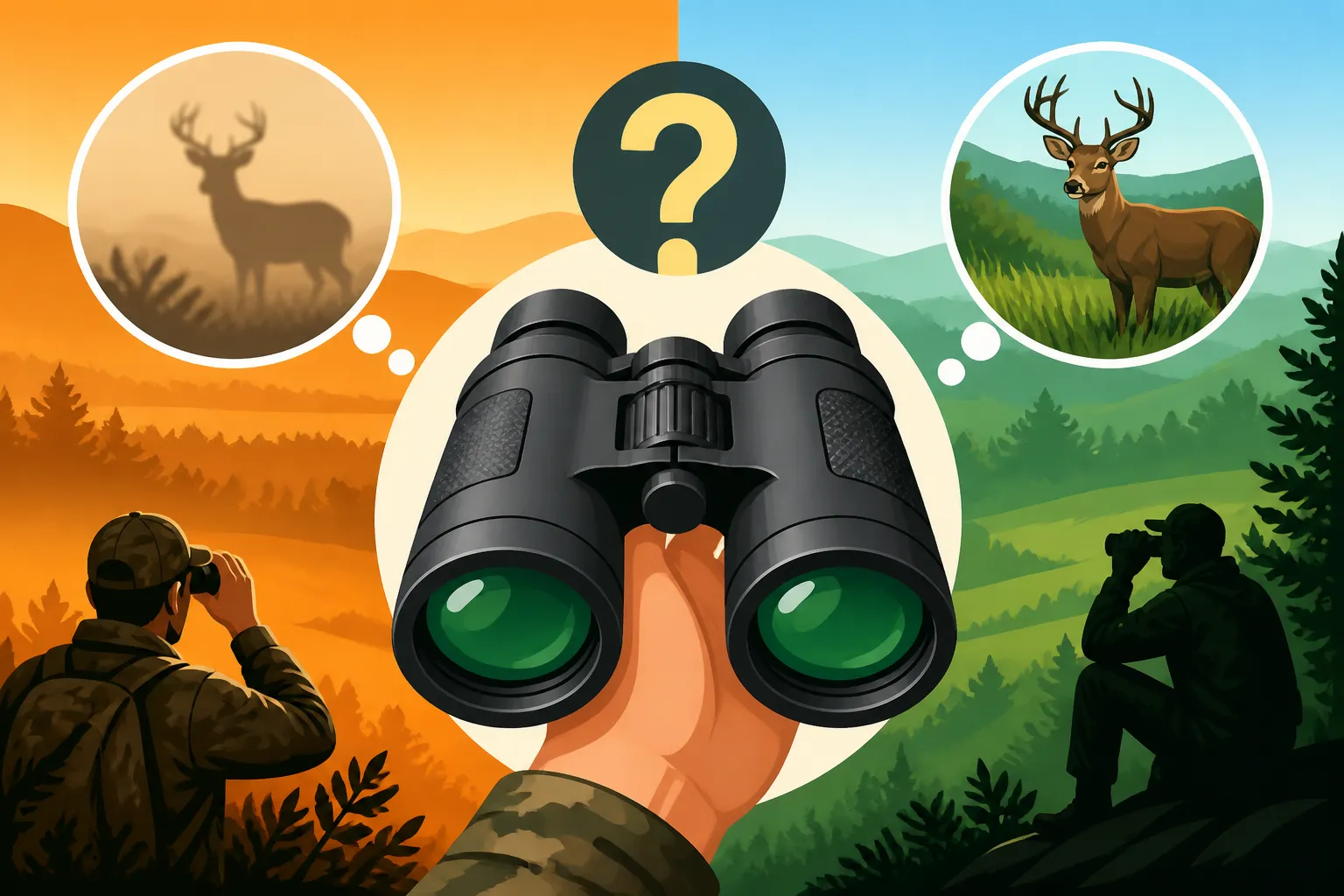
Many hunters, myself included, have started with budget binoculars, and we've all likely encountered their limitations firsthand. The most common complaint is often related to image quality. You might notice a fuzzy image, a lack of clarity, or colors that don't quite pop, especially around the edges of your view. This isn't just an aesthetic issue; it directly impacts your ability to discern details like tine length, ear tags on a managed hunt deer, or subtle movements of game camouflaged by natural cover.
Another significant frustration often arises in low light. Those crucial moments just after dawn or before dusk are when many game animals are most active, and when premium optics truly earn their keep. Inexpensive binoculars tend to gather less light, resulting in a dark, murky image that can leave you staring into a black void when better glass would still be offering a usable picture. You might find yourself squinting, straining your eyes, and ultimately missing out on critical opportunities because your binoculars simply can't pull enough light to make out details. Beyond optical performance, durability can also be a major concern. Cheap binoculars might feel flimsy, develop internal fogging after a cold rain, or simply not hold up to the inevitable bumps and scrapes that come with navigating rough Kentucky terrain.
Where Cheap Binoculars Shine (and Where They Fall Short)
It's not all doom and gloom for budget binoculars. There are definitely scenarios where they can be a perfectly viable tool, and understanding these situations can help you make a smart purchase without feeling like you have to break the bank. However, it's equally important to acknowledge their limitations, particularly when you're relying on your optics for crucial decision-making in the field.
Situations Where Basic Binos Get the Job Done
If your hunting style primarily involves sitting in a treestand overlooking a small food plot or a known deer trail in relatively open timber, and you mostly use your binoculars to confirm a deer's gender or antler size once it's already within a hundred yards or so, then an entry-level pair can certainly suffice. For someone still learning the ropes and perhaps focusing more on the overall experience of Bringing a First-Timer on a December Hunt, a basic set of binoculars is far better than no binoculars at all. They allow for identification at a comfortable distance without having to constantly raise your rifle or bow, which can spook game.
Similarly, if you're primarily hunting small game like squirrels or rabbits, where the engagement distances are typically much shorter and the game itself is smaller, a budget pair can be quite effective for spotting movement in the treetops or along fencerows. The demands on light transmission and image resolution are simply not as high as when you're trying to count points on a deer at dawn. They can also be great for casual scouting trips in broad daylight, identifying potential bedding areas or travel corridors without the pressure of a live hunt. Scouting Kentucky Public Land Before Season is a great time to use them for general observation.
The Critical Difference in Low Light and Long Distances
This is where the rubber truly meets the road, and where cheap binoculars almost universally fall short. Hunting success often hinges on those marginal light conditions at the bookends of the day. A quality pair of binoculars will have larger objective lenses, superior glass quality, and advanced lens coatings that work together to gather and transmit more light to your eyes. This means while your buddy with budget glass is seeing only shadows, you're still able to discern the faint outline of a buck browsing at the edge of a field. This difference can mean the success or failure of a hunt.
When you start pushing the range, say trying to glass an entire hollow from a ridge top, or attempting to locate an elk in a distant clearing within the Hunting Kentucky's Record Elk Herd territory, the cheap glass quickly breaks down. You'll notice chromatic aberration (color fringing), a much narrower field of view, and a general lack of crispness that makes it incredibly difficult to pick out details. Instead of seeing a clear image, you might get a blurry, distorted picture that causes eye strain and leaves you guessing. Trying to identify antler points at 200 yards with budget optics often feels like looking through the bottom of a soda bottle. This is why many experienced hunters invest heavily in good glass, recognizing it as one of the most important tools in their arsenal, particularly for long-range observation like that required for Glassing an Elk Restoration Zone Meadow.
Durability and Field Performance Considerations
Beyond optical clarity, the physical robustness of your binoculars is a huge factor, especially for active hunters navigating Kentucky's varied terrain. Inexpensive binoculars are often constructed with cheaper materials and less rigorous manufacturing processes. This can lead to a host of problems in the field:
- Fogging: Internal fogging is a nightmare. A sudden temperature drop, a heavy morning dew, or getting caught in a pop-up thunderstorm can cause moisture to condense inside the lenses, rendering your binoculars useless. Higher-end models are typically O-ring sealed and nitrogen or argon purged to prevent this.
- Water Resistance: A quick splash or a light drizzle might not phase a good pair, but cheaper models might not have adequate seals, allowing water to penetrate and damage the internal components.
- Impact Resistance: Accidents happen. Dropping your binoculars from a treestand, slipping on a wet rock, or simply bumping them against a tree can put immense stress on the housing and optical alignment. Budget binoculars are more prone to internal damage, misalignment of prisms, or shattered lenses from even minor impacts.
- Ergonomics and Feel: While not directly performance-related, how a binocular feels in your hands, the smoothness of the focus wheel, and the quality of the eye cups all contribute to user comfort and ease of use over a long day in the field. Cheaper models often feel clunky, have stiff focus mechanisms, or uncomfortable eye relief, making them a chore to use.
When you're hiking into a remote section of the Daniel Boone National Forest, or traversing the rugged terrain of eastern Kentucky for deer, you need gear that can take a beating and still perform. The added investment in a durable pair of binoculars can save you the headache and potential missed opportunities of a failed piece of equipment.
Making an Informed Decision: What to Look For
So, if you're leaning towards upgrading or buying your first pair, how do you navigate the sea of options without feeling overwhelmed? It's easy to get lost in technical jargon, but focusing on a few key specifications and practical testing methods can really help you zero in on what truly matters for your hunting needs.
Key Specifications That Matter Most
When looking at binoculars, you'll see numbers like "8×42" or "10×50." The first number (e.g., 8x or 10x) refers to the magnification. An 8x binocular makes objects appear 8 times closer. A 10x makes them 10 times closer. For most Kentucky deer and turkey hunting in timber or mixed terrain, 8x or 10x is ideal. Higher magnifications can be shaky to hold steady without a tripod and offer a narrower field of view. The second number (e.g., 42mm or 50mm) is the objective lens diameter. This is crucial for light gathering. A larger objective lens lets in more light, which is incredibly important for those low-light conditions we discussed. For good all-around performance, 42mm is a popular choice, offering a good balance of light gathering and portability. For serious low-light performance or long-range glassing, 50mm or even 56mm can be considered, though they will be heavier.
Beyond these basic numbers, pay attention to the type of glass and coatings. Look for phrases like "fully multi-coated" lenses, which means all air-to-glass surfaces have multiple layers of anti-reflective coatings. This dramatically improves light transmission and reduces glare. Also, look for "BaK-4" prisms; these are higher quality glass prisms that provide a brighter, clearer, and crisper image compared to the less expensive "BK7" prisms. These technical details, while seemingly small, make a massive difference in actual field performance, especially in those critical hunting moments. You can often find decent binoculars that feature these specs without necessarily being top-tier priced.
Testing Before You Buy: A Practical Approach
The best way to know if binoculars are "good enough" for you is to try them out. Don't just pick them up in a brightly lit store and look across the aisle. If possible, take them outside on a cloudy day, or even better, at dawn or dusk. Look at distant objects, especially those in shadows or against challenging backgrounds. Can you pick out individual leaves on a tree? Can you read distant signs? Do your eyes feel strained after a few minutes?
Compare several pairs side-by-side, if possible. Don't just look at the most expensive and the cheapest; explore the mid-range options. Often, a slight bump in price can bring a significant leap in performance. Pay attention to how they feel in your hands, the smoothness of the focus wheel, and the comfort of the eye cups. If you wear glasses, make sure they have sufficient eye relief. Consider checking out online resources or forums where hunters discuss their experiences with different brands and models. Many reputable brands offer different tiers of binoculars, and sometimes their entry-level hunting optics can be a fantastic value. Sites like GoHunt often feature reviews or discussions on various gear, offering insights into real-world performance.
When It's Time to Consider an Upgrade
You'll know it's time to consider an upgrade when your current binoculars consistently fail you in situations where better glass would likely make a difference. If you're frequently frustrated by missed opportunities because you couldn't make out a deer's antlers in dim light, or couldn't tell if that distant lump was a bedded buck or a stump, then it's probably time to invest. As your hunting skills evolve and you push into more challenging environments, your gear needs to evolve with you.
Maybe you've started Hunting Western Kentucky Bottomland Deer where fog and low light are common, or you're now focusing on Hunting the Kentucky Rut in Early November, when bucks are on the move during those dim transitional hours. These situations demand more from your optics. Upgrading doesn't necessarily mean buying the most expensive pair on the market. Often, a jump from entry-level to a solid mid-range pair (which incorporates better glass, coatings, and construction) will provide a massive improvement in performance for a fraction of the cost of top-tier models. Think of it as investing in an advantage, rather than just buying another piece of gear.
Maximizing Your Investment: Getting the Most From Any Pair
Whether you're sticking with budget binoculars for now or investing in an upgrade, proper care and smart usage can significantly impact their performance and longevity. You want every piece of gear to perform its best when you're out in the Kentucky wilds.
Proper Care and Maintenance
Even the cheapest binoculars will last longer and perform better with good care. Always use a proper lens cloth and cleaning solution designed for optics – never your shirt or a rough cloth, which can scratch the delicate lens coatings. Keep lens caps on when not in use, and store them in their case or a padded compartment in your hunting pack to protect them from bumps and dust. A good Packs for a Daniel Boone Forest Day Hunt will have dedicated pockets for optics.
If your binoculars get wet, wipe them down thoroughly with a soft cloth and allow them to air dry completely before putting them back in a sealed case. If they fog internally, unfortunately, there’s not much you can do for cheaper models in the field, but for better pairs, letting them slowly acclimate to temperature changes can help. Avoid extreme temperature fluctuations when possible. Regularly check the screws and moving parts to ensure everything is tight and functioning smoothly. These simple habits can extend the life of your binoculars by years.
Complementary Gear and Techniques
Beyond the binoculars themselves, how you use them and what you pair them with can enhance your experience. A good binocular harness is almost a non-negotiable for serious hunters. It keeps your binoculars secure, readily accessible, and takes the weight off your neck, which is crucial for comfort during long hours of Still-Hunting Eastern Kentucky Ridges or sitting in a stand. A harness also helps prevent them from swinging and potentially hitting trees or your weapon.
Technique also plays a huge role. Instead of wildly scanning, learn to "grid" an area systematically. Start at one point, scan slowly across, then drop down slightly and scan back the other way. This methodical approach, often recommended by experienced scouts and hunters, helps ensure you don't miss anything. Using your binoculars with a rangefinder, like a Rangefinders Under 100 Yards model, can also be an effective pairing, allowing you to quickly spot game and then immediately get an accurate distance, streamlining your decision-making process in the field. Even if your binoculars are not top-tier, skilled use can make them far more effective.
| Feature / Price Tier | Budget (<$150) | Mid-Range ($150-$500) | Premium (>$500) |
|---|---|---|---|
| Image Clarity | Fair to Good | Good to Very Good | Excellent |
| Low-Light Perf. | Poor to Fair | Good | Excellent |
| Durability | Entry-level | Solid | Robust |
| Weatherproofing | Minimal | Fogproof/Water-Resist. | Fully Sealed |
| Lens Coatings | Basic | Fully Multi-Coated | Advanced Multi-Coated |
| Prism Type | BK7 (often) | BaK-4 | BaK-4 |
| Eye Strain | Moderate | Low | Very Low |
| Typical Use | Casual use, short range, good light | All-around hunting, various conditions | Critical use, long range, low light |
Ultimately, the best binoculars for you are the ones that meet your specific hunting needs and budget. While cheap binoculars can get you by in certain situations, recognizing their limitations and understanding when to invest in better glass will undoubtedly make you a more effective and less frustrated hunter in the long run. GoHunt often has articles and gear reviews that can help you make an informed choice for your specific budget.
Disclaimer
This article is for general informational purposes only and does not constitute professional advice. Laws, prices and regulations vary by location and change over time. Consult a qualified professional for guidance on your specific situation.